
U.S. House Lawmakers Detail Grievances Over Government’s ‘Choke Point 2.0’

-
News
-
Video
-
Consensus 2026
-
Data & Indices
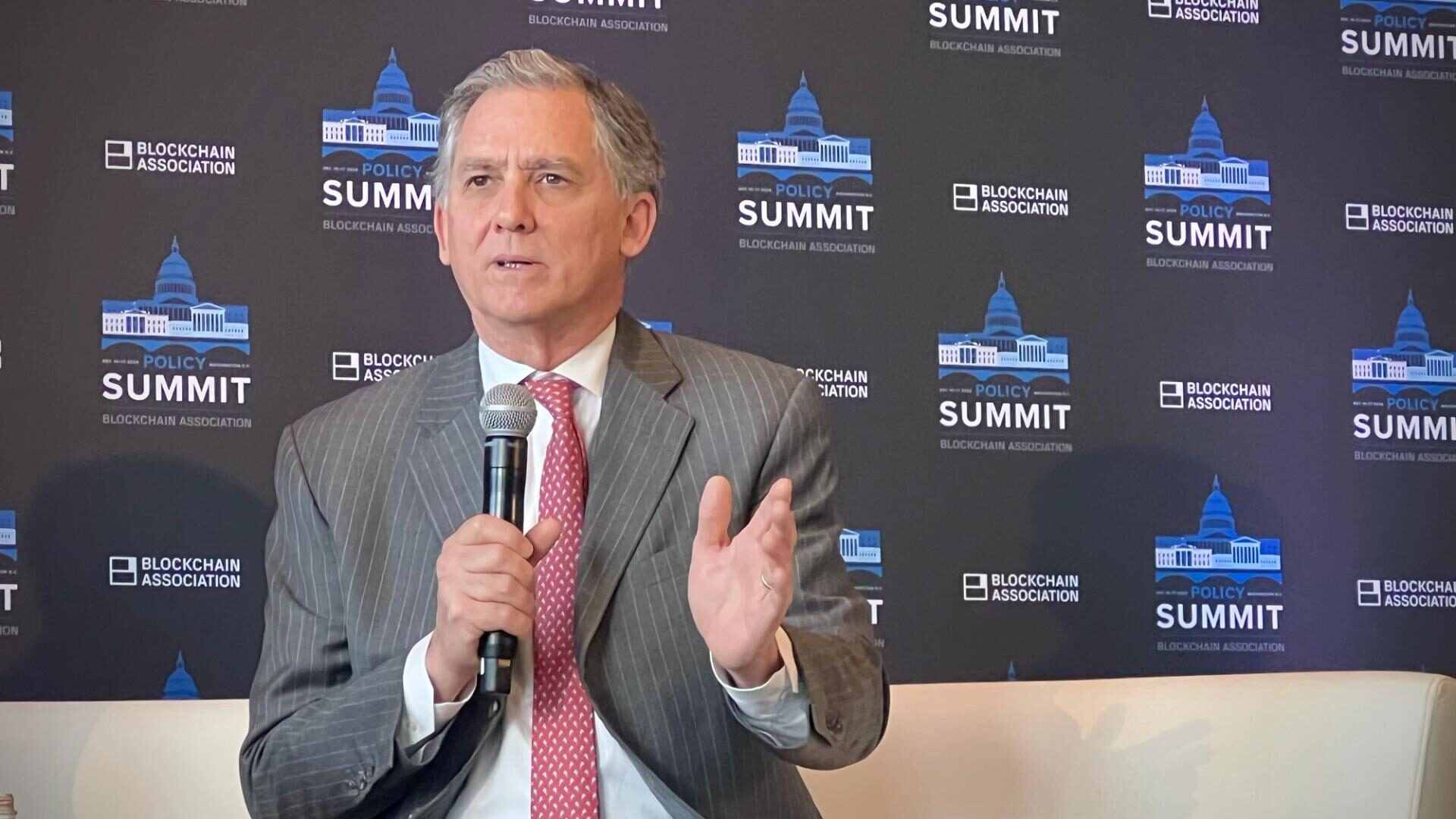
French Hill, the chairman of the House Financial Services Committee, issued a report outlining what went on at several U.S. crypto regulators in past years.
By Jesse Hamilton|Edited by Nikhilesh De
Dec 1, 2025, 5:14 p.m.

- The House Financial Services Committee, led by Republican French Hill, released a report detailing so-called “Operation Choke Point 2.0” that it says systemically resisted U.S. crypto policy.
- Agencies including the Securities and Exchange Commission and Federal Reserve got in the way of digital assets advancement in the U.S. during the Biden administration, according to the report, which highlights examples of anti-crypto actions.
The U.S. government was deliberately trying to hold back crypto development for years, according to a report released by U.S. Representative French Hill, who has been at the center of Congress’ push toward establishing crypto policies.
STORY CONTINUES BELOW
The Republican chairman of the House Financial Services Committee issued a lengthy report on Monday detailing the federal government activities he contends represent a campaign to quell digital assets activity in the U.S. during the Biden administration. While the Senate still tries to work out the next big step in crypto legislation, Hill is seeking to cement the narrative that an unfriendly U.S. government ran what the industry and its Republican allies have called “Operation Choke Point 2.0.”
The original “Choke Point” was a government task force meant to caution banks about legal industries that regulators — including the Federal Deposit Insurance Corp. — considered especially risky, such as payday lenders and ATM operators. A backlash against the controversial policy led some Republican regulatory appointees, especially focused on the firearms industry, to insist that banks be compelled to handle any legal businesses.
With this crypto-focused iteration, Hill’s report looked at the financial sector’s systemic “debanking” of digital assets firms and their executives. “The Biden administration sought to make it nearly impossible to engage in digital asset related activities,” the report said. “To do so, it utilized a regulatory regime that provided too little certainty to financial institutions and gave too much discretion to the regulators that oversee them.”
None of the report’s conclusions come as a surprise to those who’ve followed U.S. crypto oversight in recent years. It highlights the Securities and Exchange Commission’s now-abandoned preference to shape its digital assets policies with enforcement cases, and it reviews the constraints that banking agencies such as the Federal Reserve put on regulated banks engaging in digital assets activity.
The document argued that Biden-era regulators also failed to establish a clear regulatory regime for cryptocurrency and warned bankers about it, “characterizing the digital asset ecosystem as an industry prone to market volatility and risk.”In that time period — especially in 2022 — the industry saw massive high-profile firm collapses and fraud cases, and during President Joe Biden’s four-year term, the leading asset, bitcoin BTC$84,842.44, rose from about $34,000 to about $94,000, but it had also dropped below $17,000 in late 2022. Some banks closely associated with the industry also failed in 2023.
This year, BTC reached a record high above $126,000 before dropping rapidly in recent weeks to about $84,000 at the start of this week.
However, one major strength of the sector is in its relationships with President Donald Trump’s White House and with Congress. Earlier this year, lawmakers passed a bill to regulate U.S. stablecoin issuers — the first major crypto legislation to become law. And the House of Representatives also approved a bill that would oversee the wider digital assets markets, though the Senate is still working to catch up.
“Importantly, Trump administration financial regulators have rescinded numerous Biden-era guidance, supervision and regulation letters, interpretive letters, and rules that fostered the debanking of the digital asset ecosystem by certain regulators,” the report noted.
More For You
Nov 14, 2025

What to know:
- As of October 2025, GoPlus has generated $4.7M in total revenue across its product lines. The GoPlus App is the primary revenue driver, contributing $2.5M (approx. 53%), followed by the SafeToken Protocol at $1.7M.
- GoPlus Intelligence’s Token Security API averaged 717 million monthly calls year-to-date in 2025 , with a peak of nearly 1 billion calls in February 2025. Total blockchain-level requests, including transaction simulations, averaged an additional 350 million per month.
- Since its January 2025 launch , the $GPS token has registered over $5B in total spot volume and $10B in derivatives volume in 2025. Monthly spot volume peaked in March 2025 at over $1.1B , while derivatives volume peaked the same month at over $4B.
More For You
By Jamie Crawley, AI Boost|Edited by Sheldon Reback
1 hour ago

Europol dismantled a crypto-mixing platform it said is used by ransomware groups and darknet markets to launder bitcoin, seizing servers, data and $29 million in BTC.
What to know:
- Europol, along with authorities in Switzerland and Germany, has taken down Cryptomixer, a long-running crypto-mixing service alleged to have laundered more than $1.51 billion in bitcoin.
- The operation resulted in the seizure of three servers, the service’s domain, $29 million in BTC, and 12 terabytes of data.
- Crypto mixers obscure blockchain traces and can be used as money-laundering tools by cybercriminal groups to cash out illicit funds.


-
Back to menu
-
Back to menu
Prices
-
Back to menu
-
Back to menu
Indices -
Back to menu
Research
-
Back to menu
Consensus 2026 -
Back to menu
Sponsored
-
Back to menu
-
Back to menu
Podcasts -
Back to menu
-
Back to menu
Webinars
Select Language