
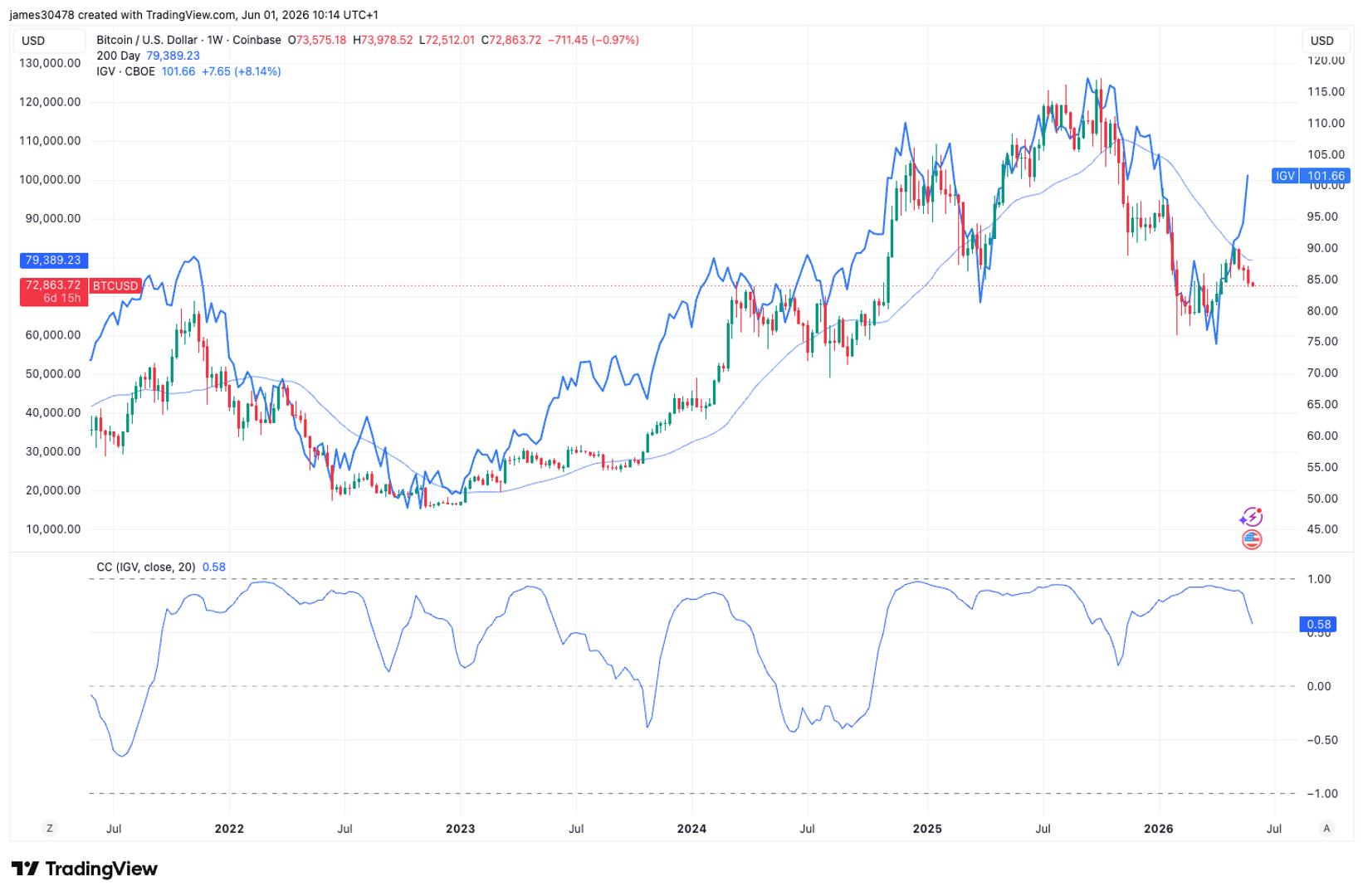
Low bitcoin-software correlation suggests a major move may be approaching
Share this article
Bitcoin and software equities have sharply diverged after moving in lockstep for years, raising questions over whether bitcoin will eventually catch up.
By James Van Straten|Edited by Jamie Crawley
Jun 1, 2026, 10:02 a.m. 2 min read

- Since April 10, the iShares Expanded Tech-Software Sector ETF (IGV) has rallied 36% and reclaimed its 200-day moving average, signaling a return to a long-term uptrend despite earlier concerns over AI disrupting traditional software businesses.
- Bitcoin’s 20-day rolling correlation with IGV has fallen to 0.58, a level last seen before major bitcoin rallies in late 2023 and mid-2024.
- Previous episodes of similarly low correlation were followed by bitcoin significantly outperforming in the months ahead.
Bitcoin BTC$72,583.97 and software stocks moved almost in lockstep for much of the past five years, with BTC treated as a high-beta technology asset.
The iShares Expanded Tech-Software Sector ETF (IGV) served as one of the best proxies for the software sector. That relationship, however, appears to have broken down.
Since May 14, bitcoin and IGV have sharply diverged. IGV has gained roughly 12%, while bitcoin has fallen about 10%, marking one of the largest disconnects between the two assets in recent years.
Bitcoin and IGV reached all-time highs in October 2025 before entering significant drawdowns, with bitcoin declining roughly 50%, while IGV around 37%. The software sector’s weakness was largely driven by growing fears that artificial intelligence would disrupt traditional software business models. The “SaaS apocalypse” narrative gained traction across markets, triggering broad selling pressure in software names such as Oracle (ORCL), Microsoft (MSFT), and Palantir (PLTR).
IGV has staged an impressive recovery since early April, rallying 36% and reclaiming its 200-day moving average, a technical indicator that represents the average closing price over the previous 200 trading days and is often used to gauge a long-term trend. IGV closed on Friday near 98 and was trading around 104 in pre-market action Monday.
Bitcoin, by contrast, is trading near $73,000, nearly 10% lower than its 200-day moving average of $79,388.
The 20-day rolling correlation between bitcoin and IGV has fallen to 0.58. The last notable periods of similarly low correlation occurred in October 2023, when bitcoin was trading near $25,000 before rallying to $70,000 over the following six months, and again during the summer of 2024, shortly before bitcoin surged toward $100,000 following President Trump’s election victory.
Historically, such periods of low correlation have not lasted long. Either bitcoin eventually catches up to software stocks, or IGV’s recovery proves a fakeout. For now, the latter scenario appears less likely given IGV’s strong momentum and its move back above the 200-day moving average.
More For You
By James Van Straten|Edited by Jamie Crawley
35 minutes ago

The preferred stock remains near its $100 par value as the company balances yield stability, ATM issuance capacity, and its bitcoin acquisition strategy.
What to know:
- STRC’s dividend rate remained unchanged at 11.5% after the stock’s monthly VWAP reached $99.62, allowing Strategy to keep shares trading close to their $100 target par value.
- Maintaining STRC near par is critical to Strategy’s ability to issue shares through its ATM program, generating capital for bitcoin purchases, debt management,…


