
Bitcoin’s compute power dwarfs top 100 supercomputers by 600k times, says Bittensor co-founder
Share this article
Ala Shaabana explains how using Bitcoin network’s coordinate-and-reward playbook can bust open corporate monopolies on AI.
By Olivier Acuna|Edited by Aoyon Ashraf
Jun 2, 2026, 11:25 p.m. 2 min read

- At a Paris summit, Bittensor co-founder Ala Shaabana argued that decentralized networks are overtaking traditional corporate data centers as the backbone of global computing power.
- Shaabana said Bitcoin’s network hash rate exceeds the combined power of the top 100 supercomputers by more than 600,000 times, illustrating the scale of distributed computing.
- He contended that by using incentive-driven subnets to reward specific tasks, open networks can more efficiently marshal global hardware and intelligence for artificial intelligence than centralized tech monopolies.
The infrastructure supporting global computing is undergoing a massive shift. True computing power no longer belongs to isolated corporate data centers, but to open, global networks.
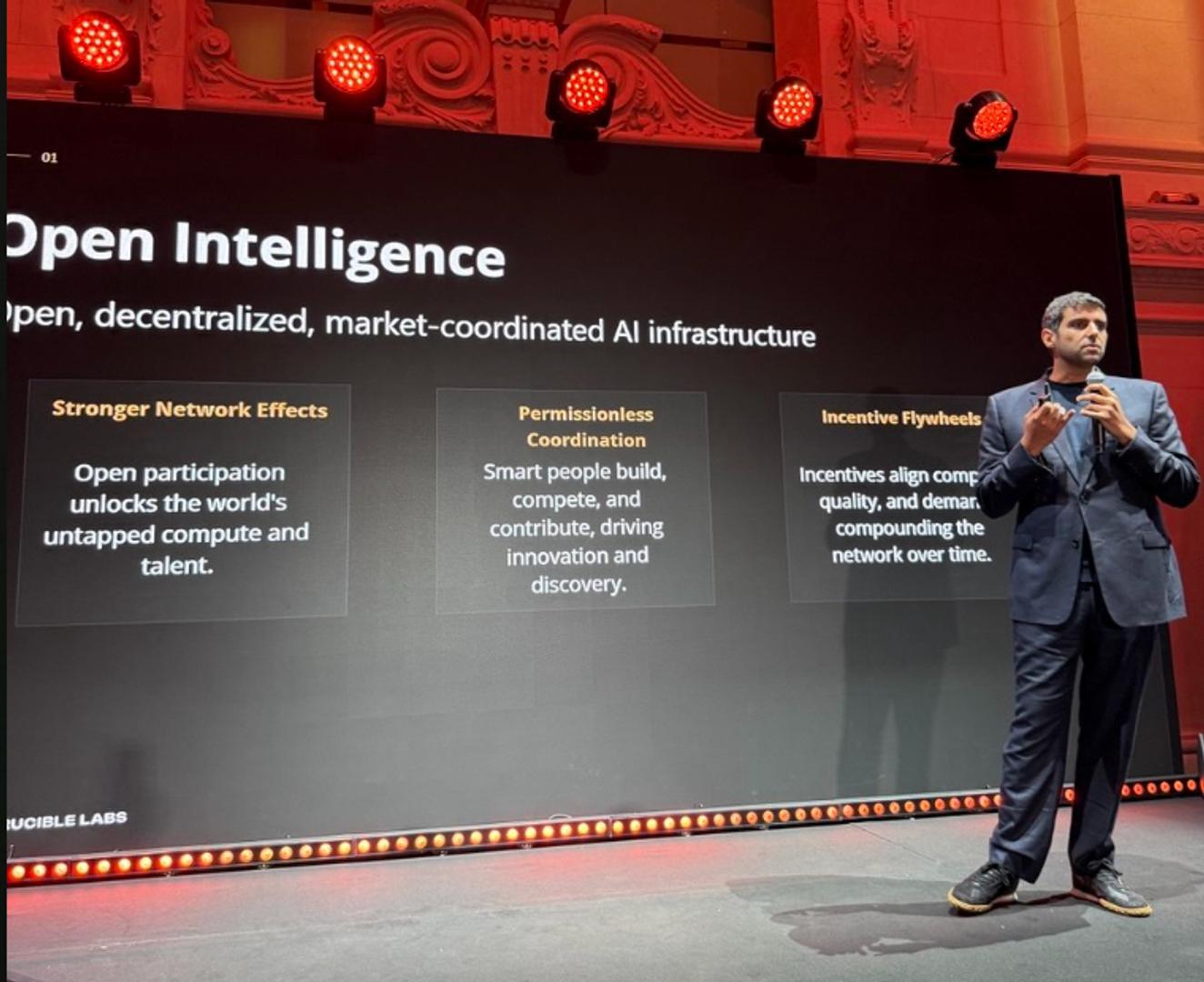
Speaking at the Proof of Talk summit in Paris, Bittensor co-founder and Crucible Labs partner Ala Shaabana highlighted the staggering math behind decentralized networks. To show the audience what distributed computing can do, he stacked the Bitcoin network up against traditional enterprise setups.
“We all know that Bitcoin really dwarfs the top 100 supercomputers,” Shaabana said. “Does anybody know, in comparison, what the hash rate is? It’s over 600,000 times the power of really what these supercomputers can do. And that’s just, really, it’s Bitcoin.”
To understand Shaabana’s comment, it helps to know what Bittensor actually is.
It is a Layer 1 protocol built on the same codebase philosophy as Bitcoin: a hard cap of 21 million tokens, halvings hardcoded into predetermined blocks, with no pre-mine, and no venture capital. Bittensor is a decentralized network that replaces Bitcoin’s hash-puzzle mining with running and validating artificial intelligence.
The same incentive architecture that turned Bitcoin into a computing force 600,000 times more powerful than the world’s top supercomputers is redirected by Bittensor toward AI, organized across 128 specialized problem-solving networks called subnets. Each subnet defines its own goal, and miners compete for TAO token rewards by meeting it, meaning the network’s intelligence is shaped entirely by what it chooses to reward. That design principle, borrowed directly from Bitcoin’s playbook, is the foundation of everything Shaabana argues below.
Shaabana’s core logic is simple: if coordination and code could create the world’s most powerful financial computing engine, the exact same blueprint can be applied to AI. By breaking a network down into 128 individual problem-solving neighborhoods or subnets, developers can source global hardware and intelligence without a central tech monopoly.
The trick to making a distributed system work relies entirely on the incentive design. “Show me the subnet, and I’ll tell you what the miners are optimizing for,” Shaabens said, adapting a famous market quote. If you reward participants for raw compute speed, they optimize for speed. If you reward them for data storage, they optimize for storage.
By setting these programmatic goals, open networks naturally attract talent and computing power far more efficiently than standard corporations.
“The long-term bull case is no longer primarily technological,” Shaabana concluded. “It is driven by debt, liquidity, and declining trust in traditional sovereign systems. Subnets really create markets. Intelligence really is no longer locked behind issues of organization; signals will define the truth, and performance is really rewarded.”
More For You
By Olivier Acuna|Edited by Sheldon Reback
8 hours ago

Titan Network says its crowdsourced computing network has signed tech giants like Tencent and Alibaba as clients, saving them as much 75% on AI costs.
What to know:
- Titan Network says its software aggregates unused computing power from consumers’ connected devices into a decentralized cloud that offers AI firms infrastructure at up to 75% lower cost than traditional providers.
- The company, which counts Tencent, Alibaba and Kling AI among its clients, pays 80% of revenue from corporate data…


