
Heaviest bitcoin ETF outflow since June follows Senate defeat: Crypto Markets Today
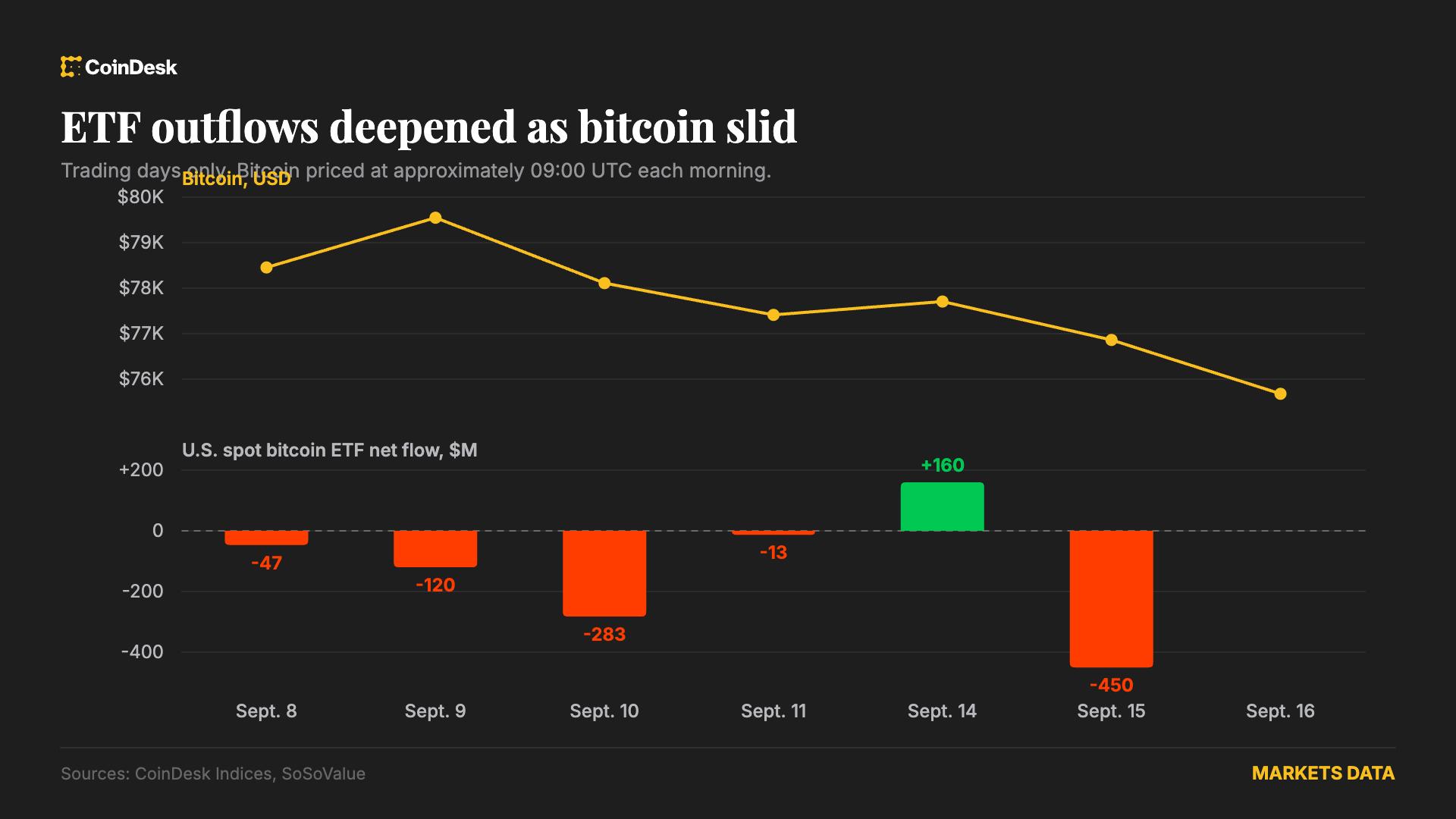
U.S. spot bitcoin ETFs shed $450 million, the most since June, as the Senate’s failure to advance the Clarity Act sent regulatory-sensitive tokens sharply lower.
By Oliver Knight, Omkar Godbole|Edited by Sheldon Reback
Share this article
Summary
BTC$76,198.41
ETFs shed $450 million on Tuesday, according to SoSoValue, the heaviest single-day outflow since June 25, after the U.S. Senate declined to advance the Digital Asset Market Clarity Act.
BTC$76,198.41
is little changed since midnight UTC, after dropping following the vote, which garnered around 10 fewer votes than the 60 required. Among those opposing the motion were seven Democrats who had spent months negotiating the text.
The CoinDesk 20 Index also held its loss, dropping less than 0.1% since midnight after falling 4.6% on Tuesday in the steepest decline since June 5.
Attention now switches to the Federal Reserve, which announces its interest-rate decision later today, with an increase having been the market’s base case going into the meeting.
The bill’s failure effectively ends any prospect of market structure legislation clearing the Senate this year, with Congress expected to be under split control in January.
Bitcoin’s 24-hour drop of 1.7% seems muted compared with slides in the tokens most exposed to U.S. regulatory treatment.
XLM$0.1764
fell 9.6% over 24 hours and XRP lost 8.1% Among CoinDesk 100 constituents, a full 95 lost value over the period.
Traditional markets have been steady by comparison, with Nasdaq 100 index futures adding 0.33%, gold 0.88% higher and silver rising 1.37%, while the Dollar Index is unchanged.
- Futures liquidations: Forced deleveraging intensified over the past 24 hours as cryptocurrency prices sold off after the Senate’s procedural vote on the Clarity Act failed. Leveraged futures positions worth more than $570 million were liquidated in that window, the most since Aug. 22, though still well short of the washouts seen in early February and early June.
- Taker long-short ratio: The taker long-short volume ratio flipped bearish, with shorts accounting for 51.5% of flow over 24 hours. Takers are traders who lift offers or hit bids at available prices in the order book, thereby draining liquidity.
- Hyperliquid long/short ratio: The Hyperliquid trader long/short ratio has pulled back slightly to 2.53 from 2.71, the highest reading since early October 2025, when bitcoin last traded at record highs above $120,000. Even so, there are still more than two longs for every short, pointing to considerable bullish leverage that could face liquidation if prices keep sliding.
- Bitcoin futures positioning: Bitcoin dropped 1.4% over 24 hours even as futures open interest ticked up to 688,000 BTC from 676,000 BTC. That combination is widely read as a short bias: traders adding bearish bets into the decline. BTC’s 24-hour OI-adjusted cumulative volume delta (CVD) is negative, a sign that more shorts are being executed at the prevailing market price rather than via passive limit orders. Perpetual funding rates, however, point to lingering optimism among some traders.
- XRP futures positioning: Payments-focused XRP has dropped nearly 10%, again alongside a slight uptick in futures open interest. The open-interest tally remains well below record highs, indicating that overall positioning is still light.
- Altcoin CVD and funding rates: XRP and most other major tokens, including ETH, TRX, DOGE, XLM and SHIB, have negative 24-hour CVDs, implying aggressive selling in the derivatives market. That setup argues for caution around a deeper decline. Funding rates also paint a bearish picture for ETH, XLM, TRX, SOL, BCH, ADA and LINK.
- Implied volatility: Both bitcoin and ether 30-day implied volatility indexes, BVIV and EVIV, remain calm within recent ranges and well below year-to-date peaks, a sign that traders are not pricing a volatility spike around the U.S. rate decision.
- Options skew: Bitcoin one-week and one-month options skews are positive and rising, a sign of growing demand for puts and downside protection. The one-week skew currently hovers around 5.76% and the one-month around 6.33%. Ether skews point in the same direction.
- Options volume: Volumes tell a different story. The most-traded bitcoin options over the past 24 hours were mostly calls, led by the $79,000 strike. In ether, however, the top five most-traded options were all puts.
- Arbitrum
ARB$0.1651
is the standout performer over the past 24 hours, adding 16% after Standard Chartered forecast the token to reach $10 by the end of 2030, roughly 70 times the current level. The bank cited revenue from Robinhood Chain and the growth of tokenized assets. The near-term target is a more restrained $0.50 by the end of this year. - Bucking the broader market selloff is Synapse (SYN), which more than doubled to $0.1787 for no apparent reason. The composition of the move, however, is instructive: Futures volume of $310.64 million over 24 hours against a market cap of just $41.18 million, open interest equivalent to 60% of the token’s value, and a long/short accounts ratio of 0.93 on Binance, suggesting the move was driven by a short squeeze as opposed to a flurry of spot demand.
- Privacy remains the month’s most durable trade, with zcash (ZEC) adding 6.9% to $1,186.75 to lead the sector on the day while dash
DASH$53.96
rose 2.9%. - Perpetuals exchange token lighter (LIT) climbed 6% to $4.27 and raydium
RAY$1.2995
added 5.4% to $1.30, both recovering ground lost in Tuesday’s rout without making it back to where they started the week. - DeFi tokens AAVE, JUP and ETHFI all lost more than 2% after midnight despite ether.fi founder Mike Silagadze telling CoinDesk in the lead up to the Clarity vote that “the U.S. is currently a very small market for ether.fi so honestly Clarity isn’t much of an impact.”
Related Assets

- 1
- 2
- 3
- 4
- 5
- 6
- 7
- 8
- 9
- 10


14 hours ago
Why it matters:
As stablecoins move into regulated finance, APAC is becoming a key proving ground. This report maps the region’s rules, use cases, and RLUSD’s role.