
liveUpdated 1 hour ago
Treasury yields eased from multi-decade highs and oil slipped on reports of a phased U.S.-Iran deal, with roughly $14 billion in bitcoin options set to expire on Deribit on Friday.
By Shaurya Malwa, James Van Straten, and Stephen Alpher|Edited by Stephen Alpher
Share this post
After a brief pause, U.S. yields have resumed higher in early trading Friday, the 10-year Treasury up five basis points to a session high 5.211%.
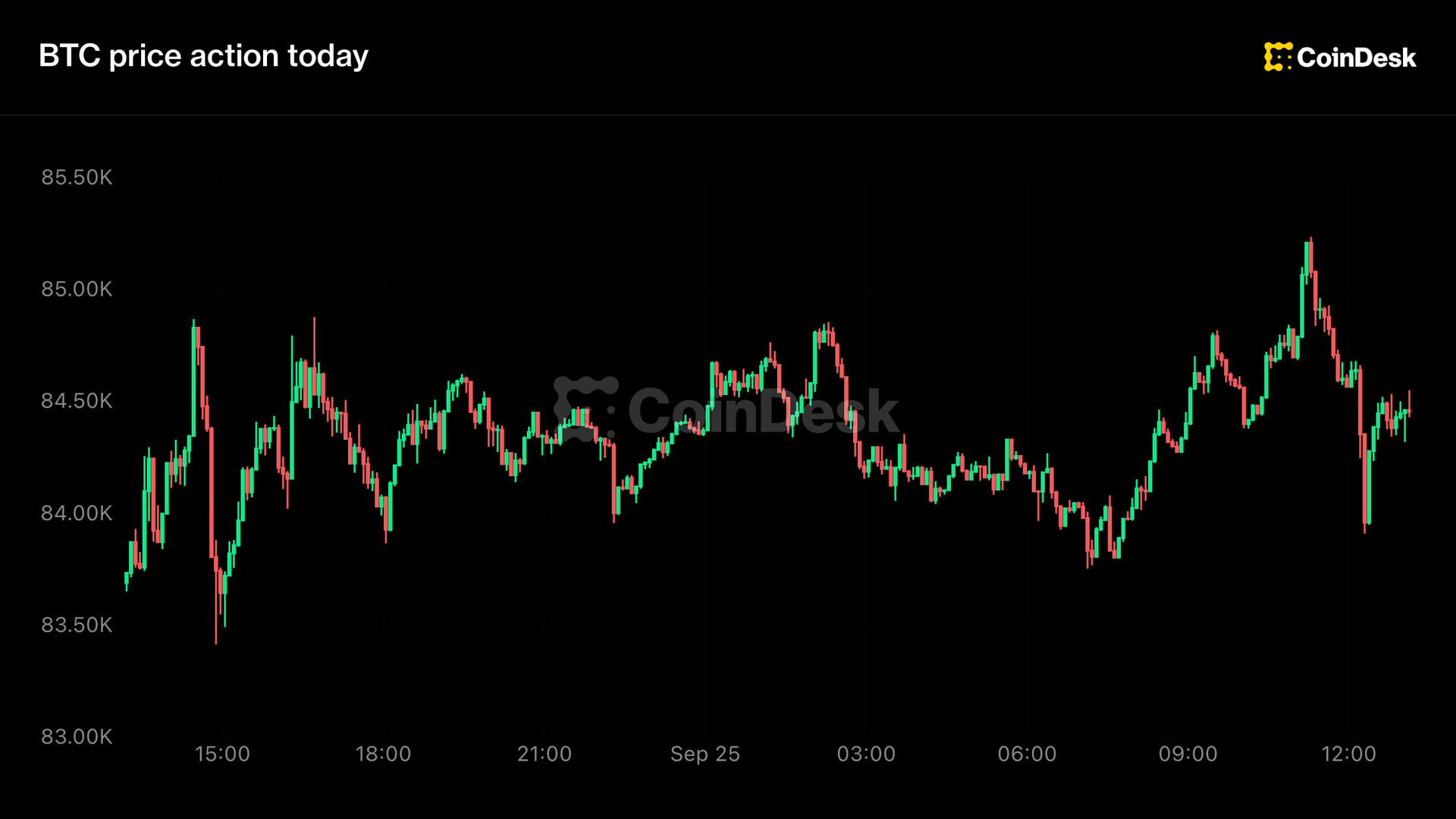
That’s dinging risk assets, where U.S. stocks have swung from small gains to small losses, and bitcoin has dipped 3% from overnight highs to the current $83,400, down 1% over the past 24 hours.
Share this post
The headline might read bearish, but bitcoin bulls will see it as nature continuing to heal.
Paris, France-based semiconductor company Sequans (SQNS) yesterday disclosed the sale of its remaining 314 bitcoin as of June 30.
The firm joined the digital asset treasury company mania in the summer of 2025. At the market peak in October 2025, Sequans had built a treasury of more than 3,200 bitcoin.
There was the issue of convertible debt, though, and the company in May sold off the majority of its BTC to redeem that paper.
Sequans joins others, including Satsuma and Empery Digital, who entered that speculative frenzy in 2025, only to have to fully reverse course roughly one year later.
Share this post
“Strategy is proposing daily dividends on STRF, STRC, STRK, and STRD accruing every calendar day, including weekends and holidays, and paid the next business day, with economics unchanged,” wrote Michael Saylor Friday morning.
“The proposed changes aim to support price stability, liquidity, and demand.”
The proposal will be put to a shareholder vote, which concludes on Oct. 28. STRC daily dividends would begin on Nov 1, while the others would commence in January.
The much-smaller Strive’s ASST$29.49 high-yielding preferred stock SATA moved to daily dividends several weeks ago.
Share this post
CIpher Mining CIFR$17.77 has inked deals with Google-backed Fluidstack extending to 20 years from 10 years the lease duration at its Barber Lake data center in Texas. Total contracted revenue is now $9 billion versus $3.8 billion prior.
CIFR is higher by 4.3% in pre-market trading.
Share this post
Risk assets are higher ahead of Friday’s U.S. open. Bitcoin briefly touched $85,000, up more than 0.5% over the past 24 hours, before slipping back below that level. Gold has risen nearly 1% to above $4,300 an ounce, while Invesco QQQ is up almost 1% in premarket trading.
The dollar index has edged below 101, WTI crude has fallen to $92.50 a barrel, and the US 10-year Treasury yield is down 0.7% to 5.171%.
Share this post
Alternative cryptocurrencies posted strong gains while bitcoin hovered between $84,000 and $85,000.
QNT led the top 100 by market cap with a 38.2% 24-hour gain. ONDO and LINK rose 28% and 11%, respectively, while ALGO, AERO and CC each climbed 8%-9%.
No memecoins cracked the top 10 performers, suggesting capital is flowing toward projects with established use cases rather than speculative plays.
Share this post
The Japanese yen rose as much as 0.6% to 158 per dollar, heading for its best day in more than two weeks, according to Bloomberg.
Finance Minister Satsuki Katayama said President Trump shared Japan’s concerns about yen weakness and pledged coordination with U.S. Treasury Secretary Scott Bessent. The yen has weakened by about 3.5% against the U.S. dollar since Sept. 8.
The two countries bought yen this summer to shore up the yen.
While, the renewed threat of intervention follows comments from Bessent, who said: “I have asymmetric information. I am the house now.”
Share this post
According to the Financial Times, Goldman Sachs earned about $200 million in fees this year from Situational Awareness, the hedge fund founded by Leopold Aschenbrenner. The fund grew rapidly through leveraged bets on AI stocks, with assets peaking at around $30 billion.
A sell-off in AI stocks in mid-July forced a major unwind, including a large sale to Citadel. The fund subsequently shrank and reduced its leverage.
Share this post
Bitcoin traded just above $84,000 on Friday, flat over 24 hours after falling below that level on Wednesday, CoinDesk data show. Most major tokens moved less than 2%. Smaller names did the running, with ONDO up 27% to about 54 cents and Quant up 39% to nearly $100.
Bonds found a floor in Asia. The 10-year Treasury yield slipped two basis points to 5.17% after jumping more than 20 basis points over the previous two sessions, and Brent fell 1% to about $105 a barrel on reports that Washington and Tehran are exploring a phased deal to reopen the Strait of Hormuz.
FxPro chief market analyst Alex Kuptsikevich reads bitcoin’s drop as a stall short of the target technical traders had projected for the rally that began in mid-August.
“As with the overall market capitalisation, the leading cryptocurrency encountered resistance near a previously significant support level. However, BTC failed to complete the Fibonacci extension pattern to 161.8% of the impulse that began in mid-August in a single move. Despite the pullback, the ongoing, unfinished nature of the uptrend suggests it may be a temporary pause on the way up,” he said in a note.
“It is worth remembering that in 2021, Bitcoin lost over 50% from its peak before reaching new highs. Similarly, today, a decline to $70K may be painful for short-term speculators, but it does not undermine the bullish outlook,” he added.
Bitcoin heads into Friday’s Deribit expiry below $85,000, the strike carrying one of the largest blocks of call options.

- 1
- 2
- 3
- 4
- 5
- 6
- 7
- 8
- 9
- 10


Sep 15, 2026
Why it matters:
As stablecoins move into regulated finance, APAC is becoming a key proving ground. This report maps the region’s rules, use cases, and RLUSD’s role.