
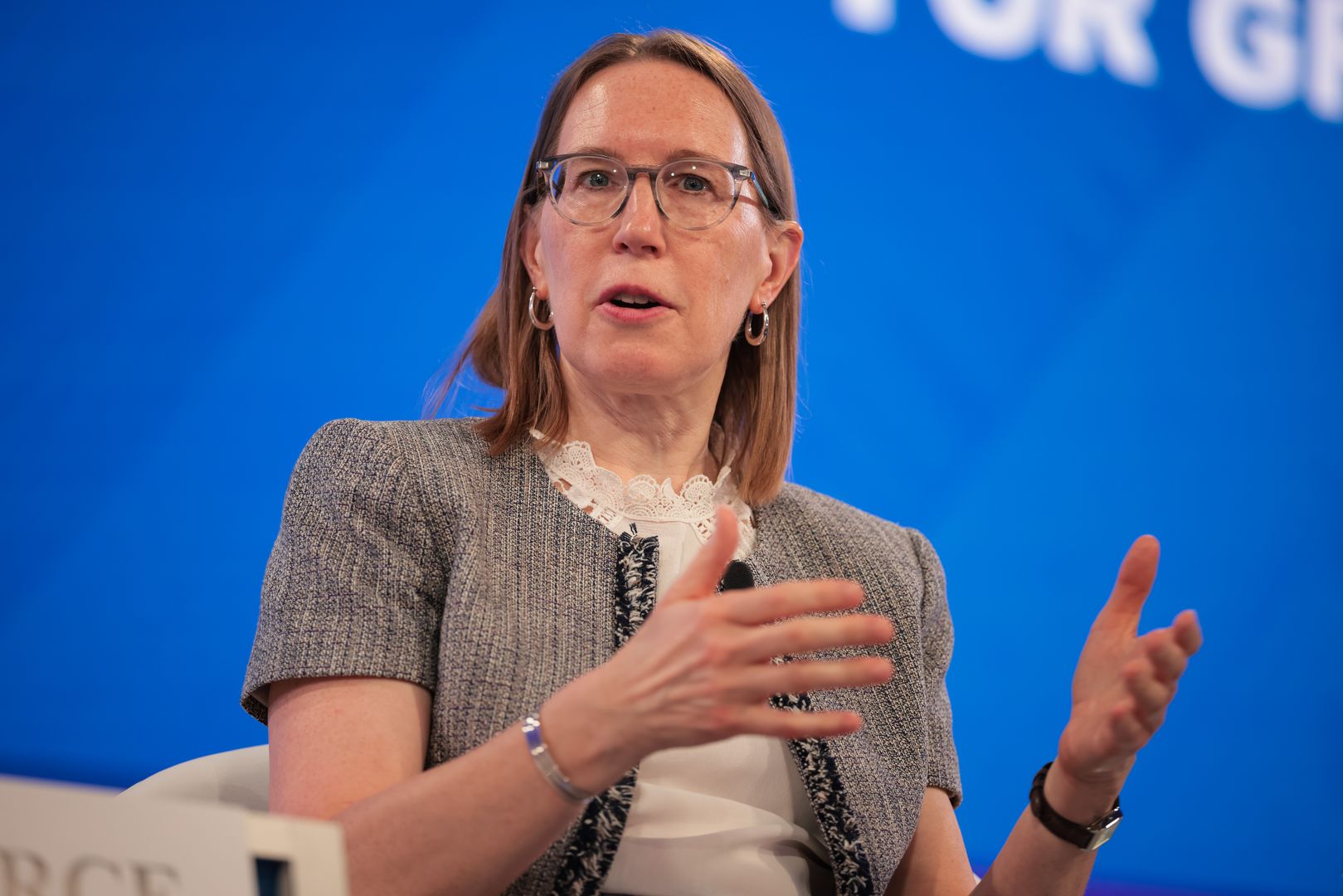
America at a crossroads: Commissioner Peirce’s parting challenge
It is incumbent upon us to continue Commissioner Peirce’s mission, writes Will Schwartz, policy associate at the Blockchain Association.
By William Schwartz |Edited by Cheyenne Ligon
Share this article

Today is Hester Peirce’s last day as an SEC Commissioner. The digital asset industry, and every American who believes regulation should mitigate risk and foster innovation, owes her an enormous debt of gratitude.
For more than eight years, Commissioner Peirce served as a principled voice at the Commission. Under the previous SEC Chairman, she frequently dissented when the Commission chose to bring enforcement actions rather than write rules the industry could comply with. She proposed a token safe harbor years before regulators were ready to listen. She led the Crypto Task Force and insisted that the agency’s duty to protect investors meant it must use its authority to provide regulatory guardrails for the rapidly expanding industry.
Commissioner Peirce brought humility, conviction, and a sense of humor to work every day. Washington could use more like her. Although she will no longer be at the SEC, her presence and the ideals she stood for will live on.
Will Schwartz is a Policy Associate at Blockchain Association, where he conducts research and analysis on digital asset legislation, regulation, and emerging policy developments.
In some of her last public remarks as Commissioner, at SIFMA’s Digital Assets Conference on September 23, Peirce did not take a victory lap. Rather, she outlined the work that is still to be done—even in her absence. As she described in her speech, our society is at a great crossroads. Down one road is the world we’ve been living in: dragnet surveillance, the datafication of every aspect of life, and cybersecurity breaches that expose our most sensitive information to bad actors all around the world. Down the other is a world of both privacy and security, where Americans can prove that they’re following the law without handing over their sensitive personal information.
Commissioner Peirce has firsthand experience seeing how our financial regulations are designed to extract as much personal data from American consumers as possible. For more than 50 years, our regulatory framework has been built upon the mass collection and storage of personal data from all Americans who interact with the financial system. Businesses collect personal data from consumers and share it with the government, which aims to track down actual criminal activity — the “needle,” as Commissioner Peirce puts it, in the “haystack” of innocent, unassuming Americans’ data.
The needle is rarely found in the haystack. Yet the law is designed as if the bigger the haystack is, the easier it is to find the needle, when the opposite is true. The status quo leaves the government with an enormous cache of consumer data it must sift through, looking for evidence of criminal activity. And the consequences of this mass collection and storage of data are stark. Centralized stores of data make breaches far more damaging, exposing consumers to greater harm and jeopardizing our collective national security. Mandated disclosures also feed data brokers, who scrape public filings and records to build and sell detailed profiles that companies use to target, price, and profit from consumers. And mass surveillance leaves Americans — regardless of their political beliefs — vulnerable to censorship and discrimination. The dire state of digital privacy will only worsen as AI becomes more integrated into everyday life, collecting more data and enabling more sophisticated surveillance and profiling of individuals.
But America does not have to go down the road of endless surveillance. There is another path at Commissioner Peirce’s crossroads that we can take, one where consumer privacy is not sacrificed in the name of security. The two are not mutually exclusive, thanks to innovation in privacy-enhancing technology, much of which is native to the blockchain ecosystem. Blockchain infrastructure may allow individuals to transact while maintaining complete control over their personal information, and transaction records are public and secure. Zero-knowledge proofs enable selective disclosure, allowing an individual to demonstrate that they’re permitted to transact without disclosing any unnecessary information. Verifiable credentials can use this technology to prove that a person is trustworthy and genuine without revealing their identity.
The technologies that allow for a more private, consumer-centric digital economy already exist. As Commissioner Peirce said in her remarks, “What is missing is the regulatory framework that would allow and encourage their adoption.”
It is incumbent upon us to continue Commissioner Peirce’s mission. Technology exists that allows consumers to maintain control over their data while satisfying legal obligations that provide law enforcement with the information necessary to monitor transactions and pursue bad actors. We need a regulatory framework designed for the modern era that allows privacy-enhancing technology to be used to minimize the unnecessary exposure of consumer data. That future is in reach, and it is a distinctly American one. As a nation, we have never accepted that liberty is the price of security. Commissioner Peirce carried that conviction through eight years at the SEC. Now, it’s our turn to carry it forward.
Note: The views expressed in this column are those of the author and do not necessarily reflect those of CoinDesk, Inc. or its owners and affiliates.

- 1
- 2
- 3
- 4
- 5
- 6
- 7
- 8
- 9
- 10


Sep 15, 2026
Why it matters:
As stablecoins move into regulated finance, APAC is becoming a key proving ground. This report maps the region’s rules, use cases, and RLUSD’s role.