
liveUpdated 11 minutes ago
Ether underperformed, losing 6% after Tom Lee said Bitmine would soon stop purchasing additional ETH.
By Shaurya Malwa, James Van Straten, Omkar Godbole, Stephen Alpher, and Helene Braun|Edited by Stephen Alpher
Share this post
Bitcoin traders should prepare for more downside risk as macro forces regain control of crypto markets, according to Jasper De Maere, OTC trader at Wintermute.
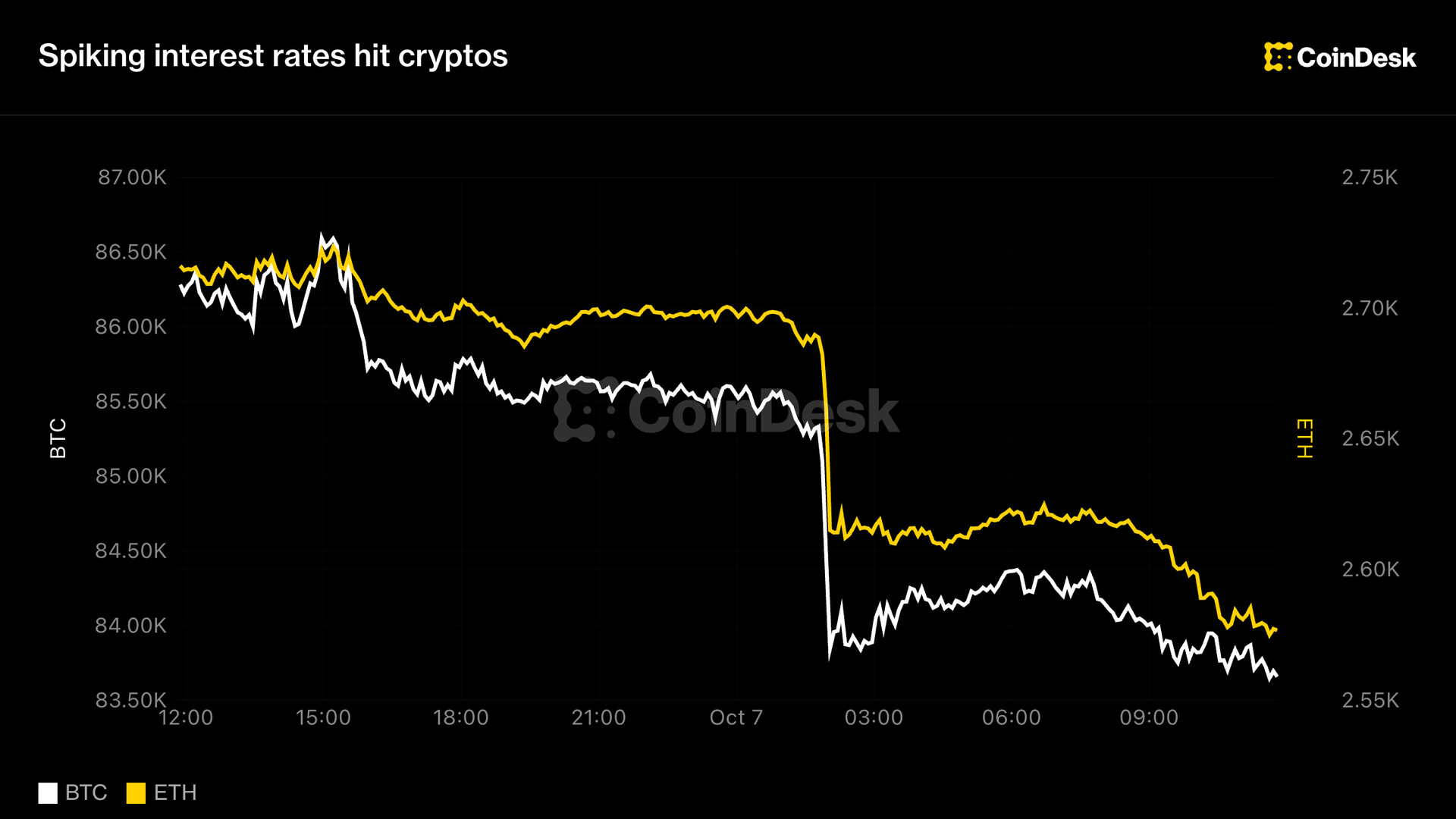
De Maere said bitcoin’s fall from $86,600 to around $84,000 overnight shows crypto is reacting more sharply to geopolitical stress than U.S. equities. About $400 million in long positions were liquidated over the past 12 hours.
The key pressure comes from rising oil prices, Treasury yields and the U.S. dollar. Reports of increased Iranian tanker attacks pushed Brent crude above $100 and the 10-year Treasury yield above 5.30%.
De Maere expects volatility around the Federal Reserve minutes at 2 p.m. ET, with markets pricing limited risk ahead of the release.
For bitcoin, he sees $82,500 as the key downside level. Holding that floor would keep the current uptrend intact, while a break could put further pressure on prices.
Share this post
The price of crude oil and its refined products — namely diesel fuel — took a large drop last week on what President Trump touted as a major new agreement for Europe to release 100 million barrels or more of its reserves.
According to a Wednesday report from Politico, though, France and Germany said they’re only releasing stocks pledged all the way back in March, calling into question whether any new reserves were agreed to.
In March, for instance, Germany had agreed to release 2.65 million tons of energy products, but to date has only released 600,000 tons to the market. France at the time agreed on 14.6 million barrels of oil, but reportedly has only released less than half of that amount.
“Why would a group of net oil and gas importers release their scarce reserves while they have the lowest inventory levels in 10+ years headed into winter to try to bring down oil prices to help the party of the guy they don’t like get elected,” said Lekkar Capital’s Quinn Thompson, reacting to the Politico story.
Oil is higher by nearly 2% on Wednesday, with diesel up 4% and gasoline ahead 3%.
Share this post
The S&P 500 yesterday notched its first record high since mid-August, but not all sectors are participating in the rally.
Surprising no one, the technology sector, with a 6% gain since that previous August top, is the leading group, according to Bespoke. Second best is energy (for obvious reasons), with a 4.6% gain. The only other positive sector is communication services, up 3.6%.
The larger group is the losers, particularly those where surging energy prices and interest rates could hit profits. Real estate is lower by 8.3%, industrials by 7.6%, financials by 7.2%, and utilities by 6.4%. Consumer discretionary and consumer staples are down by 4.3% and 3.8%, respectively. The materials and health care sectors are also lower.
Share this post
Spot gold extended its losses, falling more than 2% to $4,070 an ounce, while silver dropped almost 3.5% to below $60 an ounce. Although markets have largely priced out an October rate hike, which has made a pause the most likely outcome at the Federal Reserve’s next meeting, three further hikes remain priced in, taking the federal funds rate to 4.50% to 4.75% by June 2027.
Share this post
Space X SPCX$167.74 is in talks to raise $40 billion in debt to fund the purchase of Nvidia chips, according to the FT.
The capital would be split between bank loans and investment-grade paper, the story continued, noting that the huge sum underscored the massive amounts required to finance the infrastructure supporting the AI boom.
SPCX is down 2% pre-market.
Share this post
The EU debt crisis, part two, is back in play on Wednesday as the French 10-year OAT yield soars by 17.6 basis points to 4.924%, while the German 10-year Bund yield rises by a modest 3 basis points to 3.51%.
That puts the OAT/Bund spread — otherwise known as “le spread” — back to more than 141 basis points, a level not seen since the 2011 troubles.
Again, that first crisis affected the periphery of the EMU —the PIGS: Portugal, Italy, Greece, and Spain. This time around, it’s far more troublesome as the target of the bond selloff is a country firmly in the core of the monetary zone.
The euro is lower by 0.7% versus the greenback on Wednesday, trading at its weakest level in five months at $1.1183.
Share this post
BitMine Immersion Technologies will stop buying ether ETH$2,563.01 once it has accumulated 5% of the cryptocurrency’s supply, Chairman Tom Lee said during a keynote at Token2049 in Singapore on Wednesday.
“That’s a hard cap. We’re not gonna be accumulating past 5%,” Lee said. “We’re not gonna own more than 5% of Ethereum.”
He said the company needs to buy another 100,000 ETH to hit that self-imposed ceiling.
Ether’s price has declined by 4.5% to $2,477 since midnight UTC hours. Bitcoin, meanwhile, is down 2.2%.
Share this post
The global bond sell-off continues, with U.S. Treasury yields rising across the curve and pressure spreading across Europe and the UK. The U.S. 10-year yield is at 5.333%, while the 30-year yield has reached a fresh high of 5.715%. In the UK, the 30-year gilt yield has surpassed 6%, reaching 6.014%.
Renewed dollar strength is adding to the pressure, with the U.S. Dollar Index (DXY) climbing back above 102.
Bitcoin has fallen more than 2% over the past 24 hours, dropping below $84,000 and trading as low as $83,300. Oil initially jumped on news of Iranian tanker attacks, but WTI crude has since reversed those gains, turning slightly negative over the past 24 hours and slipping below $90 a barrel.
U.S. equities are also showing signs of a pullback after the Nasdaq 100 and S&P 500 hit all-time highs on Tuesday. Invesco QQQ, which tracks the Nasdaq 100, is down just under 1% in premarket trading.
Share this post
Bitcoin fell as much as 2.4% on Wednesday to about $83,600, slipping below $84,000 as about $550 million in leveraged crypto bets were wiped out over 24 hours, according to CoinGlass data.
Those were liquidations, positions an exchange closes automatically when a trader using borrowed money can no longer cover the losses. Most of them hit longs, or traders betting on higher prices.
Ether dropped nearly 4% to about $2,590, XRP lost about 4% and SOL fell more than 3%.
Dan Khus, chief analyst at LVRG Research, told Bloomberg the drop looks like “a leverage flush instead of a downward trend.”
The slide takes bitcoin under the $84,000 level that FxPro flagged on Tuesday as the point where sellers take control. The recent low near $83,000 is the next test.
Risk appetite cooled across markets. Renewed Iranian attacks in the Strait of Hormuz dimmed hopes that shipping through the waterway would return to normal and pushed Brent crude above $101 a barrel. The 10-year Treasury yield climbed back above 5.3%, and Europe’s Stoxx 600 snapped a three-day winning streak. U.S. stock futures were little changed after the S&P 500 closed at a record.
Minutes from the Fed’s last meeting come out later Wednesday. Rachael Lucas, an analyst at BTC Markets, told Bloomberg that a hawkish read could push yields and the dollar higher and keep risk assets under pressure.

- 1
- 2
- 3
- 4
- 5
- 6
- 7
- 8
- 9
- 10


Sep 15, 2026
Why it matters:
As stablecoins move into regulated finance, APAC is becoming a key proving ground. This report maps the region’s rules, use cases, and RLUSD’s role.