
liveUpdated 18 minutes ago
Rising Treasury yields, surging energy prices and a stronger dollar weigh on bitcoin and tech, while silver falls below $59 an ounce.
By James Van Straten and Stephen Alpher|Edited by Jamie Crawley and Stephen Alpher
Share this post
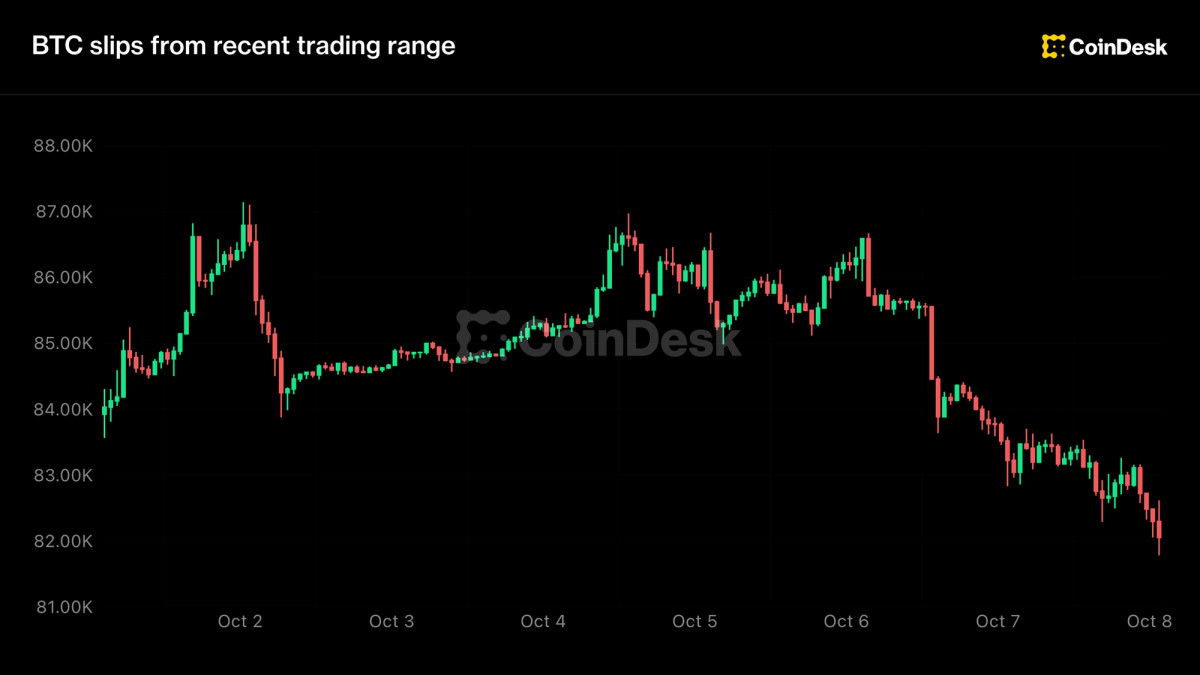
Bitcoin BTC$82,527.92 has busted out of its narrow trading range, but it’s to the downside.
Shortly after the opening of U.S. stock trading, the price of BTC has dipped below $82,000 for the first time since Sept. 20, down more than 1% over the past 24 hours, and down about 5% from Sunday evening highs near $87,000.
The Nasdaq is lower by 0.5% and S&P 500 by 0.25% in early trading.
After rising sharply overnight, long-dated bond yields are retreating; the 10-year U.S. Treasury is now flat on the session at 5.276% after touching 5.36% hours ago.
The 2-year yield remains higher by 3.4 basis points after hawkish remarks by Fed Governor Chris Waller, who said that 75 basis points in rate hikes are coming, but the moves might not be coming at consecutive meetings.
Share this post
Brent crude is trading at a historically elevated premium to WTI, with prices around $105 and $92.50 per barrel, respectively, putting the spread at approximately $12.50.
Larger premiums have emerged during several periods of market stress. In 2011 to 2013, booming North American production overwhelmed pipeline capacity and depressing WTI prices.
During covid-19, collapsing demand and limited storage pushed the expiring WTI futures contract below zero.
While, following the outbreak of the Iran war in February, the spread widened sharply in March as disrupted Hormuz shipping and higher freight costs lifted Brent more than WTI, while stronger U.S. inventories cushioned the domestic benchmark.
The widening premium highlights mounting supply and shipping pressures on internationally traded oil.
Share this post
“There is no evidence whatsoever pointing to a break of decades old hardness assumptions like elliptic curve cryptography,” wrote Yehuda Lindell, head of cryptography at Coinbase.
Lindell was responding to what’s turned into a viral post by Justin Drake, saying that thanks to AI, the cryptography underlying the security of bitcoin, ether, and others is in imminent danger of being broken long before the introduction of quantum computers. He urged the blockchain industry to enter “bunker mode,” and holders of crypto to move funds to new addresses that have never signed a transaction.
“I wasn’t going to comment since this is a really bad take IMO, but since it’s taken off I feel the need to,” said Lindell.
“Just throwing out – AI is doing amazing math so elliptic curve hardness is in danger has no logical basis whatsoever,” he continued. “Furthermore, if it really would be broken, the ramifications to our digital world, including the traditional financial industry, would be immense. Once I can break ECC, I can generate fake PKI certificates and impersonate bank websites … Worse, I can generate malicious banking apps and even operating systems and sign them and push them to people phones and computers and completely take them over.”
“But this is fear mongering since there’s zero evidence to this capability existing … Making such statements without any evidence is the opposite of responsible behavior. It is the very definition of FUD — it cannot be proven wrong but there’s also no evidence whatsoever of it being true.”
Share this post
U.S. initial jobless claims slipped to 197,000 last week from 199,000 previously. Economist forecasts had been for a slight rise to 200,000.
Jobless claims have remained at historically low levels for months now, suggesting either the labor market remains very strong or that they’re no longer a viable economic indicator.
Share this post
The latest price action offers little comfort for risk asset bulls, with U.S. treasury yields, oil and the dollar all climbing. The U.S. 10-year Treasury yield has risen to 5.352%, while the 30-year continues to set fresh highs above 5.73%.
WTI crude has jumped more than 4% over the past 24 hours to $92.40 a barrel, while Brent is also up around 4% at $105. New York Harbor ultra-low sulfur diesel (ULSD) futures have climbed a further 4% to $4.80 a gallon, adding to the surge in energy prices.
The U.S. Dollar Index (DXY) has strengthened to 102.4, adding another headwind for risk assets alongside rising yields and renewed inflation concerns.
Bitcoin has slipped below $83,000 to $82,965, almost 1% lower over the past 24 hours. Gold is holding above $4,100 an ounce, while silver has fallen to fresh lows below $59. Tech is also under pressure, with Nasdaq 100 futures down almost 1%.

- 1
- 2
- 3
- 4
- 5
- 6
- 7
- 8
- 9
- 10


Sep 15, 2026
Why it matters:
As stablecoins move into regulated finance, APAC is becoming a key proving ground. This report maps the region’s rules, use cases, and RLUSD’s role.