
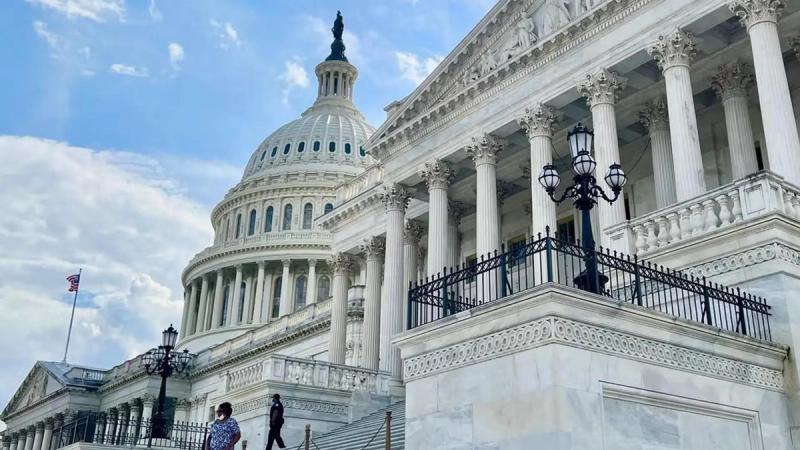
Everyone wants SCOTUS to take up prediction markets: State of Crypto
The U.S. Supreme Court hasn’t yet indicated whether it will take up cases surrounding prediction markets, but there are now several amicus briefs, an interim final rule and a rule proposal.
By Nikhilesh De
Share this article

A number of parties filed amicus briefs to the Supreme Court of the United States last week, urging it to take up a case on whether sports-based prediction market contracts are swaps, or not. And on Friday, the CFTC put out two proposals (one of which is now in effect) outlining its own thoughts on the matter.
You’re reading State of Crypto, a CoinDesk newsletter looking at the intersection of cryptocurrency and government. Click here to sign up for future editions.
The narrative
Former Senator Chris Dodd, former Commodity Futures Trading Commission (and Securities and Exchange Commission) Chair Gary Gensler, the National Football League, 39 states (and the District of Columbia), 145 tribal nations and various other parties filed amicus briefs to the Supreme Court urging it to take up this case, and with many arguing that sports-based prediction market products aren’t swaps and shouldn’t be regulated by the CFTC.
Why it matters
This newsletter covered the possibility of the Supreme Court wading into prediction markets a month ago. That calculus hasn’t changed; there is now a major circuit court split, with two appellate courts ruling that prediction markets touching sports are actually gambling products that should be regulated by the states, and one appellate court ruling it’s a CFTC issue.
Breaking it down
Most of the amicus briefs filed last week urged the Supreme Court to side with the states; that is, rule that at least sports-related prediction markets are actually gambling products that should be regulated at the state level and not the federal level.
Former Senator Chris Dodd, whose name appears on the 2010 Dodd–Frank Wall Street Reform and Consumer Protection Act at the center of this argument, said in a brief that the law was not intended to give the CFTC the authority to usurp state governments and their ability to regulate gambling.
The filing disagreed with the Third Circuit Court of Appeals panel which ruled 2-1 that the CFTC had jurisdiction over swaps and prediction markets covering sports, saying that there is a distinction between derivatives as financial instruments and sports wagers.
“Parlays that chain together multiple wagers — often on point spreads or player performances in different games, in different cities, in different sports — do not facilitate hedging or price discovery,” the filing said, pointing to one example of sports-related prediction markets that have been popular. “Nor are they ‘associated with’ the type of ‘potential financial, economic, or commercial consequences’ required to qualify as swaps under the CEA.”
Dodd’s brief then took issue with the CFTC’s argument that it has “exclusive jurisdiction” over these products.
“Nor is the CEA’s grant of ‘exclusive jurisdiction’ to the CFTC an express preemption provision immunizing every contract listed on a DCM from otherwise applicable state and tribal law. Rather, it identifies the CFTC as the federal regulator of covered financial instruments,” his filing said.
Former CFTC Chair Gary Gensler, who also played a key role in drafting regulations implementing Dodd-Frank, similarly argued that the law did not grant the CFTC authority to preempt state gambling laws. He’s made a similar argument in an appellate case as well.
The NFL argued it has a vested interest in the outcome of this case, given the importance of sports betting in, well, sports. The league took aim at what it described as the CFTC’s “laissez-faire” approach to this issue, as well as the broader issue of there being a divergence in how states regulate gambling companies and how the CFTC regulates designated contract markets (the type of license prediction market providers have).
On Friday, the CFTC proposed an interim final rule and a separate proposal aiming to clarify its interpretation of how these products fall into the definition of a “swap.” The agency said casino-style gambling falls outside its definition of a swap, but event contracts remain within it. And the regulator wants to formally include sports, politics, cultural and weather-related events as being part of event contracts that are counted as swaps.
Kalshi asked for, and was granted, an extension to file a response to the Supreme Court. Its deadline is now Nov. 9, 2026.
This week
- There are no Congressional hearings that we’re tracking this week.
If you’ve got thoughts or questions on what I should discuss next week or any other feedback you’d like to share, feel free to email me at nik@coindesk.com or find me on Bluesky @nikhileshde.bsky.social.
You can also join the group conversation on Telegram.
See ya’ll next week!

- 1
- 2
- 3
- 4
- 5
- 6
- 7
- 8
- 9
- 10


Sep 24, 2026
Why it matters:
Diversified RWA stablecoins sustain 5-7% yield from real credit as crypto funding compresses to ~4%. GENIUS pushes yield off-chain; TAM grows to $4B in 3 years.