
liveUpdated 42 minutes ago
Fixed income is again catching a bid on worries about the deflating AI bubble.
By Shaurya Malwa and Stephen Alpher|Edited by Stephen Alpher
Share this post
Rising slowly at first, the price of oil is headed straight up over the past few minutes, with WTI crude now up more than 3% on the day to a one-month high of $101 per barrel.
That’s up 16% over the past 10 days.
There are reports that Saudi Arabia’s East-West oil pipeline has been targeted in an attack.
U.S. government bond yields are responding; the 10-year Treasury is now higher by 3.5 basis points to 5.125% after earlier dipping to 5.07%.
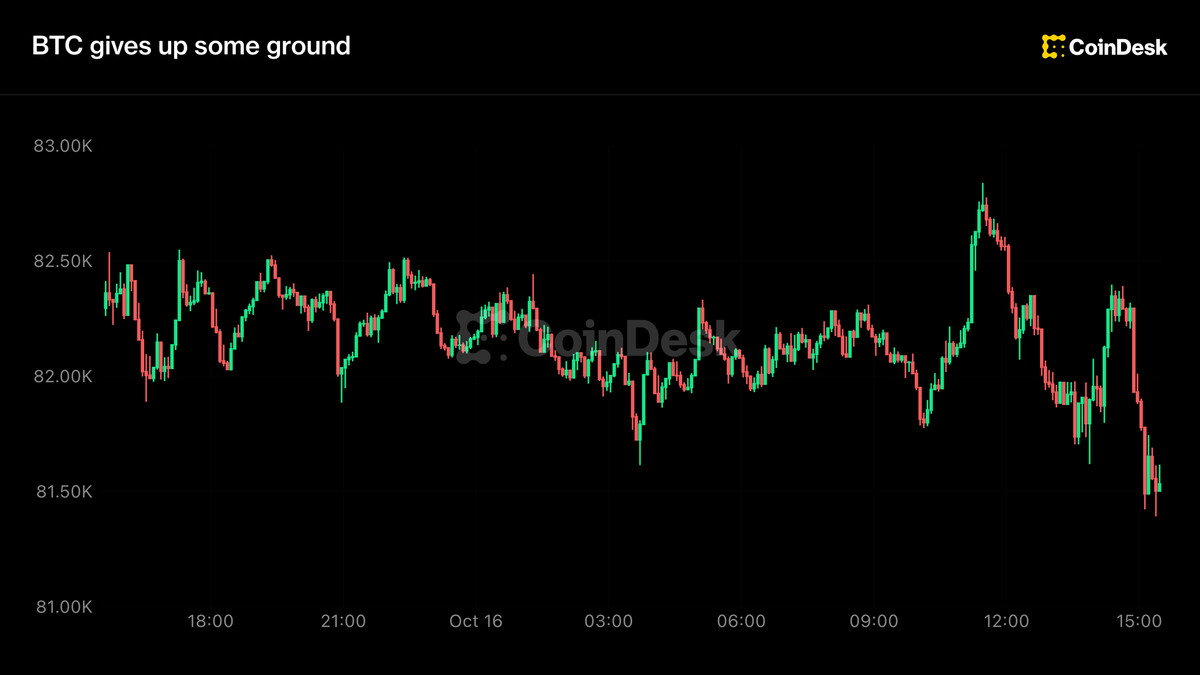
The Nasdaq is lower by 1.5% and bitcoin has pulled back to $81,300.
Among crypto-related stocks taking losses: Strategy MSTR$137.60 -9.2%, Securitize (SECZ) -13.4%, Coinbase COIN$176.74 -3.5%, Circle CRCL$82.98 -4%, Bullish BLSH$29.67 -5.9%.
Share this post
Down earlier in the session, front-month WTI crude oil has climbed to a one-month high of $99.40 per barrel, up 1.5% on the day, with much of the move coming in the past few minutes — though there’s no particular news that’s hit the tape.
The action may be spooking the bond market, where U.S. Treasury yields have swung from declines to gains over the past hour.
U.S. refined products (gasoline and distillates) inventories, meanwhile, continue at decade lows, according to government data.
The Nasdaq is near a session low, off 1.4% for the day.
Bitcoin remains in the $81,500 area.
Share this post
After a volatile week of trading in stocks and bonds, Friday had gotten off to a slow start, but declines are speeding up late in the U.S. morning.
The Nasdaq is now down 1.2%, led by big drops in familiar AI-related names.
Among the Mag 7, Tesla has turned lower after opening with sizable gains following its Roadster event last night. Apple is the only gainer in the group, up 1.1%.
The selling is spreading to crypto, where bitcoin has dipped about 1% over the 30 minutes to $81,500.
Fixed income is catching a bid, with the 10-year U.S. Treasury yield now barely down for the day at 5.08% after earlier rising to 5.13%.
Share this post
After days of relentless selling, the neoclouds — former bitcoin miners turned data center providers to the fast-growing AI sector — bounced hard on Thursday, many closing the day in the green after early sharp declines.
The selling has resumed on Friday, though, with CoreWeave (CRWV) lower by 8% and extending its weekly decline to more than 20%.
Hut 8, IREN, CleanSpark, Keel Infrastructure, and Cipher Mining are all down roughly 6%.
In a note on Friday, Goldman Sachs pointed out that the widening in high-yield bond spreads is an AI story: Non-AI-related spreads were barely higher this week, while AI-related spreads widened by 25 basis points.
“We view AI-related corporate bonds, from either neoclouds or firms with significant frontier lab exposure, as being at the epicenter of the funding cost debate,” said the bank’s Amanda Lynam.
Share this post
“I write to urge Anthropic to pause its planned initial public offering until the company fully and transparently addresses the artificial intelligence safety, governance, and development pace concerns it has raised,” wrote New York City Comptroller Mark Levine to Anthropic CEO Dario Amodei this week.
Levine noted in the letter that as comptroller, he is an investment adviser, custodian, and trustee of NYC pension funds, with more than $325 billion in assets.
Share this post
The tech sector came back from the brink on Thursday, but selling has resumed in U.S. trading on Friday morning.
The Nasdaq is slumping 0.7% while the less-AI-focused S&P 500 is flat and the DJIA is rising 0.7%.
Micron, Intel, AMD, Dell, SanDisk, and KLA Tencor are among the names down 3%-5%.
Declines among the Mag 7 are more subdued, and Tesla is even rising slightly after its flying-car demonstration last night.
Bitcoin is trading quietly near $82,000, up 2% from 24 hours ago.
Share this post
Bitcoin treasury company Strive ASST$24.09 upsized the offering of its new high-yielding preferred stock, SATS, to 7 million shares (from 5 million).
The sale was priced at $90 per share, giving the company gross proceeds of $630 million.
At $90, the effective yield on the 15% dividend-paying stock would be a whopping 16.67%.
Share this post
Led by Michael Saylor, the company announced weeks ago its plan to switch to a daily dividend (from monthly) for its high-yielding preferred stock STRC.
The change is subject to a shareholder vote, which is underway, and the results will be known on Oct. 28.
Today’s announcement is thus conditional on the vote being in favor of the move to daily payments.
While strongly rebounding from its panicky lows of early summer, STRC continues to trade just below par value (yesterday’s close was $99.53), leaving Saylor and team unable to raise bitcoin-buying capital by issuing more shares.
Share this post
“I don’t prejudge meetings,” said Fed Chair Kevin Warsh, speaking at a fireside chat overnight at an IMF event. “I don’t believe in saying now what I might do at the meetings we have.”
“It’s a new chapter at the Fed, and we’re not in that business anymore.”
Warsh defended the September rate hike as a necessary move to cool inflation.
He said the AI boom was the most important thing happening to global economies now, and said it was likely creating price pressures. Productivity gains will come, he said, but the road will be bumpy.
Rates are modestly higher from yesterday’s close, the 10-year U.S. yield up 2.9 basis points to 5.12%.
October Fed rate hikes odds have dipped to 15% from nearly 45% in the moments after the CPI report on Wednesday.
Share this post
The latest inflation-driven crypto selloff is a short-term reaction rather than a sign of deeper trouble, according to Catherine Chen, Binance’s head of institutional.
“The CPI-driven selloff is a sentiment shock, not a structural break,” Chen said, referring to the Consumer Price Index, a measure of U.S. inflation.
Chen expects inflation to peak around October, with clearer signs of cooling potentially emerging in March 2027. Lower energy prices and easing inflation could eventually help crypto markets recover, she said.
“A difficult trading day does not determine the outlook for the next several months,” Chen added. “The window for relief may already be approaching.”
Share this post
Bitcoin climbed back above $82,000 on Friday, a day after a brief drop under $80,000, as ZEC led a broad crypto bounce with an 11% jump to about $1,230 — even as investors pulled money from the token’s only U.S. ETF.
SOL and ether each gained more than 3%, to about $106 and $2,450, and DOGE and XRP added between 2% and 3%. BNB, HYPE and TRX rose about 1%, and bitcoin was up nearly 1%, according to CoinDesk data.
The bounce hasn’t reached the ETFs. The U.S. spot ZEC fund lost about $15 million on Thursday, its fifth outflow this month, according to SoSoValue data. Ether funds shed about $60 million, and SOL funds lost nearly $10 million, their ninth straight day of withdrawals. XRP funds saw a small outflow.
Bitcoin ETFs drew a net $5 million, a thin inflow after Wednesday’s $261 million exit.
A second straight day of bitcoin ETF inflows would be the first sign the bounce from $80,000 has buyers behind it.

- 1
- 2
- 3
- 4
- 5
- 6
- 7
- 8
- 9
- 10


Sep 24, 2026
Why it matters:
Diversified RWA stablecoins sustain 5-7% yield from real credit as crypto funding compresses to ~4%. GENIUS pushes yield off-chain; TAM grows to $4B in 3 years.