
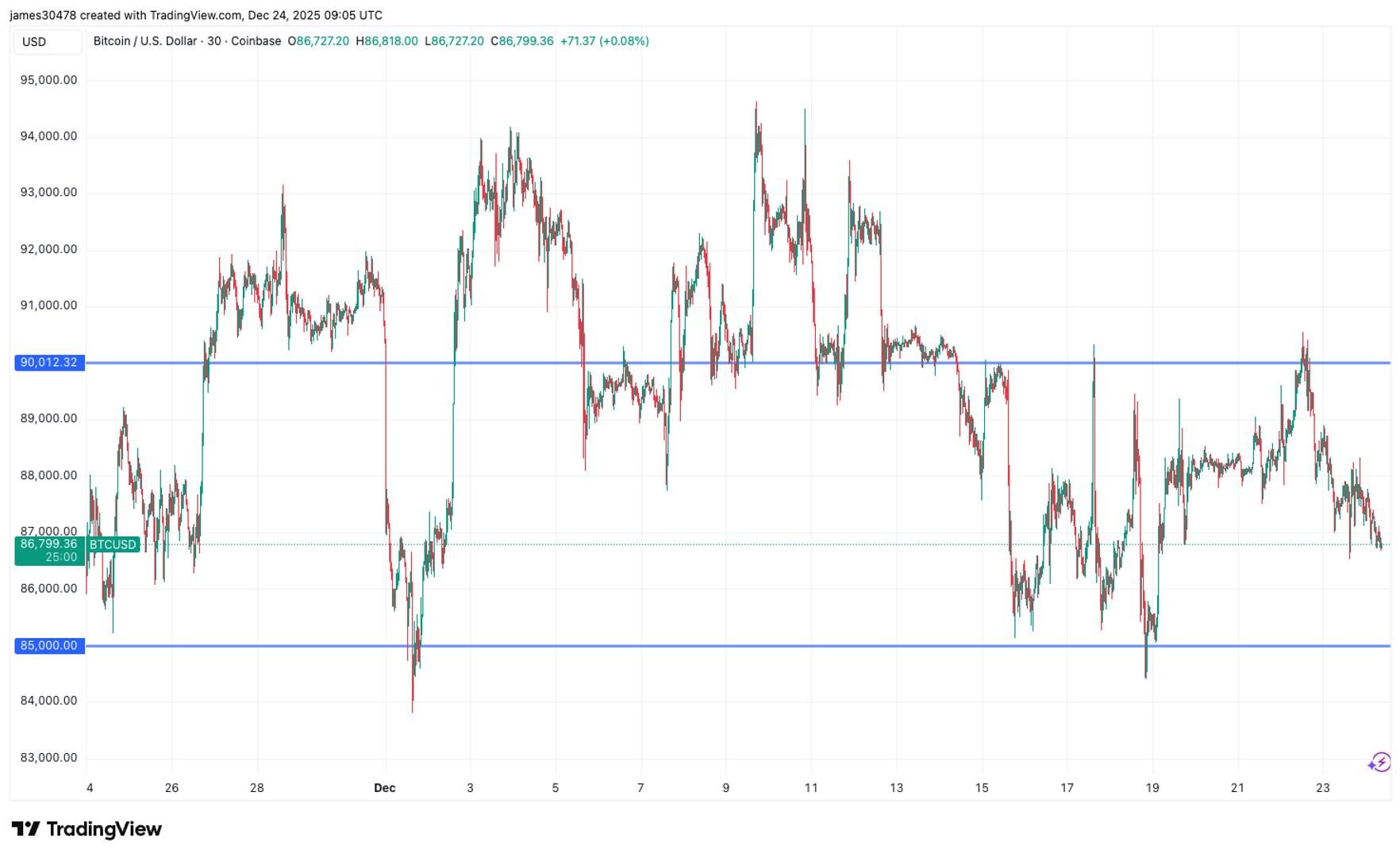
BTC set for a volatility shift from the $85k to $90k range as options expiry looms

-
News
-
Video
-
Consensus 2026
-
Data & Indices
A year-end options expiry for bitcoin is suppressing volatility just as macro and risk-asset positioning turns supportive for a higher price.
By James Van Straten|Edited by Sheldon Reback
Dec 24, 2025, 10:02 a.m.

- Bitcoin has spent the majority of December pinned between $85,000 and $90,000.
- That range has been enforced by dealer hedging tied to heavy options exposure, with dips bought near $85,000 and rallies sold near $90,000.
- Some $27 billion of open interest are set to expire on Deribit with a strong call bias, and options mechanics point to a resolution toward the higher end as the more likely outcome.
Bitcoin BTC$87,013.41 has spent virtually all of December locked between $85,000 and $90,000, while U.S. equities rallied and gold hit all-time highs. That’s left bitcoin investors frustrated, and the explanation lies in derivatives mechanics.
Now, those same mechanics indicate that the largest cryptocurrency could be making a break toward the high end of the range. The more likely outcome after expiry is an upside resolution toward the mid $90,000s rather than a sustained break below $85,000.
STORY CONTINUES BELOW
The key driver has been a heavy concentration of options around current prices. Options are contracts that give traders the right, but not the obligation, to buy or sell bitcoin at a set price. Call option holders benefit if price rises, while put options benefit if price falls.
On the other side of these trades are the options writers, who have to honor the contracts if the holders choose to exercise them. They hedge their risk dynamically in the spot and futures markets, and that behavior is controlled by what’s known as gamma and delta.
Delta measures how much an option’s value changes for a $1 move in the bitcoin price. Gamma measures how quickly that delta changes as price moves. When gamma is high and close to spot, dealers are forced to buy and sell frequently, suppressing volatility.
According to X account, David, in December, large put gamma near $85,000 acted as a floor, forcing dealers to buy bitcoin as the price dips. At the same time, heavy call gamma near $90,000 capped rallies, with dealers selling into strength. This created a self-reinforcing range driven by hedging necessity rather than conviction.

With $27 billion of options approaching expiry on Dec. 26, this stabilizing effect weakens as gamma and delta decay.
This expiry is extremely large and has a bullish tint towards it. More than half of Deribit open interest rolls off, with a put-call ratio of just 0.38 (that is, there are almost three times as many call options as puts) and most open interest concentrated in upside strike prices between $100,000 and $116,000.
The max pain point, which refers to the price level at which options buyers would lose the most money at expiry and the sellers, typically dealers, would make the most, is at $96,000, which reinforces the upside skew.
In addition, implied volatility measures the market’s expectation of how much bitcoin’s price may fluctuate in the future, and the Bitcoin Volmex implied volatility index hovering near one month lows around 45 suggests traders are not pricing in elevated near-term risk.
More For You
Dec 19, 2025

L1 tokens broadly underperformed in 2025 despite a backdrop of regulatory and institutional wins. Explore the key trends defining ten major blockchains below.
What to know:
2025 was defined by a stark divergence: structural progress collided with stagnant price action. Institutional milestones were reached and TVL increased across most major ecosystems, yet the majority of large-cap Layer-1 tokens finished the year with negative or flat returns.
This report analyzes the structural decoupling between network usage and token performance. We examine 10 major blockchain ecosystems, exploring protocol versus application revenues, key ecosystem narratives, mechanics driving institutional adoption, and the trends to watch as we head into 2026.
More For You
3 hours ago

Gold is rallying on rate cut expectations and geopolitical risk, while bitcoin has struggled to hold key psychological levels and remains sensitive to the same forces that tend to hit equities and other risk assets.
What to know:
- Gold is experiencing significant gains, driven by rate cut expectations and geopolitical risks, while bitcoin struggles to maintain key levels.
- Bitcoin’s performance is hindered by market positioning and macroeconomic factors, contrasting with gold’s role as a reserve asset.
- Gold-backed ETFs have seen consistent growth, with major banks forecasting further price increases in the coming years.


-
Back to menu
-
Back to menu
Prices
-
Back to menu
-
Back to menu
Indices -
Back to menu
Research
-
Back to menu
Consensus 2026 -
Back to menu
Sponsored
-
Back to menu
-
Back to menu
Podcasts -
Back to menu
-
Back to menu
Webinars
Select Language