
MARA’s ‘Discount’ Is a Myth Once Debt Is Included, VanEck’s Sigel Warns

-
News
-
Video
-
Consensus 2026
-
Data & Indices
VanEck’s Matthew Sigel argues MARA’s valuation looks expensive when adjusted for its leverage and capital structure.
By James Van Straten|Edited by Oliver Knight
Updated Dec 5, 2025, 3:58 p.m. Published Dec 5, 2025, 3:38 p.m.

- VanEck’s Matthew Sigel argues once you account for MARA’s $3.3 billion in convertible debt, it’s net bitcoin value sits near $1.6 billion, which means the stock trades at a premium rather the perceived discount to its bitcoin holdings, with a $4.7 billion market cap.
- Sigel says much of MARA’s short interest and volatility stems from its capital structure, making it a far less direct bitcoin proxy compared to Strategy (MSTR).
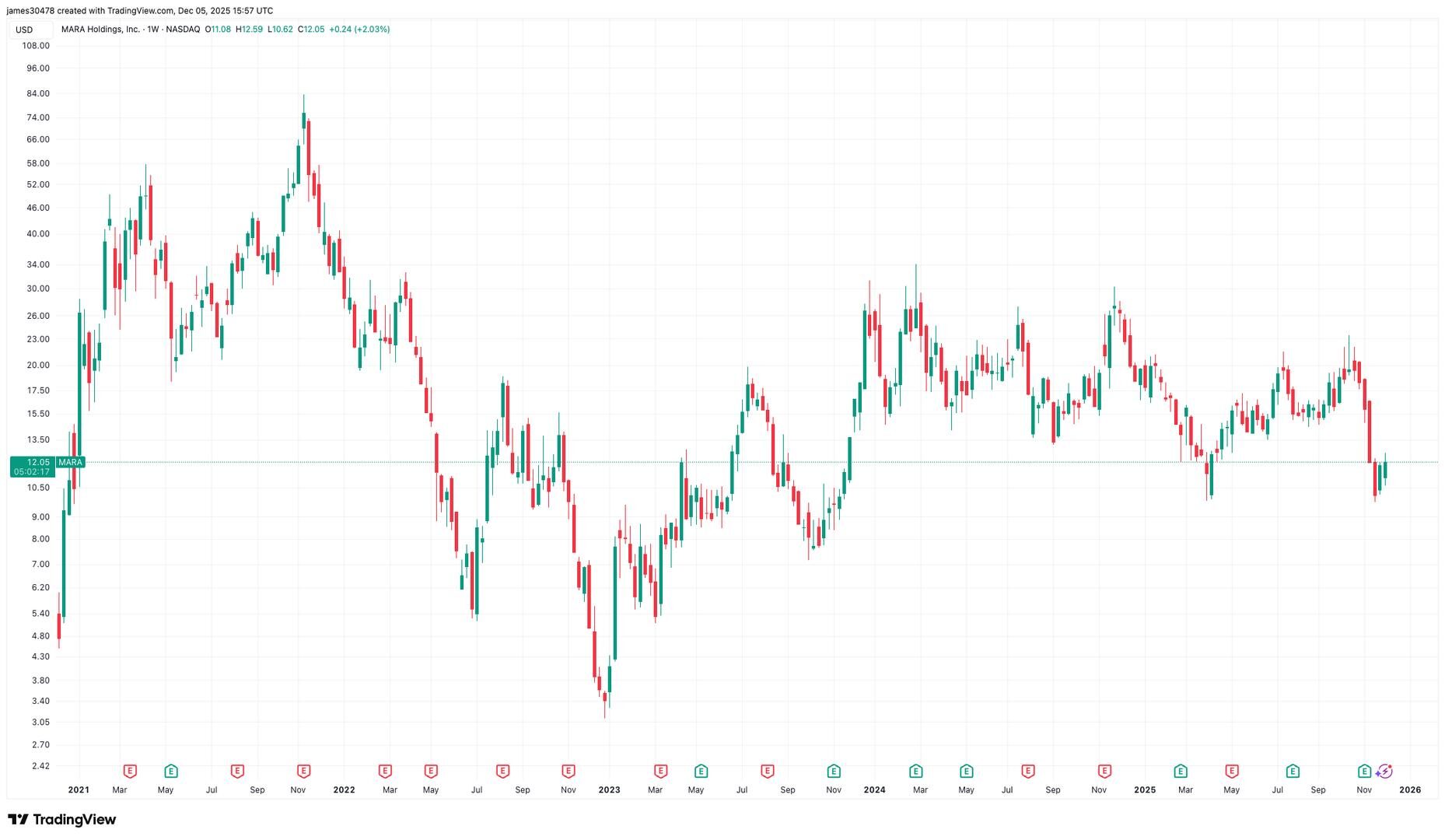
The two largest publicly traded companies holding bitcoin, Strategy (MSTR) and MARA Holdings (MARA), have each fallen roughly 40% over the past six weeks.
CoinDesk Research has extensively covered the MSTR correction, but MARA, which is down 55% year over year, is also attracting attention as some investors view it as inexpensive at current levels.
STORY CONTINUES BELOW
Matthew Sigel, head of digital assets research at VanEck, argues that the perception of MARA as cheap is not supported by the data. Sigel argues that the company is actually trading at a premium to it’s bitcoin holdings and not a discount.
Sigel highlights MARA’s $3.3 billion in outstanding convertible debt relative to its $4.9 billion in bitcoin holdings. Adjusting for the convertible debt leaves just $1.6 billion of net bitcoin value before accounting for any additional liabilities that the mining business incurs.
That compares with a $4.7 billion equity market cap, which Sigel implies that MARA is in fact trading at a premium once debt is included, rather than at a discount to its bitcoin holdings.
Sigel also addresses MARA’s high short interest, which currently stands at 27%. After adjusting for delta hedging related to the company’s convertible notes, Sigel estimates that true short interest falls to about 15%, a reduction of 44%.
Sigel contrasts this with MSTR, which has more than $8 billion of convertible debt, compared to a $53 billion market cap.
Once hedge related shorts are removed, MSTR’s short interest declines by only 31%, or by roughly 9 million shares. Sigel characterizes MARA’s short interest as more structural, compared with MSTR’s which he frames as more fundamentals driven.
Sigel argues that over half of MARA’s equity volatility stems from its capital structure and financing dynamics rather than from pure bitcoin beta. He concludes that MSTR offers a much cleaner bitcoin duration exposure, while MARA’s mining equity performance is dominated by what he describes as a problematic capital structure.
More For You
Nov 14, 2025

What to know:
- As of October 2025, GoPlus has generated $4.7M in total revenue across its product lines. The GoPlus App is the primary revenue driver, contributing $2.5M (approx. 53%), followed by the SafeToken Protocol at $1.7M.
- GoPlus Intelligence’s Token Security API averaged 717 million monthly calls year-to-date in 2025 , with a peak of nearly 1 billion calls in February 2025. Total blockchain-level requests, including transaction simulations, averaged an additional 350 million per month.
- Since its January 2025 launch , the $GPS token has registered over $5B in total spot volume and $10B in derivatives volume in 2025. Monthly spot volume peaked in March 2025 at over $1.1B , while derivatives volume peaked the same month at over $4B.
More For You
By Will Canny, AI Boost|Edited by Jamie Crawley
1 hour ago

Digital-asset treasury plays that once traded at big premiums have fallen back toward net asset value.
What to know:
- CoinShares said the DAT bubble has deflated, with some names dropping from 3x–10x mNAV in summer 2025 back to around 1x or below.
- The near-term path splits between a disorderly sell-off and a hold-and-recover, with CoinShares head of research James Butterfill leaning toward the latter on improving macro and possible Dec. rate cuts.
- The longer-term fix is structural: less dilution and concentration, clearer category lines, and more credible businesses using digital assets as treasury tools rather than the whole story, the report said.


-
Back to menu
-
Back to menu
Prices
-
Back to menu
-
Back to menu
Indices -
Back to menu
Research
-
Back to menu
Consensus 2026 -
Back to menu
Sponsored
-
Back to menu
-
Back to menu
Podcasts -
Back to menu
-
Back to menu
Webinars
Select Language