
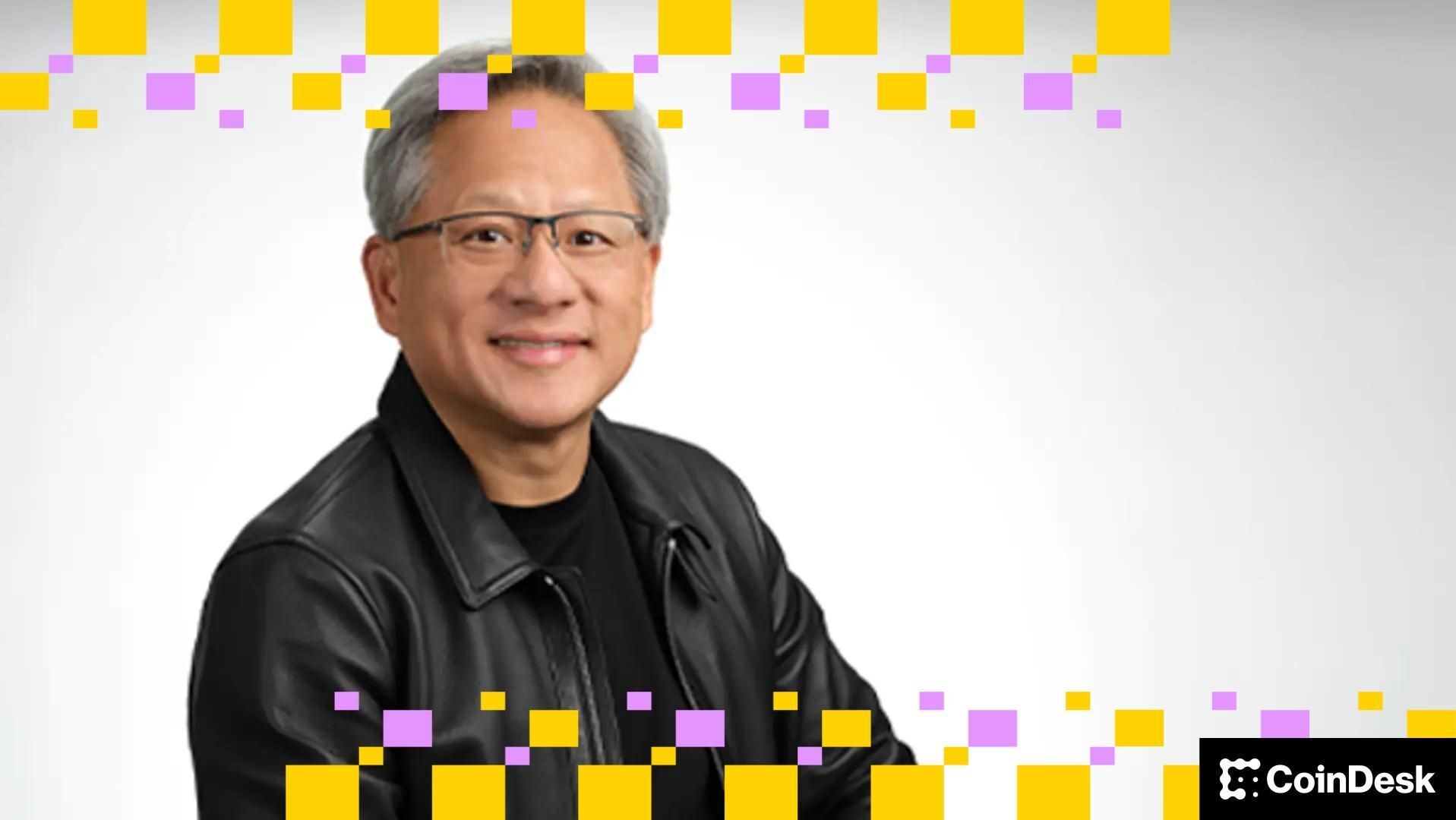
Nvidia CEO Jensen Huang Tells Joe Rogan AI Race Is Real, But It Won’t Have a Clear Winner

-
News
-
Video
-
Consensus 2026
-
Data & Indices
In a wide-ranging interview, Huang claims AI growth is gradual, powerful and already changing global power dynamics.
By Will Canny, AI Boost|Edited by Nikhilesh De
Dec 3, 2025, 8:08 p.m.

- AI’s rise is a long race, not a single breakthrough, according to Nvidia CEO Jensen Huang.
- He said in an interview with Joe Rogan that capability is surging, with an emphasis on safer, more useful systems, including defense uses.
Nvidia (NVDA) CEO Jensen Huang doesn’t think the artificial intelligence race will be decided in a single breakthrough.
On The Joe Rogan Experience, Huang cast AI’s acceleration as the latest chapter in a long-running global competition for technological advantage, one that has repeatedly redrawn geopolitical lines, from World War II through the Cold War.
STORY CONTINUES BELOW
“We’ve always been in a tech race with someone,” Huang said, likening today’s push for AI leadership to the Manhattan Project. The difference, he argued, is tempo: rather than a sudden, decisive finish line, AI will advance in waves, continuous gains that are easy to miss in the moment but obvious in hindsight.
That doesn’t mean the stakes are modest, according to the CEO of one of the biggest manufacturers of the the chips AI firms need to operate. Huang said AI systems have become roughly 100 times more capable over the last two years, a rate of progress that has fueled public anxiety about autonomous weapons and machines operating beyond human moral constraints.
Huang’s counterpoint: much of the momentum is flowing into functionality and safety, making systems more reliable, more useful and less error-prone, he claimed.
He also defended the U.S. military’s role in AI development, suggesting that defense involvement can normalize the technology’s place in national security rather than leaving it to shadowy, unaccountable actors.
Rogan pressed on a familiar set of fears: AI outpacing human judgment, and the longer-term threat that quantum computing could crack modern encryption. Huang pushed back, arguing that AI will remain “a click ahead,” and that history is full of moments when society panicked over its newest inventions, only to adapt once the technology became legible and regulated.
If Huang has an ideal end state, it’s not a single winner hoisting a trophy. It’s something quieter: AI becoming infrastructure, fading into the background as it powers everyday systems, from healthcare to transportation, less a conquering intelligence than a new layer of computing people stop noticing because it simply works.
Read more: Amazon Enters AI Arms Race as Crypto and Risk Asset Fears Mount
AI Disclaimer: Parts of this article were generated with the assistance from AI tools and reviewed by our editorial team to ensure accuracy and adherence to our standards. For more information, see CoinDesk’s full AI Policy.
More For You
Nov 14, 2025

What to know:
- As of October 2025, GoPlus has generated $4.7M in total revenue across its product lines. The GoPlus App is the primary revenue driver, contributing $2.5M (approx. 53%), followed by the SafeToken Protocol at $1.7M.
- GoPlus Intelligence’s Token Security API averaged 717 million monthly calls year-to-date in 2025 , with a peak of nearly 1 billion calls in February 2025. Total blockchain-level requests, including transaction simulations, averaged an additional 350 million per month.
- Since its January 2025 launch , the $GPS token has registered over $5B in total spot volume and $10B in derivatives volume in 2025. Monthly spot volume peaked in March 2025 at over $1.1B , while derivatives volume peaked the same month at over $4B.
More For You
By Margaux Nijkerk, AI Boost|Edited by Stephen Alpher
27 minutes ago

Distribution is designed to go to the ecosystem, With 30% to airdrops, 25% to growth initiatives, and 10% for liquidity and launch support.
What to know:
- Solana Mobile has released new details Wednesday about SKR, the forthcoming native token for its Seeker smartphone ecosystem.
- The company said SKR will launch in January 2026, forming the economic and governance backbone of its decentralized mobile platform.
- According to a post on X from Solana Mobile, SKR will have a fixed total supply of 10 billion tokens.


-
Back to menu
-
Back to menu
Prices
-
Back to menu
-
Back to menu
Indices -
Back to menu
Research
-
Back to menu
Consensus 2026 -
Back to menu
Sponsored
-
Back to menu
-
Back to menu
Podcasts -
Back to menu
-
Back to menu
Webinars
Select Language