
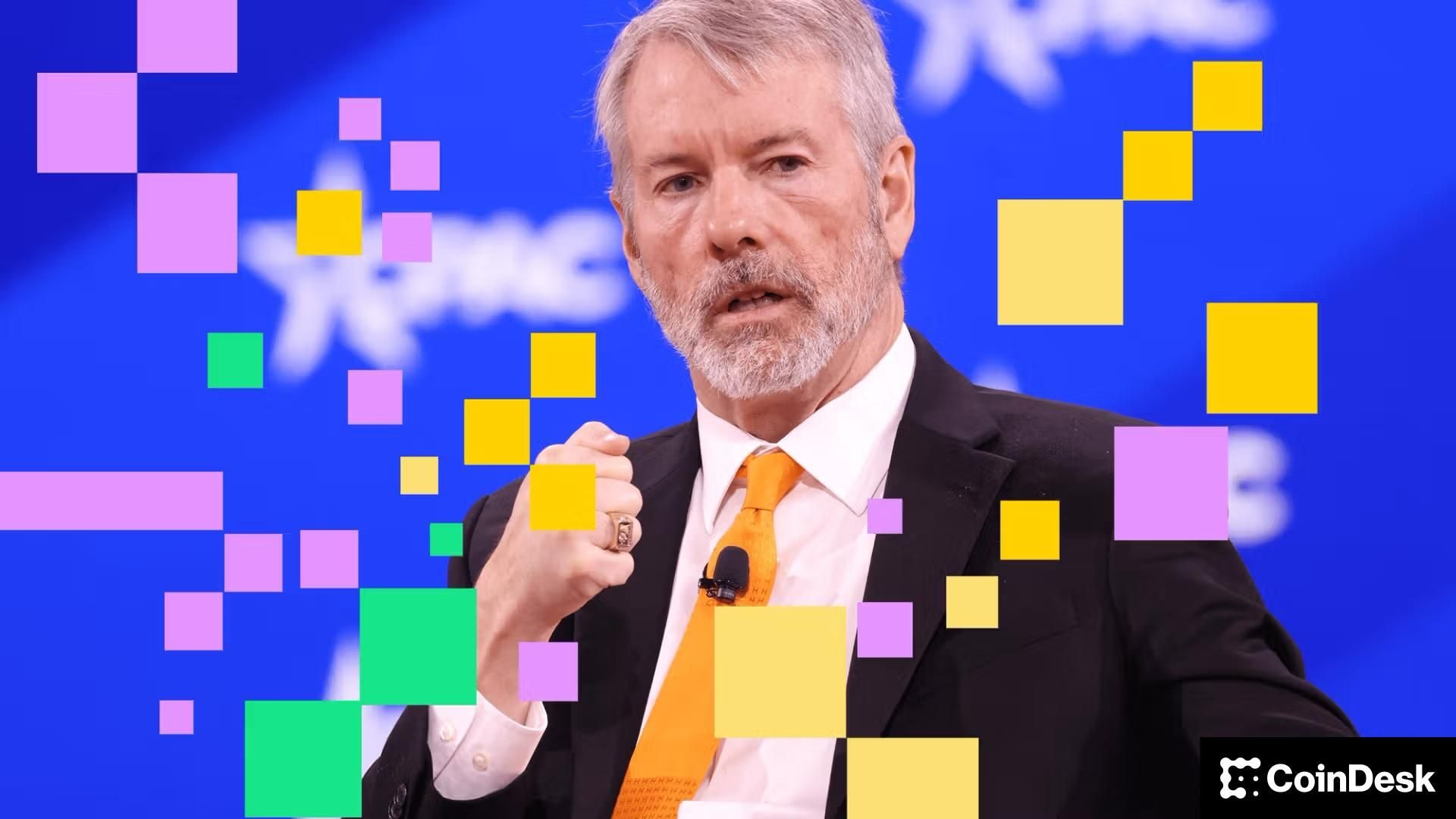
Michael Saylor’s MSTR Responds to Potential MSCI Exclusion

-
News
-
Video
-
Consensus 2026
-
Data & Indices
Michale Saylor and team urged MSCI to maintain neutral index standards after a plan to exclude firms with significant digital asset holdings.
By James Van Straten, AI Boost|Edited by Stephen Alpher
Dec 10, 2025, 3:19 p.m.

- Strategy has submitted a formal letter to MSCI opposing its proposal to exclude companies with large digital asset holdings from global equity indices.
- Strategy argues DATs are operating companies, not investment funds, and should remain eligible for benchmark inclusion.
- The firm warns that the proposed 50% digital asset threshold is arbitrary, unworkable and risks harming innovation and U.S. competitiveness.
Strategy (MSTR) has written a formal letter in response to MSCI’s proposal to exclude companies whose digital asset holdings represent 50% or more of total assets from MSCI Global Investable Market Indexes.
Led by Executive Chairman Michael Saylor, Strategy argued that digital asset treasury companies (DATs), including Strategy itself, are operating businesses that use digital assets as productive capital, not passive vehicles for tracking price movements. Strategy builds bitcoin backed credit instruments, manages an active corporate treasury program and maintains a global enterprise analytics software business. Investors buy the company’s strategy and management, not a static wrapper for bitcoin, the company said.
STORY CONTINUES BELOW
Already under serious pressure thanks to falling bitcoin prices and a narrowing mNAV (the premium to bitcoin holdings at which investors value a company), Strategy shares tumbled even further two weeks ago as the MSCI proposal came to light. MSTR stands to loss many billions in passive capital flows should it be removed from MSCI indexes.
Turning back to Strategy’s arguments, the company also listed five reasons the company is not an investment fund:
1. Strategy is organized as a conventional operating company.
2. The company has no fund or ETP like structure or obligations.
3. MSTR is not an investment company under applicable laws.
4. The company creates no fund like tax treatment for investors
5. It has a long history as an operating software business.
The proposed 50% threshold is described as arbitrary and unworkable, Strategy said. Many companies hold concentrated reserves in oil, real estate, timber or utilities, yet remain eligible for MSCI indices. MSCI is thus singling out only digital asset backed companies.
Strategy further argued that the proposal injects policy views into index construction at a time when federal policy has shifted toward supporting digital asset innovation. Excluding DATs could force large passive outflows, undermine American competitiveness and slow the expansion of new financial technologies.
If MSCI continues to remain inclined to treat DATs differently, Strategy urged the firm to extend the consultation and provide a more detailed basis for any proposed changes.
AI Disclaimer: Parts of this article were generated with the assistance from AI tools and reviewed by our editorial team to ensure accuracy and adherence to our standards. For more information, see CoinDesk’s full AI Policy.
More For You
Nov 14, 2025

What to know:
- As of October 2025, GoPlus has generated $4.7M in total revenue across its product lines. The GoPlus App is the primary revenue driver, contributing $2.5M (approx. 53%), followed by the SafeToken Protocol at $1.7M.
- GoPlus Intelligence’s Token Security API averaged 717 million monthly calls year-to-date in 2025 , with a peak of nearly 1 billion calls in February 2025. Total blockchain-level requests, including transaction simulations, averaged an additional 350 million per month.
- Since its January 2025 launch , the $GPS token has registered over $5B in total spot volume and $10B in derivatives volume in 2025. Monthly spot volume peaked in March 2025 at over $1.1B , while derivatives volume peaked the same month at over $4B.
More For You
By Shaurya Malwa|Edited by Oliver Knight
1 hour ago

The Elon Musk–run company is moving ahead with plans for an initial public offering that would seek to raise “significantly more than $30 billion.” Even relatively small balance-sheet allocations matter at that scale.
What to know:
- SpaceX is planning an IPO by 2026, potentially valuing the company at $1.5 trillion.
- The company holds significant cryptocurrency assets, including bitcoin and dogecoin.
- Elon Musk’s influence in crypto markets is notable, with SpaceX’s IPO potentially expanding his reach in AI and crypto infrastructure.


-
Back to menu
-
Back to menu
Prices
-
Back to menu
-
Back to menu
Indices -
Back to menu
Research
-
Back to menu
Consensus 2026 -
Back to menu
Sponsored
-
Back to menu
-
Back to menu
Podcasts -
Back to menu
-
Back to menu
Webinars
Select Language