
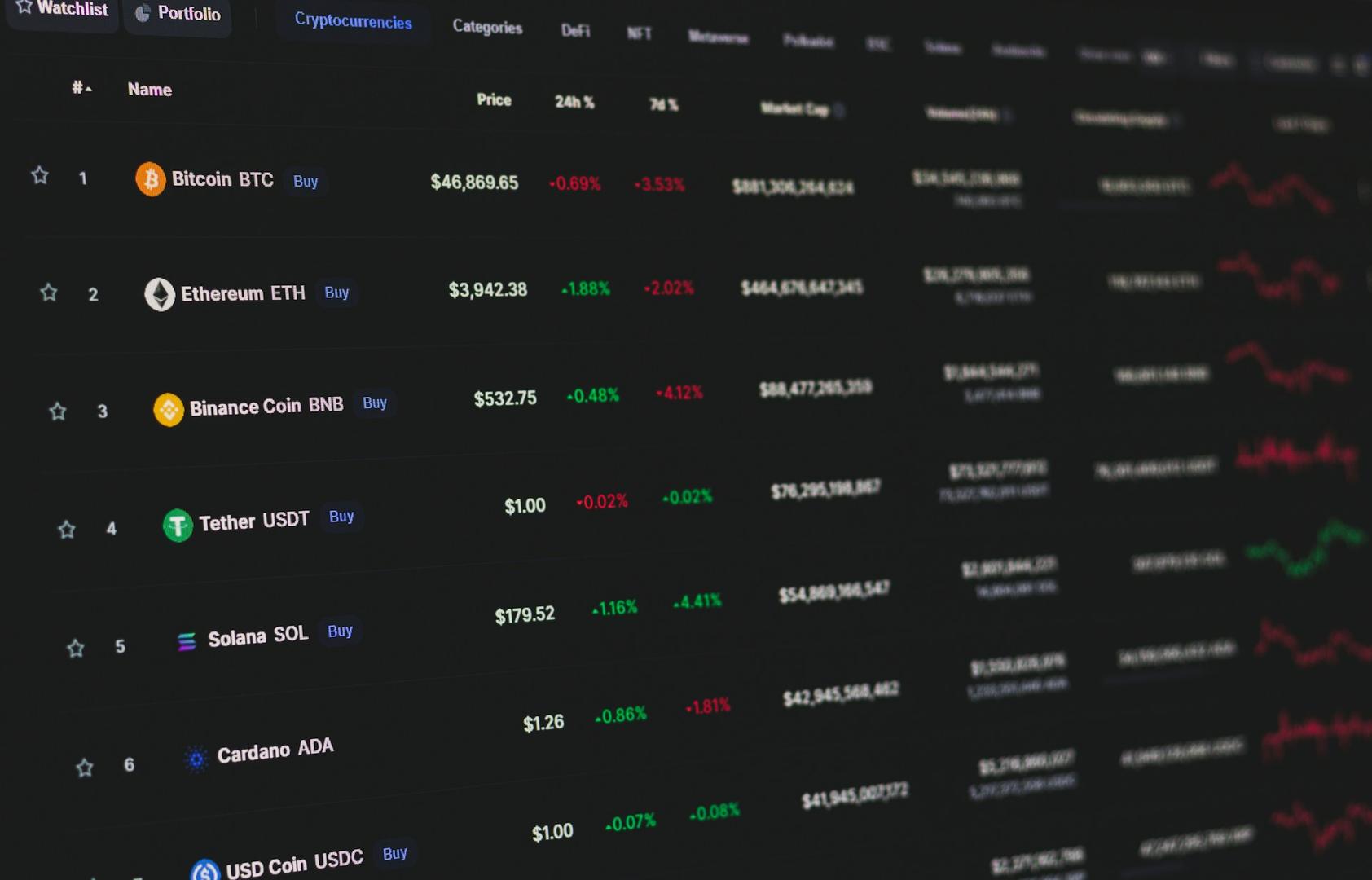
Crypto investors are looking past market-cap rankings and back to fundamentals
Investors are starting to judge crypto tokens on usage, economics and value capture rather than market-cap rank, industry executives said.
By Francisco Rodrigues|Edited by Nikhilesh De
Share this article

Summary
Crypto investors are increasingly using revenue, usage and value capture to sort tokens over longer horizons, even as perpetual futures continue to drive prices day to day, industry players at Bitwise, Wintermute and the Arbitrum Foundation told CoinDesk.
During an interview with CoinDesk, Bitwise CEO Hunter Horsley described the shift as the end of crypto’s “CoinMarketCap leaderboard” era. In earlier cycles, investors often valued new layer-1 networks as a fraction of the largest blockchain above them, he said. Smaller projects were then priced at a discount.
That approach is losing ground as investors focus on addressable markets, adoption and how much economic value a project can capture, Horsley said.
He cited Hyperliquid as an example. Investors can examine the derivatives platform’s trading activity and economics when assessing its HYPE token rather than treating it as a smaller version of another blockchain. The token is up around 20% in the past year.
“When we speak with wealth managers at a firm that has recently approved access to the space, they have no idea where something ranks on CoinMarketCap,” Horsley said. “It’s irrelevant.”
Wintermute OTC trader Jasper De Maere told CoinDesk fundamentals and trading flows matter over different time horizons.
Perpetual-futures volumes still run at a multiple of spot across most major tokens, while funding, positioning and liquidations set the tone intraday, he said
Over the past 12 to 18 months, however, attention has moved from infrastructure toward applications and appchains that fit more familiar fintech and venture-capital frameworks, De Maere said.
Fundamentals are starting to carry more weight in areas including decentralized finance, perpetual-futures exchanges and decentralized physical infrastructure networks.
“Fundamentals set the floor and the shortlist, while flows set the price,” De Maere said. Revenue and usage can determine which tokens survive drawdowns or make it onto allocator shortlists, but they rarely determine the price on a given day, he added.”
Wintermute’s flow data suggests the clearest change is in who is trading. Rather than a wholesale migration from spot to derivatives, institutional counterparties accounted for roughly 72% of its spot over-the-counter flow in the first half of 2026, up from around 59% a year earlier, De Maere revealed.
Those flows have concentrated in major cryptocurrencies and a shortlist of revenue-generating tokens, with tokenized real-world assets emerging as the main new category, he said.
“Part of the outperformance of revenue-generating tokens reflects fundamentals being rewarded, and part reflects the fact that fundamentals are the current narrative, so those tokens attract the flows,” De Maere cautioned. “The two are hard to separate.”
The split is also showing up between crypto tokens and listed companies tied to the industry. Cryptocurrencies fell 36% in the first half while crypto stocks rose 23%, according to a Bitwise market review.
The divergence does not mean stocks will keep outperforming tokens, but it shows the two groups are drifting apart.
Brendan Ma, head of investment strategy at the Arbitrum Foundation, told CoinDesk that analysts are arriving with a better understanding of revenue composition, transaction activity and value capture than they had a year ago.
“The credible metrics are the ones that cost something to produce and can be verified onchain,” Ma said. He identified fee revenue, fee-paying users and capital that remains on a network, including stablecoin balances and tokenized assets, as harder to manufacture.
Address counts and total value locked can be inflated by incentives or bots, Ma said. Rising transactions are more meaningful when accompanied by higher fee revenue and user retention.
Ma pointed to Arbitrum, the network he works on, as one example of the project-level analysis now taking place. The network has processed more than 2.7 billion lifetime transactions, including more than 500 million in 2026, while Robinhood Chain is running at roughly $40 million in annual revenue, according to the foundation.
Under Arbitrum’s expansion program, 10% of that chain’s net protocol revenue returns to the Arbitrum ecosystem.
Bitwise’s Horsley said index products can give investors broad crypto exposure without requiring them to pick individual winners. Bitwise, Horsley’s firm, offers such products, as do some other asset managers including 21Shares.
Grayscale head of research Zach Pandl told CoinDesk bitcoin remains a macro asset tied to demand for alternatives to fiat currencies, while other cryptocurrencies will face greater scrutiny of their underlying economics.
To Pandl, the outlook for the crypto sector itself is “very bright as stablecoins, tokenized assets, and decentralized finance tools will drive demand for digital assets beyond Bitcoin in the years ahead.”
“A small number of tokens with strong fundamentals will play a central role in digital assets’ next chapter,” Pandl said. “Weaker projects with poor fundamentals will be left behind.”

- 1
- 2
- 3
- 4
- 5
- 6
- 7
- 8
- 9
- 10


Zcash’s Tachyon upgrade aims to scale shielded payments, improve quantum readiness, and test whether its funding, security, and governance can hold.
Jun 30, 2026
Zcash’s Tachyon upgrade aims to scale shielded payments, improve quantum readiness, and test whether its funding, security, and governance can hold.
Why it matters:
Zcash’s Tachyon upgrade aims to scale shielded payments, improve quantum readiness, and test whether its funding, security, and governance can hold.