
Aave rewrites the rulebook for asset listings after $293 million exploit
Share this article
The lending giant is expanding its asset listing criteria beyond financial risk to include cybersecurity and architecture, and wants the rest of DeFi to follow.
By Oliver Knight|Edited by Stephen Alpher
May 7, 2026, 2:27 p.m. 2 min read

- Aave will assess all future collateral assets on cybersecurity, interoperability, and technical architecture — not just price volatility — and will publish a minimum-standards playbook for issuers seeking to list on the protocol.
- The changes follow April’s KelpDAO bridge exploit, in which an attacker minted $293 million in unbacked rsETH tokens and used them as collateral on Aave, leaving the protocol with hundreds of millions in bad debt.
- Rather than a government rescue, DeFi self-organised through an industry coalition called “DeFi United” to plug the gap — a response Jeng compared favourably to the government-led bank bailouts of 2008.
Miami — Aave Labs is set to fundamentally reshape how it assesses and lists collateral assets on its protocol, following the largest DeFi exploit of 2026, and the overhaul could set a new standard across the entire industry.
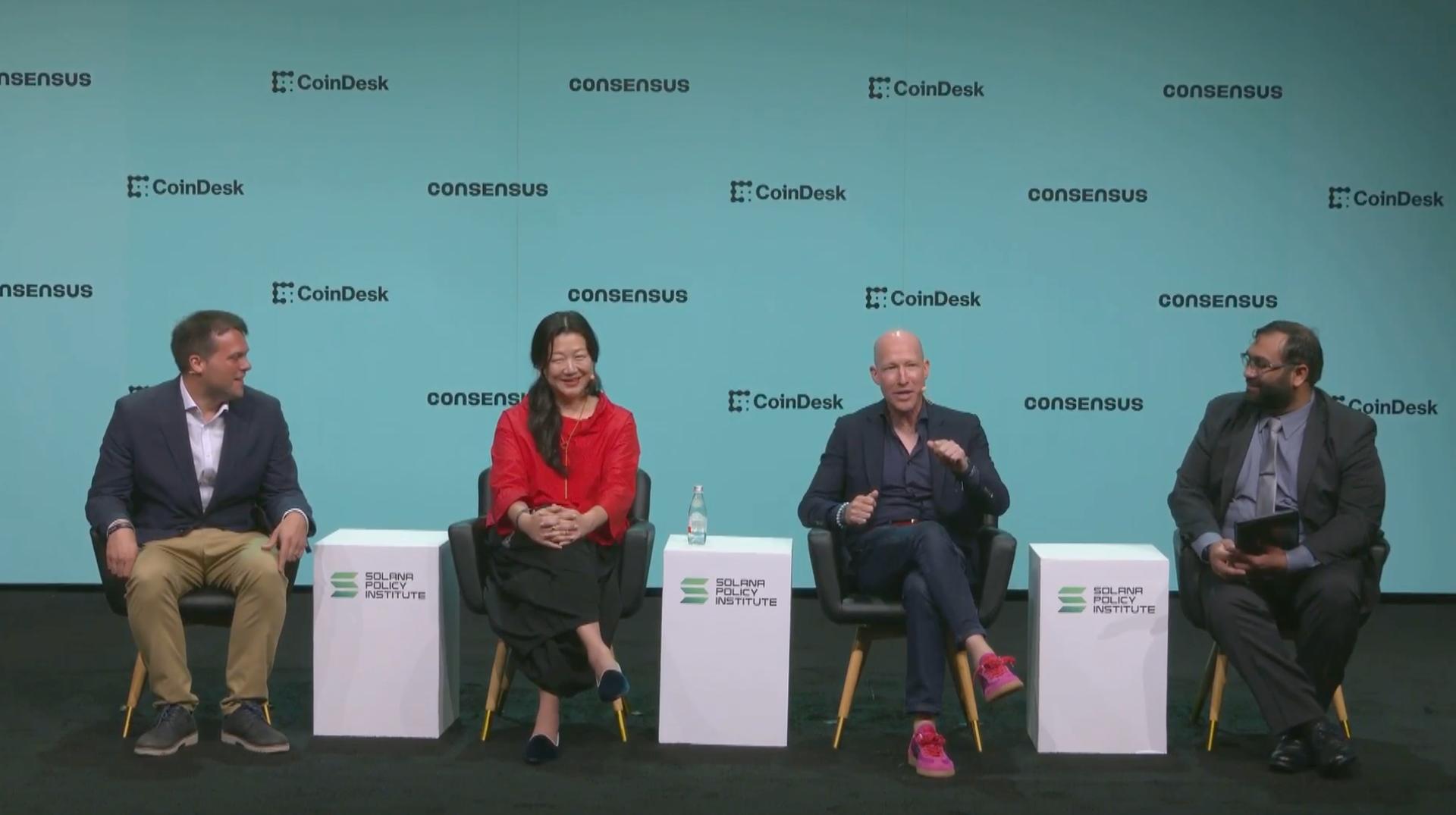
Linda Jeng, chief legal and policy officer at Aave Labs, said at Consensus Miami 2026 that the protocol’s existing risk framework, while robust, had been too narrowly focused on financial risk and volatility.
Going forward, every asset seeking to be listed on Aave will face a broader assessment covering interoperability, cybersecurity vulnerabilities, and the underlying architecture of the asset. She cited rsETH, the restaking token issued by KelpDAO that sat at the center of April’s crisis, as the catalyst for the change.
Beyond the new assessment criteria, Jeng announced that Aave would publish a formal playbook for asset issuers — a set of minimum standards that projects must meet before they can list on the protocol. She also said Aave would begin examining systemic interconnections across protocols, moving away from analyzing pools in isolation to understanding how exposure in one corner of DeFi can ripple into another.
“Out of a crisis like this, it ups our standards,” she said.
The remarks came as Jeng reflected on a month she described as “two weeks of no sleep.” An attacker had exploited KelpDAO’s cross-chain bridge, minting 116,500 unbacked rsETH tokens worth roughly $293 million, then depositing them into Aave as collateral to borrow real wrapped ether — leaving the protocol holding hundreds of millions in impaired debt.
Jeng, who worked as a regulator during the 2008 financial crisis, said the episode triggered a strong sense of déjà vu. But the resolution, she argued, was markedly different. Rather than a government-led bailout, the industry mobilized itself. An initiative called “DeFi United,” which has drawn commitments from Lido, EtherFi, Ethena and others, was launched to cover the collateral shortfall and prevent systemic bad debt from spreading further across DeFi lending markets.
“In the financial crisis, we had to bail out the banks,” she said. “Here, we came together as an ecosystem to bail ourselves out.”
More For You
By Francisco Rodrigues|Edited by Jamie Crawley
27 minutes ago

The combined migrations by Solv and Kelp shift nearly $1 billion in assets to Chainlink’s CCIP, reflecting an industry “flight to quality.”
What to know:
- Solv Protocol is moving $700M in tokenized bitcoin (SolvBTC, xSolvBTC) from the LayerZero bridge to Chainlink’s CCIP following a security review and recent cross-chain hacks.
- This follows Kelp DAO’s shift after a $292M exploit on its LayerZero bridge. LayerZero and Kelp are blaming each other over the bridge’s single-verifier setup.


Top Stories


