
Crypto and stocks go their separate ways as bitcoin’s failed breakout continues to weigh
Share this article
Bitcoin’s failed breakout above $83,000 is looking increasingly like a bear market signal, even as S&P 500 and Nasdaq futures notch gains and approach all-time highs.
By Oliver Knight, Saksham Diwan|Edited by Sheldon Reback
May 29, 2026, 10:29 a.m. 2 min read

- Bitcoin’s rejection above $83,000 has compounded a pattern of lower highs stretching back to October.
- Derivatives markets are sending mixed signals: Implied volatility has compressed to its lowest since September, suggesting traders expect near-term calm, yet one-week put-call skew has crept higher, meaning demand for downside protection is building.
- Stellar (XLM) was the standout performer, surging 25% in 24 hours after DTCC announced plans to connect its tokenized securities platform to the network. Bitcoin cash shed 7.2% and is now down 20% for the week.
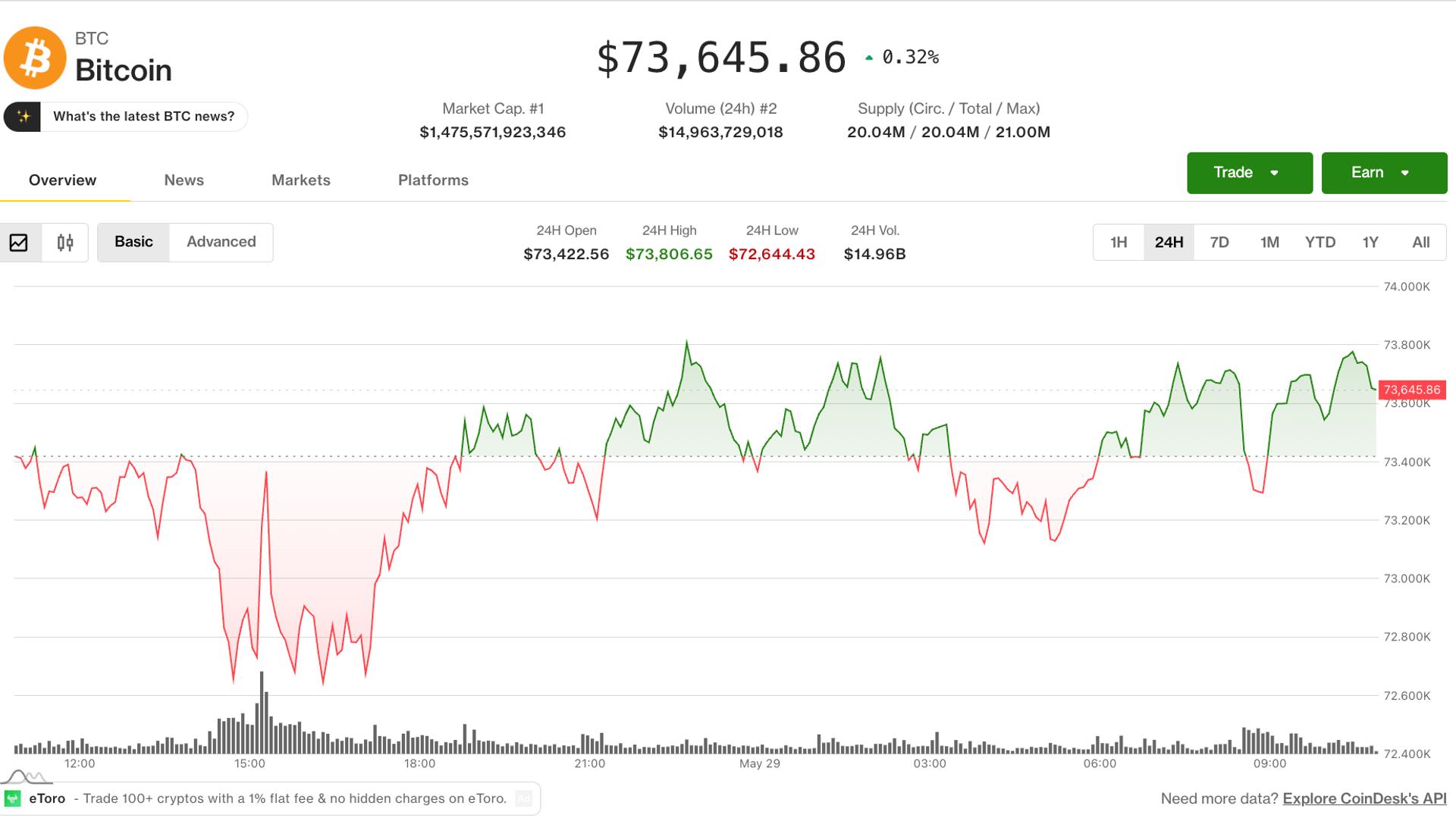
Bitcoin BTC$73,565.90 added as much as 0.4% since midnight UTC on Friday and was recently just 0.07% higher after slumping to its lowest level since early April the day before.
Thursday’s drop extended a decline that has emerged over the past three weeks after a failed attempt to climb above $83,000. There is now a chance that the rejection will have contributed to a series of lower highs dating back to October — a key characteristic of a bear market.
Ether (ETH) tracked bitcoin. It fell to $1,965 on Thursday before staging a recovery back above $2,000.
U.S stocks continued to outperform the crypto market on Friday, with S&P 500 and Nasdaq 100 index futures both posting 0.15% gains as the equity gauges approached fresh record highs.
There is no clear explanation why the crypto market is struggling against sectors it has historically been correlated with. The divergence since early October, however, aligns with a leverage wipeout that the market has failed to fully recover from.
- BTC open interest sits at $20.05 billion, up from $19.7 billion a week ago, with speculative positioning showing slight growth.
- Funding rates remain positive across multiple venues at under 10% annualized. The exception is Deribit, where they spiked to 44%.
- The three-month annualized basis pushed closer to 3%, led by Deribit, rising from 2.2% last week, pointing to a mild improvement in institutional risk appetite.
- Options positioning shows mixed signals: one-week 25-delta skew ticked up to 12.85% from 12.4%, suggesting slightly higher demand for downside protection.
- Front-end implied vol (DVOL) compressed to about 36 – the lowest since September — while the 1 month–6 month term structure slope sits at -6%, keeping the curve in contango. Markets are pricing near-term calm alongside longer-dated uncertainty.
- Coinglass data shows $224 million in 24-hour liquidations, with a 54-46 split between longs and shorts. BTC ($46 million) and ETH ($43 million) were the leaders in terms of notional liquidations. The Binance liquidation heatmap indicates $72,280 as a core liquidation level to monitor, in case of a price drop.
- Stellar (XLM) was the top-performing altcoin on Friday, rising by 25% in the past 24 hours and 4.5% since midnight UTC after it was announced that The Depository Trust & Clearing Corporation (DTCC) is planning to connect its tokenized securities platform to the network.
- There were also double-digit gains for ALGO, INJ, HBAR and HYPE over the past 24 hours as the altcoin market showed strength while the major cryptocurrencies showed weakness.
- One asset that continued its woeful performance of late was BCH$300.30. The token that spawned out of a Bitcoin fork in late 2017 lost 7.2% of its value in the past 24 hours and has now shed 20% in the past week alone.
- DeFi tokens are also losing their luster, with ENA, JUP and UNI dropping as much as 18% over the past week.
- CoinMarketCap’s “Altcoin Season” indicator reflected the weakness on Friday, falling to 34/100 from 37/100.
More For You
By James Van Straten|Edited by Jamie Crawley
18 minutes ago
The longest run of withdrawals since U.S. spot bitcoin ETFs listed in January 2024 comes as bitcoin underperforms high-flying AI and semiconductor stocks.
What to know:
- U.S. spot bitcoin ETFs have recorded nine consecutive trading days of net outflows. The longest withdrawal streak since the funds began trading in January 2024.
- The ETFs have shed approximately $1.3 billion this week, extending a run of three consecutive weeks of net outflows
- Previous periods of sustained ETF selling,…


