
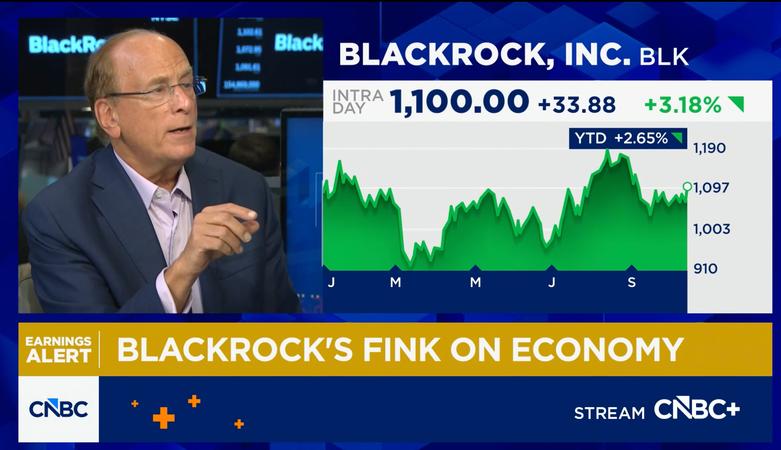
BlackRock’s Larry Fink names a U.S. recession trigger and its tied to AI
BlackRock’s CEO says “a moratorium of some sort” on data center buildouts would put the U.S. in a recession.
Share this article
Summary
Companies are pouring so much money into data centers that power artificial intelligence (AI) that any attempt to slow it could hurt the U.S. economy, not just the stock market.
Larry Fink, CEO of BlackRock, the world’s largest asset manager, made that clear Wednesday in a CNBC interview, while also warning about the burgeoning national debt.
He said “a moratorium of some sort in this country” would put the U.S. in a recession, commonly defined as two straight quarters of shrinking economic output.
Fink was referring to a potential push to stop data center buildouts across the U.S. over concerns that they harm the environment. Data centers are the huge buildings packed with computers that power AI.
“So much of our economy is based on the buildout of this capex,” Fink said.
Public opinion on data centers is souring. A Pew Research Center survey found at least 49% of Americans say data centers are mostly bad for the environment, home energy costs and quality of life for those living near them.
Fink pushed back on that. He said most of the fears about data center buildouts are “misinformation,” adding, “Data centers are not the problem.”
He also pointed to data centers’ job creation, noting demand for construction workers, energy infrastructure and AI compute hardware.
Moody’s estimates planned capital spending on U.S. data centers at $700 billion this year, rising to between $2.4 trillion and $2.48 trillion through 2030. Globally, spending is expected to reach $7 trillion by the end of the decade.
Any attempt to stifle that spending could have wide-ranging effects. The U.S. economy is already stressed on several fronts, including sticky inflation and rising bond yields.
A recession would matter for crypto traders too, since it typically reduces investors’ appetite for risky assets. Bitcoin proponents hail it as a haven, but it has historically faced selling pressure during broad-based risk aversion. At press time, the cryptocurrency traded near $81,200, down 0.8% since midnight UTC.
BlackRock’s iShares Bitcoin Trust (IBIT) is the world’s largest publicly listed bitcoin fund, with cumulative net inflows of $65.62 billion since its debut in January 2024, according to SoSoValue.
Fink also pointed to government borrowing. “U.S. deficits are starting to have a serious impact,” he said, noting the national debt has gone from $8 trillion in 2000 to $40 trillion in 2026.
“We grew $32 trillion in 26 years,” Fink said. “That’s a massive impact on demand for credit. The government is demanding more and more credit, and bond auctions are getting larger and larger.”
His answer is private money. “We need to unlock private capital to grow the U.S. economy by 3%,” he said.
Growing government debt is widely seen as bullish for scarce assets like gold and bitcoin.
BlackRock itself reported solid third-quarter results. Net inflows, or new money from clients, came to $205 billion, and revenue rose 19%, even as organic asset growth slowed slightly over the last 12 months. Adjusted earnings per share rose 38% from a year earlier, and operating margin rose to 47.8%.

- 1
- 2
- 3
- 4
- 5
- 6
- 7
- 8
- 9
- 10


Sep 24, 2026
Why it matters:
Diversified RWA stablecoins sustain 5-7% yield from real credit as crypto funding compresses to ~4%. GENIUS pushes yield off-chain; TAM grows to $4B in 3 years.