
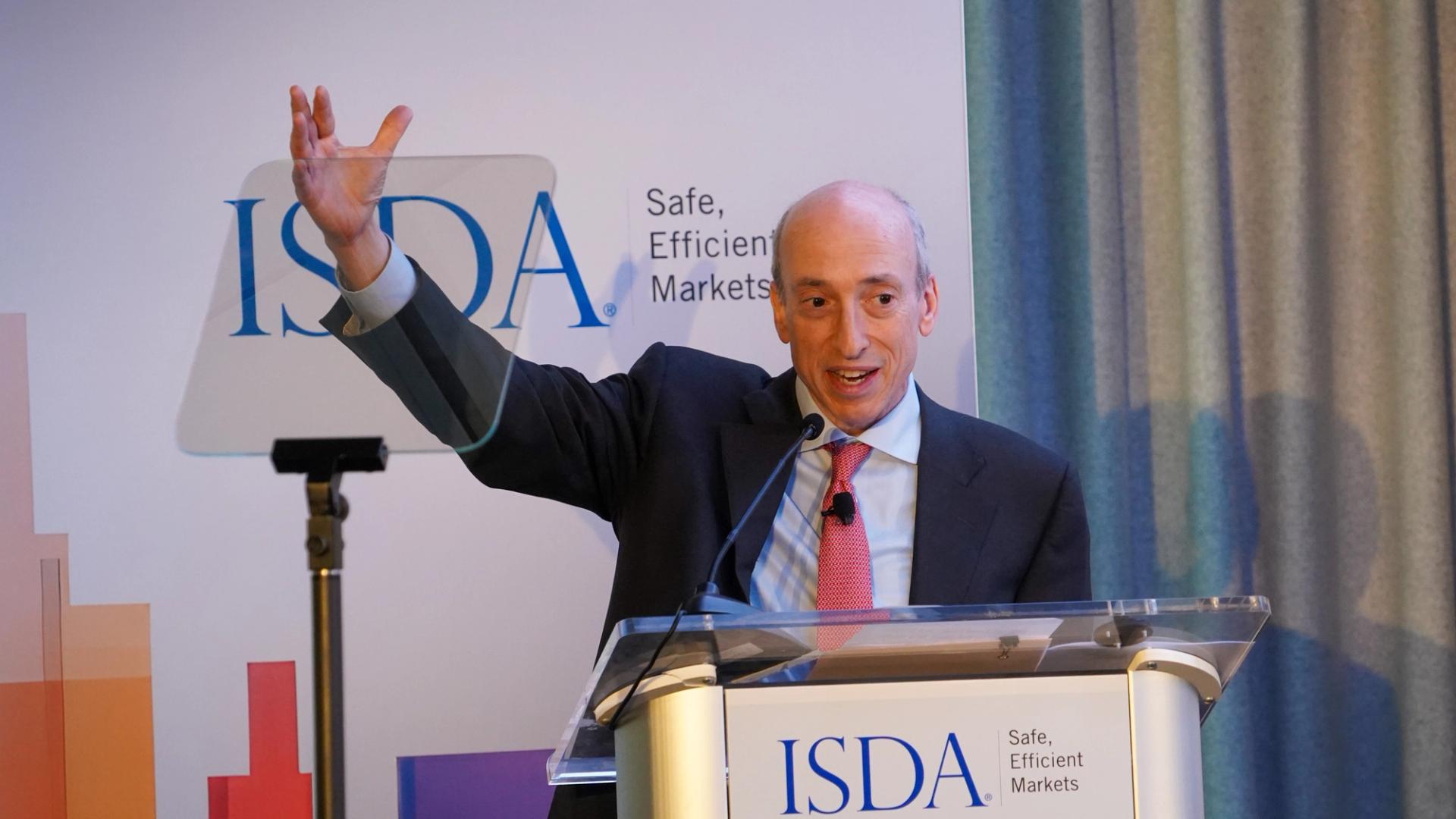
Former SEC, CFTC Chair Gary Gensler argues that prediction markets don’t overrule state regulations
The former regulator joined a number of interest groups in arguing that prediction markets are overstepping their bounds by offering sports-related contracts.
By Nikhilesh De|Edited by Omkar Godbole
Jun 12, 2026, 6:27 a.m.
Share this article

Summary
Prediction markets should not preempt state laws around sports gambling, the former head of the Commodity Futures Trading Commission and Securities and Exchange Commission, Gary Gensler, said in a court filing late Thursday.
Gensler, the Indian Gaming Association and Native American tribal organizations, the American Gaming Association and Better Markets all filed amicus briefs – otherwise known as friend-of-the-court briefs – with the Sixth Circuit Court of Appeals to argue that prediction market provider KalshiEx (otherwise known as Kalshi)’s sports-related prediction markets violate state gaming regulations.
The appellate court case arises from a lawsuit that Kalshi preemptively filed against the state of Ohio in an effort to block the state from filing suit against it. A federal judge ruled against Kalshi in March.
In Thursday’s filing, Gensler outlined the history of derivatives, the Commodity Exchange Act, and the Dodd–Frank Wall Street Reform and Consumer Protection Act (Dodd-Frank), arguing that Congress explicitly gave the CFTC authority to oversee specific types of derivatives products. Gensler was the chair of the CFTC from 2009 to 2014, during which he oversaw the implementation of the Dodd-Frank Act, and chair of the SEC from 2021 to 2025.
“Congress did not include sports betting contracts within the statutory Dodd-Frank definition of swap,” the brief said. “Such contracts do not fit the CEA’s purpose or the statutory language defining swap, which focus on hedging economic risk. Sports bets are very rarely, if ever, about hedging.”
The question at the heart of the case — whether sports-related events contracts, the official term for prediction markets, are actually federally regulated swaps or are just sports gambling dressed up as a novel financial product — has consumed courts across the country.
A number of states have sued prediction market providers, arguing that these companies are violating state regulations by failing to register as gambling platforms. The CFTC has sued several states and filed amicus briefs in a number of other cases arguing that it is the rightful overseer of prediction markets. Some of these companies have also filed suits against states, hoping to secure preemptive rulings that they are not subject to those state regulations.
If the CFTC is successful in convincing courts, and ultimately the U.S. Supreme Court, that it’s right, states stand to lose significant amounts of tax revenue. On the other hand, if states succeed in convincing the top court that they’re right, prediction market providers will have to register and comply with regulations in each state they want to operate in – and potentially face criminal penalties in states like Arizona and Minneapolis for operating unregistered platforms.
“To put the argument in the plainest real-world terms: Senate Majority Leader Harry Reid of Nevada would never have consented to or passively accepted legislation displacing an activity so critical to his state’s economy and politics by permitting sports betting only under CFTC auspices,” Gensler’s brief said.
Courts have so far been split; some have ruled in favor of prediction market providers, while others have ruled in favor of states.
The Third Circuit Court of Appeals ruled in April that the state of New Jersey could not shut down prediction markets, but panel of the Ninth Circuit Court of Appeals seemed more inclined to rule for the states.
It is likely that the Supreme Court will ultimately take up the issue, and Congress is also poking around.
The CFTC, currently helmed by Chair Mike Selig, filed its own amicus brief in this case last month, arguing that any event contract traded by a designated contract market overseen by the regulator is a swap.
Congress’ definition of a swap was broad and the language in the statutes allows for the CFTC-regulated firms to offer their products, the regulator’s filing said.
Genler’s brief disagreed.
“The CFTC now posits hedging theories for some sports bets that are at best only tenuously connected to reliable hedges of commercial risks. That connection, however, is crucial, as Congress included only those event contracts that hedge risks in a manner similar to a swap and are sufficiently ‘associated with a potential financial, economic, or commercial consequence,'” Gensler’s brief said.
Other amicus briefs took aim at different aspects of prediction markets. The filing by the Indian Gaming Association and other affiliated parties argued that sports-related prediction markets infringe on tribal nations’ sovereign rights, on the grounds that any gaming activity on native lands must benefit the tribes and not private firms, citing the Indian Gaming Regulatory Act.
“Kalshi has brazenly entered onto state and tribal lands across the nation to conduct unregulated gaming with its so-called ‘legal sports betting’ app,” the filing said. “In doing so, Kalshi is siphoning away vital tribal and state governmental revenue to its owners’ pockets.”
The American Gaming Association’s filing focused on arguing that there is no real distinction between sports prediction markets and sports betting — going so far as to cite a trademark application by Kalshi which said “its services are associated with … ‘providing of information related to sports betting; organizing, arranging, conducting sports betting and gambling tournaments, competitions and contests.'”
The brief compared sportsbooks to offerings on Kalshi’s platform, looking at various offerings including parlays.
The AGA and Gensler’s filing both also argued that sports-related prediction markets aren’t providing economic hedges for entities.
Better Markets’ filing similarly argued that sports-related prediction markets should not be treated as swaps, quoting past Kalshi filings where the company drew a distinction between markets for political events like elections and sporting events like horse races.

- 1
- 2
- 3
- 4
- 5
- 6
- 7
- 8
- 9
Crypto for Advisors: Crypto ETFs
15 hours ago
- 10


Tokenized assets hit a record $28.9B in May; their tenth consecutive monthly all-time high. The stablecoin market cap also extended its run to $320B.
Jun 9, 2026
Tokenized assets hit a record $28.9B in May; their tenth consecutive monthly all-time high. The stablecoin market cap also extended its run to $320B.
Why it matters:
Tokenized assets hit a record $28.9B in May; their tenth consecutive monthly all-time high. The stablecoin market cap also extended its run to $320B.