
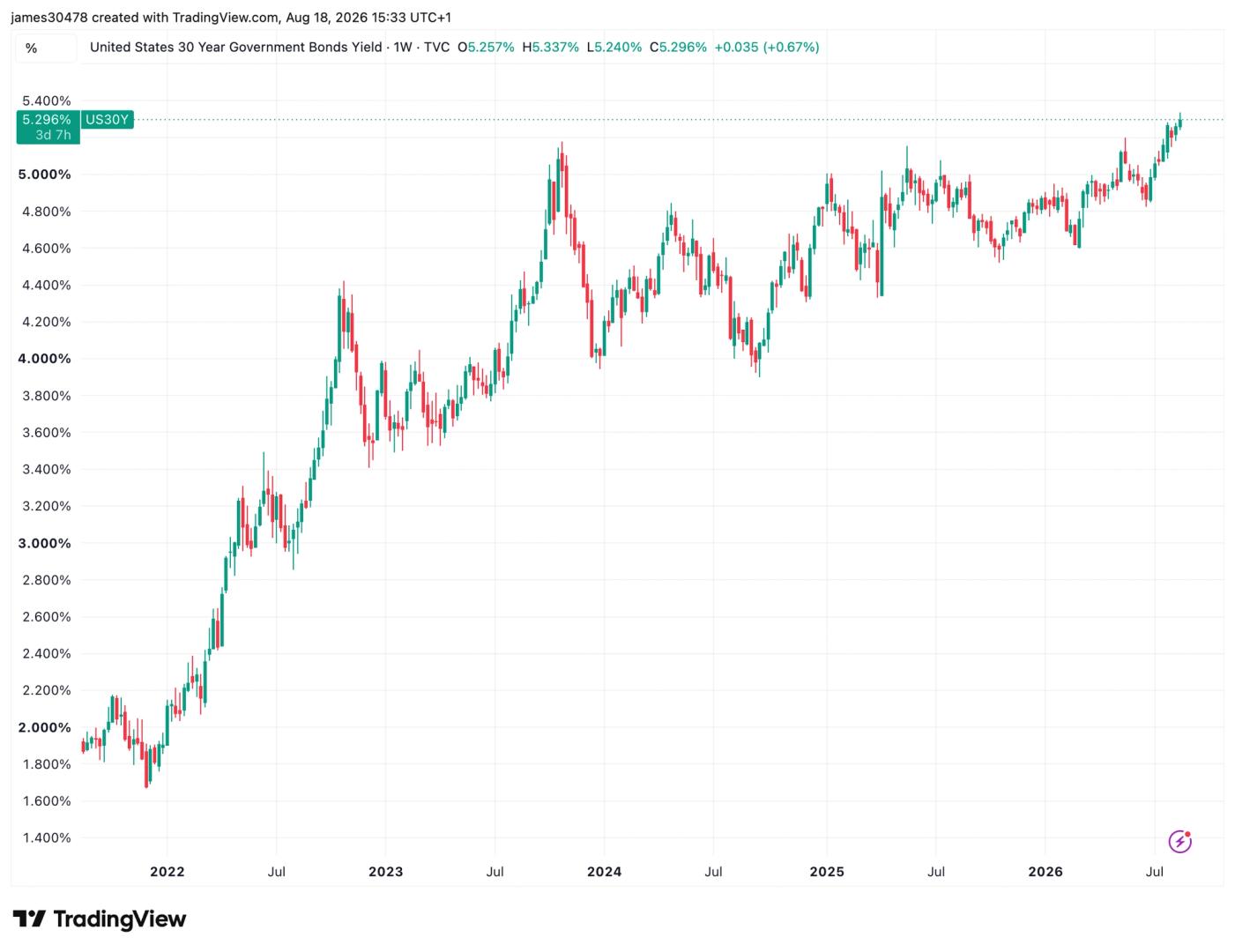
Rising sovereign yields threaten tech financing and crypto markets
Long-term borrowing costs are reaching multi-decade highs as U.S. debt approaches $40 trillion and AI hyperscalers accelerate bond issuance.
By James Van Straten|Edited by Stephen Alpher
Share this article

Summary
Long-term government bond yields are climbing to levels not seen in decades, as investors contend with a wave of debt issuance and growing concerns about sovereign finances as U.S. government debt is approaching $40 trillion.
Bond prices and yields move inversely, meaning yields rise when investors sell bonds. The 30-year U.S. Treasury yield has reached 5.33%, its highest level since 2007, while the equivalent U.K. gilt yield is approaching 6%. French borrowing costs are at their highest since 2008, and Japan’s long-term yields continue to set records.
TLT, the exchange-traded fund (ETF) tracking long-duration U.S. Treasuries, fell to an all-time low of $81.35 on Monday.
Oil remains a concern, as WTI crude is trading above $84 a barrel, up 25% from its July low, and has remained above $70 since the war began in February. However, five and ten-year inflation expectations have been relatively stable over the past week, at 2.25% and 2.28%, respectively. That suggests inflation is not the market’s primary concern.

Attention is increasingly turning to debt supply and refinancing risk on the AI infrastructure buildout. Hyperscalers have issued a combined $159 billion of bonds in 2026, up 47% from a year earlier, largely to finance AI infrastructure. Goldman Sachs expects total issuance to reach $400 billion this year. Every basis-point increase raises the cost of refinancing that debt.
The bearish argument for crypto and risk assets is that higher yields can also pull capital away from speculative assets. As CNBC’s Jim Cramer noted, “5.31% isn’t that bad for 20-year paper.”
Gold and bitcoin, which generate no yield, should theoretically become less attractive as bond yields rise. Gold, however, has gained 10% this month, suggesting investors may view the bond selloff partly as a loss of confidence in sovereign fiscal credibility.
Bitcoin was meant to share that potential hedge narrative but has yet to fulfill it, having underperformed for 9 months and now stuck in a low-volatility summer lull just above $64,000.

- 1
- 2
- 3
- 4
- 5
- 6
- 7
- 8
- 9
- 10


Zcash’s Tachyon upgrade aims to scale shielded payments, improve quantum readiness, and test whether its funding, security, and governance can hold.
Jun 30, 2026
Zcash’s Tachyon upgrade aims to scale shielded payments, improve quantum readiness, and test whether its funding, security, and governance can hold.
Why it matters:
Zcash’s Tachyon upgrade aims to scale shielded payments, improve quantum readiness, and test whether its funding, security, and governance can hold.