
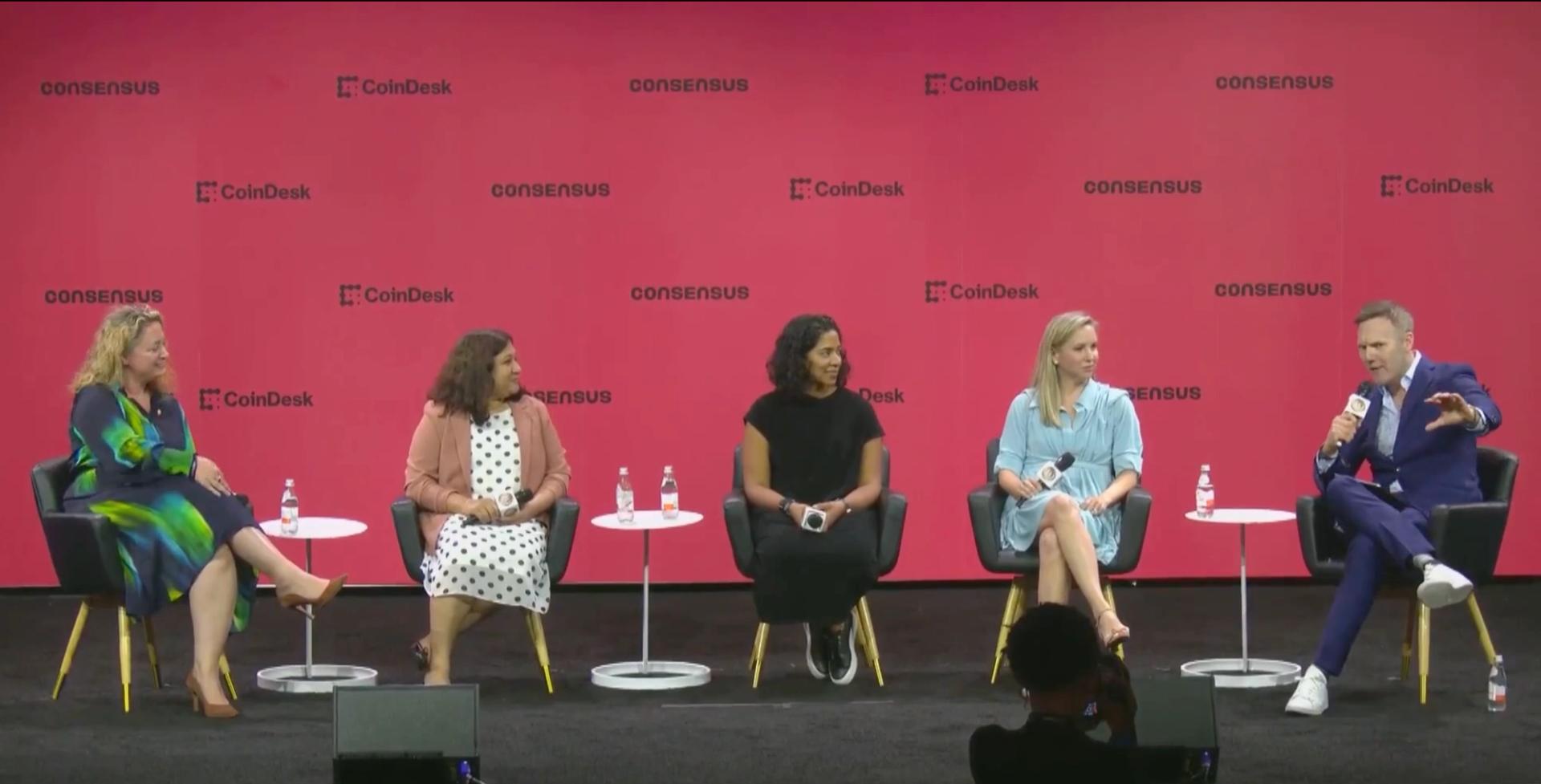
It’s transparency, not tech alone, that drives crypto adoption, panelists tell Consensus Miami
Share this article
Execs from PayPal, Robinhood, Public.com and 248 Ventures said the way to move retail into crypto and AI is to slow down, show your work, and put users back in control.
By Jeffrey Albus|Edited by Nikhilesh De
May 5, 2026, 10:04 p.m. 2 min read

- Executives from PayPal, Robinhood, Public.com and 248 Ventures said at CoinDesk’s Consensus Miami conference Tuesday that the bottleneck for crypto and AI-product adoption is not technology alone, but user trust earned through visible, controllable design.
- Robinhood VP of Crypto Institutions Nicola White said 50% of Robinhood’s new platform users in Q1 were first-time investors and warned that retail-facing 100x-leverage perpetuals are a risk the industry should be slowing down to address.
- Public.com CFO Sruthi Lanka predicted that retail users will increasingly “make the wealth manager redundant,” and 248 Ventures’ Lindsey Bell projected that 80% of Americans will be operating with at least one AI agent by early 2027.
The path to mainstream crypto adoption runs through more visible, controllable product design, executives from PayPal, Robinhood, Public.com and 248 Ventures told CoinDesk’s Consensus Miami conference Tuesday.
“It’s important to tell users with AI products what the underlying system is not doing in addition to what it is doing,” Public.com CFO Sruthi Lanka said. Public has built its agentic-investing product so that users review and approve a “deterministic recipe” before any trade is placed. “Make sure it’s not a black box,” she said. The result, according to Lanka, is an organization where everyone is now writing code: “I have accountants writing code. We have marketing people playing with code. Everyone is an engineer, and I think that’s only going to become more commonplace.”
Smitha Purohit, PayPal’s senior director of product for crypto, said trust is “a factor of two things;” whether users can start small and experiment, and whether the company has their back when something goes wrong.
“When you build too fast, compliance comes as a secondary thought, and I don’t think that’s the way to build scalable products. It should be compliance first, regulatory first, and that’s how PayPal looks at everything,” she said.
Nicola White, Robinhood’s vice president of crypto institutions and general manager of Bitstamp, said 50% of the company’s new first-quarter users self-identified as first-time investors, pointing to that as the reason to push back on retail product velocity.
“We’re all building so quickly. I think we need to make sure that we’re slowing down and thinking about: is what we’re building the right thing for the customer? […] I think we’re introducing risks that maybe people don’t understand,” she said, citing the Oct. 10 crypto liquidation event and questioning, “Is 100x something that a retail client should be offered?”
Lindsey Bell, Chief Investment Strategist at 248 Ventures, framed adoption as ultimately an emotional decision. “People’s purchasing or usership is really driven by emotion; it’s driven by fear. You have to be able to tap into that. And I think you do that best by talking to your customers and your prospects and really figuring out what’s making their heart beat,” she said, citing earlier remarks from a former Mastercard CMO that traditional market research is now only “23% accurate.”
In a closing lightning round, Lanka predicted users will “increasingly make the wealth manager redundant”; White predicted CLARITY Act passage and tokenized RWAs hitting stride in the U.S.; Bell floated that “by the beginning of next year,” 80% of Americans could be operating with at least one AI agent; and Purohit predicted “pay as you go” models for content, pointing to stablecoins as a way to enable micropayments.
More For You
By Olivier Acuna|Edited by Nikhilesh De
5 minutes ago

The Consensys CEO and founder said tokenization can be traced back to Ethereum, the blockchain he helped co-found.
What to know:
- Joseph Lubin, the founder and CEO of Consensys and an Ethereum co-founder, said at Consensus Miami 2026 that tokenization of virtually the entire global economy is now inevitable rather than experimental.
- Lubin argued that Ethereum’s early design enabling anyone to issue tokens without creating a new blockchain has positioned it…


Top Stories


