
liveUpdated 34 minutes ago
Stocks also turned positive after big early losses, helped by sharply lower bond yields.
By Shaurya Malwa, James Van Straten, Omkar Godbole, and Stephen Alpher|Edited by Stephen Alpher
Share this post
“A brutal few days across the AI infrastructure sector, and TeraWulf WULF$12.61·Market Closed has been no exception,” tweeted company CEO Paul Prager earlier this afternoon.
After speaking with a group of investors organized by Morgan Stanley yesterday, Prager summarized some of the issues and his responses.
Among them were the questions about the effect of high interest rates.
“Our customers are investing billions in compute to generate substantial economic returns,” said Prager. “The cost of delaying that capacity can far exceed the incremental cost of financing it today.”
“That’s why financing costs are central to our lease negotiations and, where contractually provided, borne by the tenant … Higher rates matter. But so does the value of time. Our job is to protect the economics.”
And on execution:
“At Lake Mariner, we’re advancing CB4 and CB5 toward their planned Q4 and Q1 deliveries. And our construction costs remain squarely within guidance. We’re currently tracking ~$9 million per critical IT MW at Lake Mariner, within our $8–10 million guidance range.”
WULF is higher by 9.2% today, but still lower by 9% over the past five days.
Share this post
It was late August when then-newish Fed Chair Kevin Warsh surprised markets with his hawkish Jackson Hole speech, setting up a rate hike a few weeks later.
The 10-year U.S. Treasury yield was at about 4.65% when Warsh gave that speech and rose to 5.30% by early October.
The Fed chair speaks again tonight (11:30 pm ET), and yields have tumbled in the past two days despite two very troubling inflation reports.
It’s possible that Warsh goes with the flow and eases back on the hawkish rhetoric, given recent equity market stumbles. However, thanks in part to those two poor inflation reportss, it seems more likely Warsh will reiterate his hawkish position, setting markets up for multiple rate hikes in coming months.
“Warsh has no choice tonight, he has to sound even more hawkish than at Jackson Hole,” said one trader. “Fresh off hot CPI and PPI, anything soft will be read as surrender.”
Share this post
Nvidia NVDA$217.23·Market Closed doesn’t need to backstop CoreWeave (CRWV), said Nvidia CEO Jensen Huang, speaking at an event in Sweden.
CoreWeave’s cost of capital is “actually decreasing,” he added, with strength improving every day.
Nvidia, of course, has a major stake in CoreWeave, having invested $2 billion into the neocloud’s common stock earlier this year. CoreWeave’s data centers run nearly totally on Nvidia chips and hardware.
CRWV has narrowed its loss on the day to 2.9%, but remains lower by nearly 50% over the past six months.
Share this post
A recovery in U.S. stocks is spreading to crypto in late-morning U.S. hours.
Down nearly 1.5% earlier, the Nasdaq is just shy of flat on the session, while the S&P 500 climbs 0.2% and the DJIA rises more than 1%.
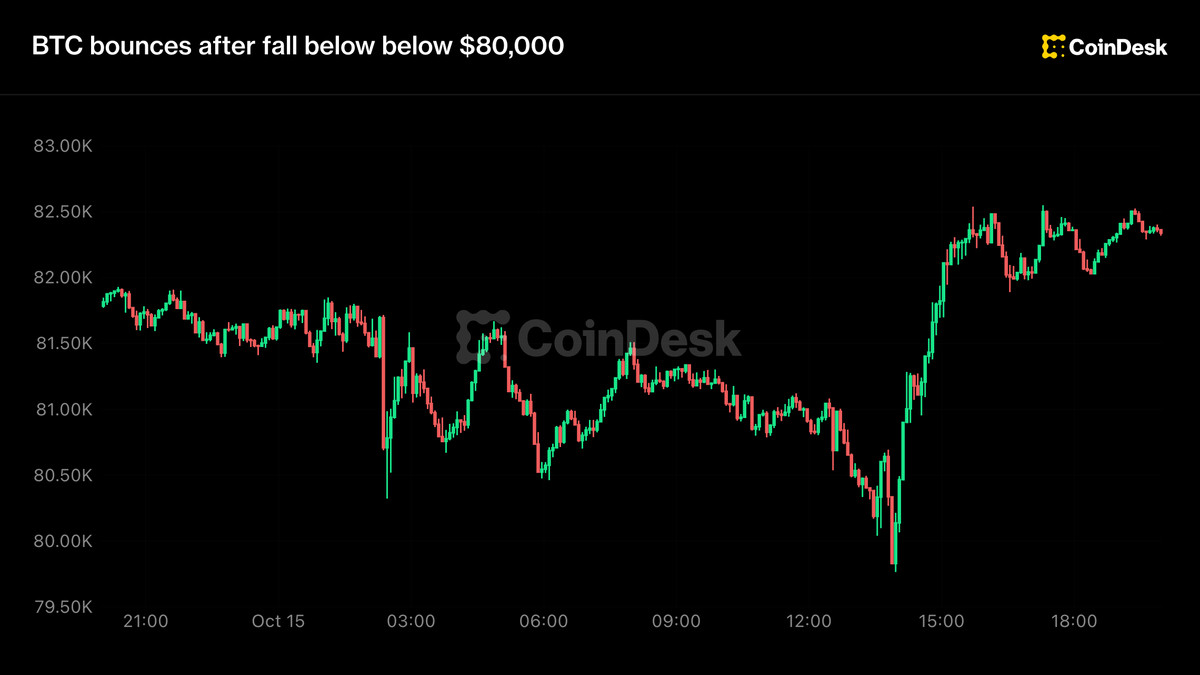
Bitcoin BTC$80,955.28 has risen about 3% in the past 90 minutes, now trading at $82,200, up 0.5% over the past 24 hours.
Solana (SOL) is leading among the majors, up 1.7%.
Supporting risk markets is a fast drop in bond yields, the 10-year U.S. Treasury now trading at 5.09% after reaching 5.36% at one point yesterday following the fast September CPI report.
Among crypto-related stocks, Circle Financial CRCL$86.99·Market Closed is leading with a 6.7% gain. Also higher are Strategy MSTR$151.24·Market Closed, up 2.4%, Coinbase COIN$183.75·Market Closed, up 2.4%, and Securitize (SECZ), up 3.9%.
Share this post
The European Banking Authority (EBA) classified Circle’s USDC as the first “significant” e-money token under the EU’s Markets in Crypto-Assets (MiCA) regulation.
USDC is the first of the 45 e-money MiCA-registered tokens to receive the designation. The EBA will oversee USDC’s capital requirements, reserves and liquidity, while France’s banking regulator will retain responsibility for governance and other areas.
The EBA also signed an agreement with New York regulators to coordinate oversight of USDC’s operations across Europe and the U.S.
Share this post
Buyers have quickly stepped in, making bitcoin’s first dip below $80,000 in one month a very brief one.
The price has quickly rebounded to above $81,000, still lower by 1% over the past 24 hours. Solana is down similarly, with ether and XRP each lower by 2%.
The bounce in crypto comes alongside one for stocks, with the Nasdaq narrowing its big early decline to 0.8% and the S&P now down just 0.25%.
Share this post
The selloff across neocloud and bitcoin mining stocks is deepening. Soluna (SLNH) is down 85% from its all-time high, followed by Boost Run (BRUN) at 77%, Cipher Digital CIFR$10.06·Market Closed at 67%, CleanSpark CLSK$9.3460·Market Closed at 60% and CoreWeave (CRWV) at 56%.
CoreWeave has become the focal point as concerns spread from equities into credit markets. Its unsecured bonds maturing in 2032 traded as high as 15% yield, according to Bloomberg. Investors are demanding a substantially higher return to hold the company’s debt, signalling growing concern about its creditworthiness.
Investor Chamath Palihapitiya highlighted the warning on Tuesday, sharing a chart showing neoclouds falling as CoreWeave’s bonds sold off. CoreWeave shares then plunged more than 15% on Wednesday, and 8% thursday, alongside a broader retreat in AI infrastructure stocks. The sequence suggests credit-market concerns preceded the latest equity selloff, although it does not establish that they caused it.
Share this post
With U.S. stocks adding to early losses, bitcoin has lost the $80,000 level for the first time since mid-September.
Trading at $79,950, it’s now lower by 3.5% over the past 24 hours.
The Nasdaq is down 1.4% and S&P 500 0.6%.
Government bond yields, meanwhile, are at session lows, the U.S. 10-year now down 15 basis points to 5.04%, its softest level in about one month.
Share this post
Bitcoin BTC$80,955.28 is trading at $80,500 shortly after the open of U.S. stocks, down 2.9% over the past 24 hours. It’s traded down to just dollars above $80,000 in recent minutes, with buyers stepping in to prevent a $79K handle for the first time since mid-September.
For the moment, the worst fears of the tech sector haven’t come to fruition, the Nasdaq slipping just 0.9%.
Small gains for Microsoft, Apple, and Google are masking the destruction going on in the AI favorites. Micron, Intel and AMD are all lower by more than 4%. Dell, Arista Networks, and SanDisk are down by about 7%.
Share this post
The shockingly fast PPI report didn’t dent the rally in fixed income.
The U.S. 10-year Treasury yield is at a session low, down 14.5 basis points to 5.044%. The iShares 20+ Year Treasury Bond ETF (TLT) is up 2% in pre-market trading, extending its rebound from recent lows to 5%.
The CME FedWatch tool now shows a 27% probability of a 25-basis-point rate hike at the Fed’s Oct. 28 meeting. At one point yesterday, the odds were nearly 45%.
Share this post
The September U.S. Producer Price Index rose a whopping 1.3%, far above August’s 0.4%, and blowing past forecasts for 0.5%.
On a year-over-year basis, PPI was higher by 6.3%, up from 5.4% in August, and above estimates for 5.3%.
The core PPI rose 0.7% versus 0.2% in August, and well above forecasts for 0.3%.
Year-over-year core PPI rose 5%, up from 4.6% in August, and higher than estimates for 4.4%.
Market reaction, for now, is rather muted:
Already under pressure on Thursday, bitcoin BTC$80,955.28 slumped about another $500 on the news to $80,500. Nasdaq 100 futures remain lower by 1% and bond yields remain sharply lower in response to growing concerns about the popping of the AI bubble.
In other economic news, initial jobless claims remained at historically low levels, edging up to 199,000 from 197,000.
Retail sales for September were stronger than forecast, rising 0.9% (ex-autos) versus the 0.5% estimate.
The October Empire State Manufacturing Index jumped to 25.5 from 7.6 in September, well above forecasts for a rise to 10.3.
Share this post
The chip-heavy (Samsung, SK Hynix) Kospi plunged another 7.5% overnight, as the U.S. slump Wednesday made its way around the globe.
According to Bespoke, the Kospi is now down 20% over the past seven trading days — the worst seven-day stretch since the Covid panic of March 2020.
The Kospi remains higher by 29% year-to-date.
Nasdaq 100 futures are lower by 1%, but have bounced a bit from their worst levels. S&P 500 futures are just marginally lower and DJIA futures are up 0.3%.
A fixed income rally is providing support. The U.S. 10-year Treasury yield is down another 10 basis points to 5.088%. At one point on Wednesday, following the fast CPI report, the 10-year yield spiked to 5.36%.
The September PPI report is coming up shortly.
Bitcoin is at $81,000, up a bit from its worst levels, but down 2.75% over the past 24 hours. Ether, solana, and XRP are lower by 4%-5%.
Share this post
Ether has recovered to $2,360, up from $2,314 hit early Thursday — its lowest level since Aug. 20, according to CoinDesk data.
ETH has pulled back sharply since topping $2,800 on Sept. 21, with the decline outpacing bitcoin’s.
A likely catalyst for the underperformance is elevated bond yields, which reduce the appeal of yield-generating DeFi protocols, a sector still largely built on Ethereum.
Share this post
The AI selloff continues led by CoreWeave (CRWV), which is down 4% in pre-market trading after tumbling more than 15% on Wednesday. Other AI infrastructure stocks are also under pressure, with Cipher Digital CIFR$10.06·Market Closed down 5%, TeraWulf WULF$12.61·Market Closed falling 6% and IREN IREN$30.40·Market Closed losing 4%.
Bitcoin has been dragged below $81,000, while gold appears to be the main beneficiary, rising more than 1% to reclaim $4,150 an ounce.
The U.S. Dollar Index (DXY) has surrendered some gains but remains above 102. Treasury yields continue to fall, with the U.S. 10-year yield now at 5.085%.
Attention now turns to producer price index (PPI) data, due within the next hour. Consensus forecasts point to a 0.5% monthly increase and a 5.3% annual rise. Following Wednesday’s hot consumer price inflation report, the release takes on added significance, with markets pricing in a 27% chance of a Federal Reserve rate hike at its October meeting.
Share this post
A hotter-than-expected U.S. inflation report briefly lifted bitcoin to nearly $84,000 on Wednesday, then sent it sliding to about $80,400 early Thursday. That’s just above last Thursday’s low of about $80,430. Bitcoin traded under $81,000, down 2.6% over 24 hours.
Core inflation, which strips out food and energy, rose to 2.6% against a 2.5% forecast. A hot print makes another Federal Reserve rate hike more likely, and that tends to lift the dollar and weigh on assets like bitcoin. The Fed meets again on Oct. 27–28.
AI stocks added to the pressure. Nasdaq 100 futures fell 1.2% after Anthropic told prospective investors its revenue grew $16.8 billion in the third quarter, a figure that showed growth slowing.
ZEC led crypto losses, down 11% to about $1,100. Ether dropped 5% to about $2,370, and U.S. spot bitcoin ETFs lost about $261 million on Wednesday, according to SoSoValue data.
A daily close below $80,400 would break the floor buyers have defended twice since last Thursday.

- 1
- 2
- 3
- 4
- 5
- 6
- 7
- 8
- 9
- 10


Sep 24, 2026
Why it matters:
Diversified RWA stablecoins sustain 5-7% yield from real credit as crypto funding compresses to ~4%. GENIUS pushes yield off-chain; TAM grows to $4B in 3 years.