
liveUpdated 52 minutes ago
Blockchain investigator ZachXBT came down heavily on hardware wallets. BTC traded steady near $65,000 after South Korea’s rate hike.
By Omkar Godbole and Shaurya Malwa
Share this post
June retail sales were higher by 0.2%, in line with forecasts and down from a 1% rise in May.
Retail sales ex-autos, though, declined 0.2% versus expectations for just a 0.1% fall and May’s 1% rise.
Balancing out that modestly weak news, initial jobless claims declined to 208,000 last week versus forecasts for 217,000 and the previous week’s 216,000.
The Philadelphia Fed Manufacturing Survey for July shot higher to 41.4 from 10.3 in June. Forecasts had been for just 13.
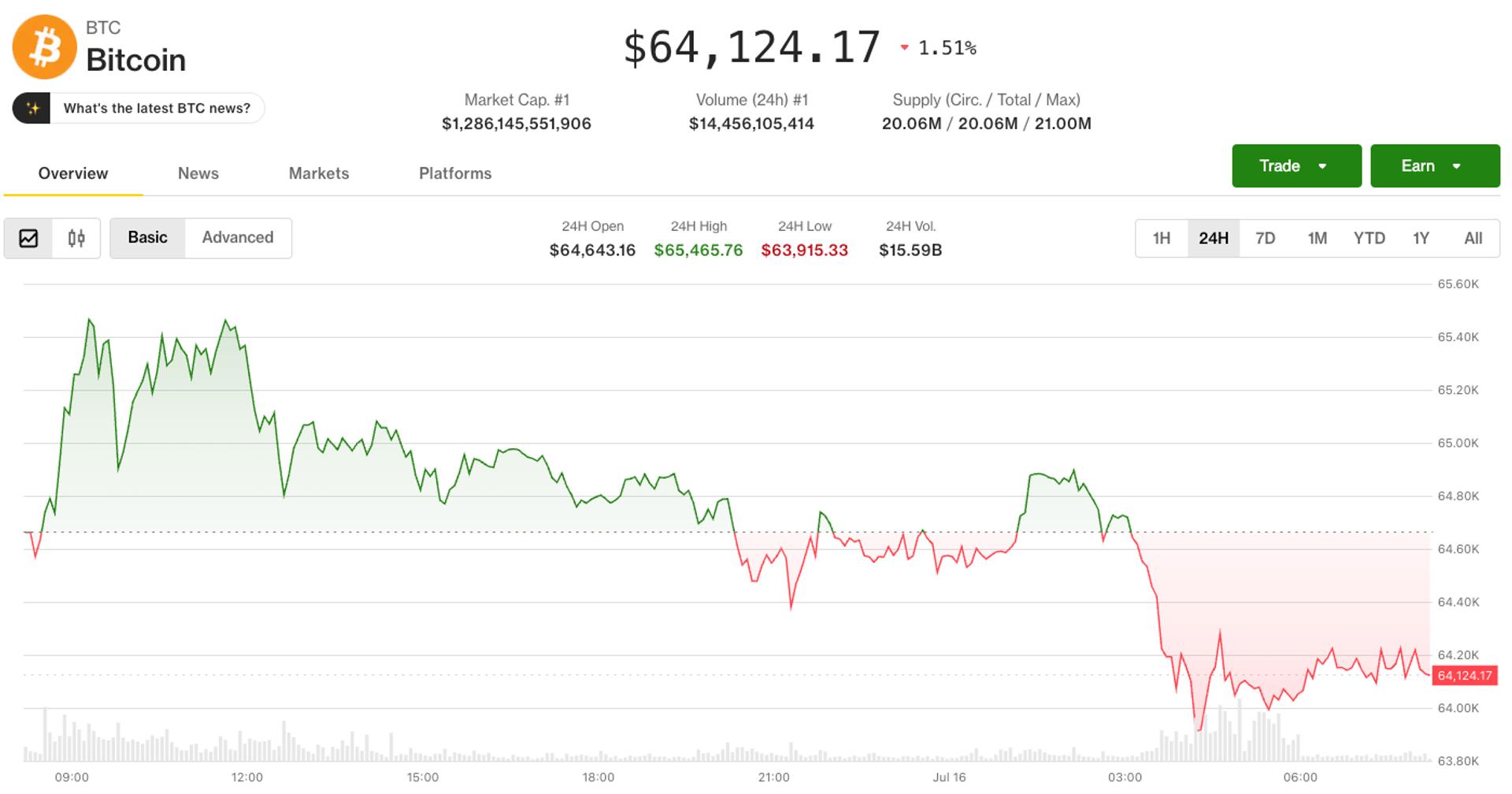
Markets are showing little reaction, bitcoin remaining at $64,100 and Nasdaq futures still lower by 0.9%.
Share this post
Here’s a quick look at what’s been going on in the largest cryptocurrencies since the U.S. market closed at 4 p.m. ET.
The CoinDesk 20 Index is trading at 17,56.14, down 1.1% (-20.25) since yesterday’s close.
UNI (+2.0%) and XLM (+1.0%) lead, while BCH (-2.9%) and AAVE (-2.2%) lag.
Three of the 20 assets are trading higher.
Share this post
Futures tied to Wall Street’s tech-heavy index, the Nasdaq, fell by 0.6% Thursday alongside a near 1% decline in bitcoin’s price.
Asian stocks declined, with South Korea’s Kospi index falling by over 6% and Japan’s Nikkei losing nearly 2%.
Korea’s central bank hiked its benchmark interest rate for the first time in over three years, warning of sticky inflation.
Later on Thursday, investors will get U.S. retail sales data and jobless claims data. These reports will likely be scanned for signs of whether the economy is deteriorating just enough to keep inflation under control or slipping into a destabilizing downturn.
Share this post
Bitcoin’s climb toward $65,000 is a macro trade, not a crypto one, according to Bitfinex analysts.
The soft June inflation print cut the odds of a July rate hike to about 12% from 42%, and the two-year Treasury yield fell 14 basis points. Bitcoin repriced higher alongside equities and other risk assets, which is the whole of the move as Bitfinex reads it.
What is missing is any sign of bitcoin demand of its own. U.S. spot ETFs sold about $425 million on July 13, the day before the print. Strategy bought nothing. The Coinbase premium, the gap between bitcoin’s price on the U.S. exchange and other venues that works as a rough proxy for American institutional demand, remains negative.
A rally on a macro catalyst with limited spot absorption and no price-agnostic buyer is “borrowed strength” the lender can call back, the analysts said, noting that a steady bid regardless of price had been present in past bitcoin uptrends.
Share this post
Bitcoin (BTC) traded just below $65,000 early Thursday after South Korea raised interest rates for the first time in over three years to combat inflation.
The Bank of Korea’s 25 basis point hike lifted its benchmark interest rate to 2.75%, matching median estimates from economists polled by Reuters. The bank said in its statement that inflation is projected to remain elevated for some time as the impact of the rise in energy prices feeds through with a time lag.”
Korea’s headline inflation jumped to 3.2%, the highest since 2023.
Following the rate hike, the Korean won firmed to 1,480 per U.S. dollar, extending an appreciation trend from about 1,560 roughly two weeks ago. Bitcoin traded largely flat against the won, with the BTC/KRW pair hovering above KRW 94.96 million on leading local exchange Upbit.
South Korea’s crypto market is widely seen as one of the most speculative in the world, driven by an active retail base that treats digital assets almost like high‑stakes day trading rather than long‑term investment.
Share this post
Crypto investigator ZachXBT criticized hardware wallets Thursday, calling them unreliable for signing transactions or storing meaningful funds.
In his view, all hardware wallet solutions present today fall short on security and usability, making them unsuitable for high-stakes operations.
He recommends using a dedicated iPhone solely as a signing device, stripped down for wallet purposes only. This approach, he said, offers better control and fewer vulnerabilities than traditional hardware wallets, though he added the tongue-in-cheek caveat: “Only do this if you are not low iq.”
The investigator singled out Ledger as the worst offender, pointing to frequent Ledger Live updates that unnecessarily overhaul the UI and apps, often breaking basic functions in the process. The post quickly sparked debate ion crypto social media, with users sharing their own experiences with hardware wallet frustrations.

- 1
- 2
- 3
- 4
- 5
- 6
- 7
- 8
- 9
- 10


CEX trading volumes rose for the first time in five months in June, with spot climbing 15.3% to $1.11T and RWA perpetual volumes surging to a record $311B.
Jul 13, 2026
CEX trading volumes rose for the first time in five months in June, with spot climbing 15.3% to $1.11T and RWA perpetual volumes surging to a record $311B.
Why it matters:
CEX trading volumes rose for the first time in five months in June, with spot climbing 15.3% to $1.11T and RWA perpetual volumes surging to a record $311B.