
liveUpdated 27 minutes ago
The U.S. lost 23,000 in July, the first such loss since February. Expectations had been for a gain of 80,000 jobs.
By Shaurya Malwa, Omkar Godbole, and Stephen Alpher|Edited by Stephen Alpher
Share this post
Fed Chair Kevin Warsh has spent much of his early tenure focused on inflation, but Friday’s weak jobs report could force the labor market back into the conversation, according to Stephen Coltman, head of macro at digital asset manager 21Shares.
“Since Warsh took over as Chair, the focus has been squarely on inflation, and the employment side of the Fed’s mandate has been barely discussed. That changes today,” said Coltman.
The weak print, following disappointing June numbers and downward revisions to earlier months, makes another rate hike harder to justify, Coltman said.
The latest numbers “undermine the position of those on the committee arguing for higher rates,” he said.
Another hike could now carry a bigger cost, Coltman added, potentially putting more pressure on “what looks like an already deteriorating labour market.”
Share this post
“A seasonal adjustment issue at the BLS likely distorted the topline number and does not reflect the underlying trend in employment,” said Joe Brusuelas, chief economist at RSM.
He noted a large decline in leisure and hospitality, likely reflecting the end of the World Cup.
This isn’t going to move the needle at the Fed, he continued, and investors and the central bank should instead be focused on next week’s inflation data.
Share this post
The U.S. labor market showed weakness for the second consecutive month in July, possibly giving the Federal Reserve room to hold rates in place despite high inflation.
According to the government’s Nonfarm Payrolls Report released Friday morning, the U.S. lost 23,000 jobs last month. That was far below the consensus expectation of a gain of 80,000 jobs, and down from June’s addition of 20,000 (revised down from an originally reported 57,000).
May’s job gains were also revised sizably lower — down to 63,000 from an originally reported 129,000.
The last negative jobs print was in February, when the U.S. lost 156,000 jobs.
The unemployment rate dipped to 4.1%, compared with the expected 4.2% and June’s 4.2%.
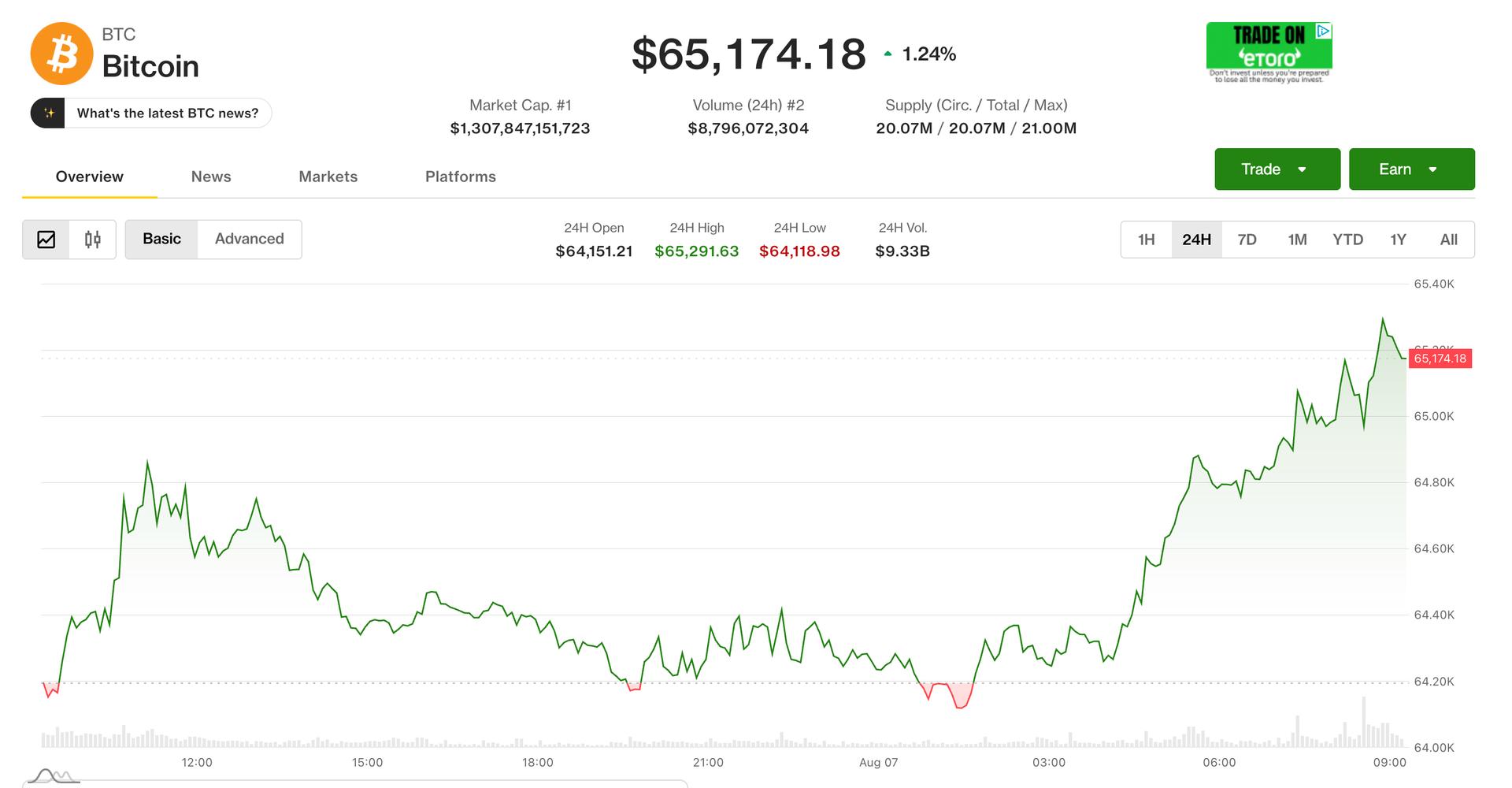
Market reaction is swift, with U.S. stock index futures gaining and interest rates dipping. Also moving higher are precious metals, with gold now up 3% for the day and silver up just shy of 6%. There’s little action in crypto, with bitcoin remaining modestly higher on the session at $65,000.
Checking other jobs report data, average hourly earnings missed forecasts as well, rising just 0.1% in July against 0.3% expected, and 0.3% in June. On a year-over-year basis, earnings rose just 3.2% verus 3.5% expected, and 3.4% in June.
Ahead of this morning’s data, markets were split on whether the Fed would hike rates at its next policy meeting in September. According to CME FedWatch, interest rate traders were pricing in a 55% chance the U.S. central bank would tighten next month. In the immediate aftermath of the print, that number has slipped back to 46%.
Share this post
Bank of America’s bull-and-bear reading just rose to its highest level since 2021, when the Covid-related helicopter drops of cash were making their way into the stock market.
“We recommend investors retreat from risk assets and/or rotate into some defensives, duration and U.S. dollar,” wrote the bank’s team, led by Michael Hartnett, as the gauge rose to 9.7 from 9.4 (the chart tops out at 10).
For crypto fans, the key difference between now and 2021 is that in 2021, crypto markets were also the beneficiaries of raging investor bullishness. At the moment, bitcoin and the others are watching from the sidelines at heavily depressed prices as markets elsewhere notch near-daily record highs.
Share this post
The upcoming U.S. jobs report is expected to show nonfarm payrolls rising by 80,000 in July, after 57,000 in June, while unemployment is forecast to remain at 4.2%. Markets currently price a 55% chance of a September Fed rate hike, which would increase the target range to 3.75%-4.00% if it occurs.
Share this post
Bitcoin miners’ transfers to exchanges often signal preparations to sell. However, NYDIG also offers custody and financing, meaning the coins may remain in custody or serve another purpose. Ten hours ago, according to Lookonchain, MARA Holdings (MARA) deposited 200 BTC ($12.86M), while Riot Platforms (RIOT) transferred another 381 BTC ($24.51M) to NYDIG.
Share this post
MetaMask announced the deployment of its Agent Wallet, which allows users to put AI agents to work on their behalf to monitor markets and execute crypto trades, swaps and other onchain transactions. Users can connect tools such as Claude Code, Codex and Cursor, set how much an agent can spend and which protocols it can use and then choose a more cautious Guard Mode or a less restrictive Beast Mode.
The wallet supports HyperLiquid and selected Ethereum-compatible networks or blockchains, and MetaMask says it adds transaction simulations, threat checks and Miner Extractable Value (MEV)-protection tools before an agent completes a trade.
Share this post
Metals momentum continues on Friday. Gold is up a further 1%, trading near $4,300 an ounce, while silver has surged above $64 an ounce, gaining more than 4% over the past 24 hours. The metals appear to be the biggest beneficiaries of the AI slowdown, which has prompted a rotation out of AI stocks and into precious metals.
Share this post
Nothing good happens when the yield on the U.S. 10-year Treasury note trades above 4.5%, Fidelity’s Director of Global Macro Jurrien Timmer said Friday.
“Long-term bond yields are on the move again, with the 10-year yield well into the danger zone at 4.73%. As I have written many times, recent history suggests that nothing good happens above 4.5%,” he noted.
The rise in yields could be driven by several factors, Timmer explained.
One possibility is a reverse “crowding out” effect: rather than heavy government borrowing squeezing out private-sector investment, insatiable demand for financing from AI companies may be diverting investor appetite away from Treasuries.
Another explanation is growing skepticism that a hawkish Federal Reserve will back its rhetoric with meaningful action. Alternatively, the move may reflect the consequences of a less transparent Fed, as reduced clarity tends to increase uncertainty and push up risk premia.
“Less transparency means more uncertainty, and more uncertainty usually means high risk premia. Either way, we have a bear steepening on our hands,” he noted.
Hardening bond yields often create a headwind for stocks and emerging technologies such as cryptocurrencies.
Share this post
SK Hynix will invest 54 trillion won, about $38 billion, to expand its chipmaking facilities in South Korea, the company said Friday. It is building new fabs in Yongin and Cheongju to meet what it called the continuously growing demand for memory in the AI era.
The spend is one of the largest single commitments yet from the memory maker, whose stock has been among the most volatile of the AI trade this year, swinging the Kospi through sharp selloffs and a record US listing.
For crypto, it reads as another sign the AI infrastructure spending that bitcoin has loosely tracked is still climbing.
Share this post
Bitcoin traded near $64,350 on Friday, unchanged on the week, as the whole market drifted ahead of the US payrolls report, per CoinDesk data. Ether held at $1,903 and the rest of the majors sat within a point or two, a market waiting on the data rather than moving on anything of its own.
The setup turned slightly less friendly overnight. Brent rose 1.4% to $83.61 after reports Iran will try to restrict US and Israeli ships through the Strait of Hormuz and demand compensation from countries it deems hostile before letting them pass, stalling the deal that had been pulling oil lower. Higher crude revives the inflation worry that keeps the Fed leaning tight, and the 10-year Treasury yield climbed seven basis points on it during the US session.
That macro chain is the one bitcoin has been stuck inside all summer. Oil up feeds inflation, inflation keeps yields and the dollar firm, and firmer financial conditions cap risk assets. The dollar just posted its best day in two weeks, which is the opposite of the easing setup bulls want.
Today’s jobs number is the release that matters. A soft print revives the case for the Fed to loosen and gives bitcoin room above its range. A strong one, stacked on climbing oil, hands the hawks another reason to hold, and the range that has held since May holds again. Watch the reaction in yields, not just the headline number.

- 1
- 2
- 3
- 4
- 5
- 6
- 7
- 8
- 9
- 10


Zcash’s Tachyon upgrade aims to scale shielded payments, improve quantum readiness, and test whether its funding, security, and governance can hold.
Jun 30, 2026
Zcash’s Tachyon upgrade aims to scale shielded payments, improve quantum readiness, and test whether its funding, security, and governance can hold.
Why it matters:
Zcash’s Tachyon upgrade aims to scale shielded payments, improve quantum readiness, and test whether its funding, security, and governance can hold.