
liveUpdated just now
The third-quarter U.S. earnings season is kicking off today, with results from Goldman Sachs, JPMorgan, and UnitedHealthcare, among others. The key September CPI report comes tomorrow.
By Shaurya Malwa, Stephen Alpher, James Van Straten, and Helene Braun|Edited by Stephen Alpher
Share this post
Strategy’s MSTR$153.33 perpetual preferred stock, STRC, reached $99.90 on Monday before easing to $99.83 on Tuesday. Monday’s peak marked its highest level since May 14, when it last traded at its $100 par value, before subsequently falling as low as $71, a rise of 40% from the June low.
Strategy has spent approximately $1.65 billion repurchasing STRC through Oct. 11.The company has $354.8 million remaining under its preferred-stock repurchase programme.
Share this post
“You’ve got it completely, perfectly bifurcated in the sense that you have everything that’s adopting AI and everything that’s not, and they’re going in opposite directions,” the billionaire hedge funder told CNBC on Tuesday morning. “That was pretty much the case in 1999.”
“For me it’s just so clear that we’re on this path that could be great short term but may not be so great long term,” he added, noting that so few today were actually around in 1999 to see what a true bubble was like.
“2027 is going to be really, really challenging for the stock market,” Jones concluded. “I’ll be short the whole year.”
Share this post
JPMorgan Chase CEO Jamie Dimon warned Tuesday that AI agents pose risks to customers and banks, including misuse and questions over who bears liability when things go wrong.
“We’re not going to allow just any outside agent to come in inside the company because that’s just too risky for clients and for JPMorgan,” Dimon said during the bank’s third-quarter earnings call.
He said JPMorgan plans to build tools to protect customers from those risks.
The comments came as JPMorgan reported revenue of $50.9 billion, up 8% year over year, and net income of $15.3 billion, up 6%.
Share this post
Metaplanet (335) plans to issue zero-coupon, unsecured yen-denominated convertible bonds due in 2031, generating approximately $328.5 million in net proceeds. Around $149.4 million will repay bitcoin-backed borrowings, while up to $179.1 million will fund share buybacks between October and December 2026.
The company held 44,000 BTC at September’s end and had $649.5 million in bitcoin-backed borrowings, equivalent to 17.7% of its bitcoin net asset value, exceeding its 10% guideline.
The financing will replace some interest-bearing, bitcoin-backed debt with unsecured funding carrying no regular interest payments. This should release bitcoin collateral and reduce the risk of forced sales if prices fall further. It improves the debt structure without immediately reducing total liabilities or overall leverage. Conversion into shares could dilute existing shareholders, while unconverted bonds would require repayment at maturity.
Share this post
“The recent supply-chain hack on [Ledger] confirmed what we have always known,” wrote Trezor COO Danny Sanders, minutes ago. “A hardware wallet is only as safe as the path it travels to reach its owner.”
“We have made the difficult decision to make our reseller network much smaller, small enough that we can vet and check every partner that remains.”
Sanders added that “there is not a single piece of evidence that Trezeor devices have been compromised.”
Those resellers notified will be removed from the authorized list as of January 1, 2027.
Share this post
“Our data shows that our consumer and business customers are doing well,” said Wells Fargo (WFC) CEO Charlie Scharf, as his company released its third-quarter earnings results.
“Consumers are spending more, loan delinquencies are low, and deposit and investment balances have grown,” he continued.
“Businesses continue to have strong balance sheets and losses remain low. While higher interest rates, higher oil prices and persistent inflation create risks to the economy, strong positive forces such as the investment in AI infrastructure, high employment levels and consistent wage growth continue to outweigh the risks.”
WFC is modestly lower in pre-market trading after EPS topped estimates, but revenue fell short.
Share this post
Formerly a bitcoin miner, but now in the data center business, Cipher Digital CIFR$11.15 is selling $850 million of 2032 convertible debt, with a 0% coupon.
Shares are lower by 13% in pre-market trading.
Share this post
Led by Matt Cole, Strive ASST$27.56 added a whopping 3,311 bitcoin last week, bringing holdings to 32,773 coins.
The funds for the purchase — roughly $275 million — came from sales of the company’s preferred stock SATA as well as cash coming in from the exercise of warrants (for the common stock).
ASST has sold off nearly 10% in recent days, in part due to those warrant exercises. Shares are flat in pre-market trading on Tuesday.
Share this post
“I transferred the stock that was sitting in DTCC, and now it’s sitting on some blockchain, whatever it is, doesn’t really matter,” said longtime crypto veteran Arthur Hayes.
“How much money can you actually make doing that.”
Better bookkeeping? Wonderful, said Hayes, “but where are you actually going to make money in tokenization … I think that has been the issue with this narrative for a long time.”
Not averse to participating in a bull run, though, Hayes concluded, “if the standard bearer of contrarian thinking for Wall Street Muppets says it’s time to buy some tokens, then you buy the fucking tokens.”
Share this post
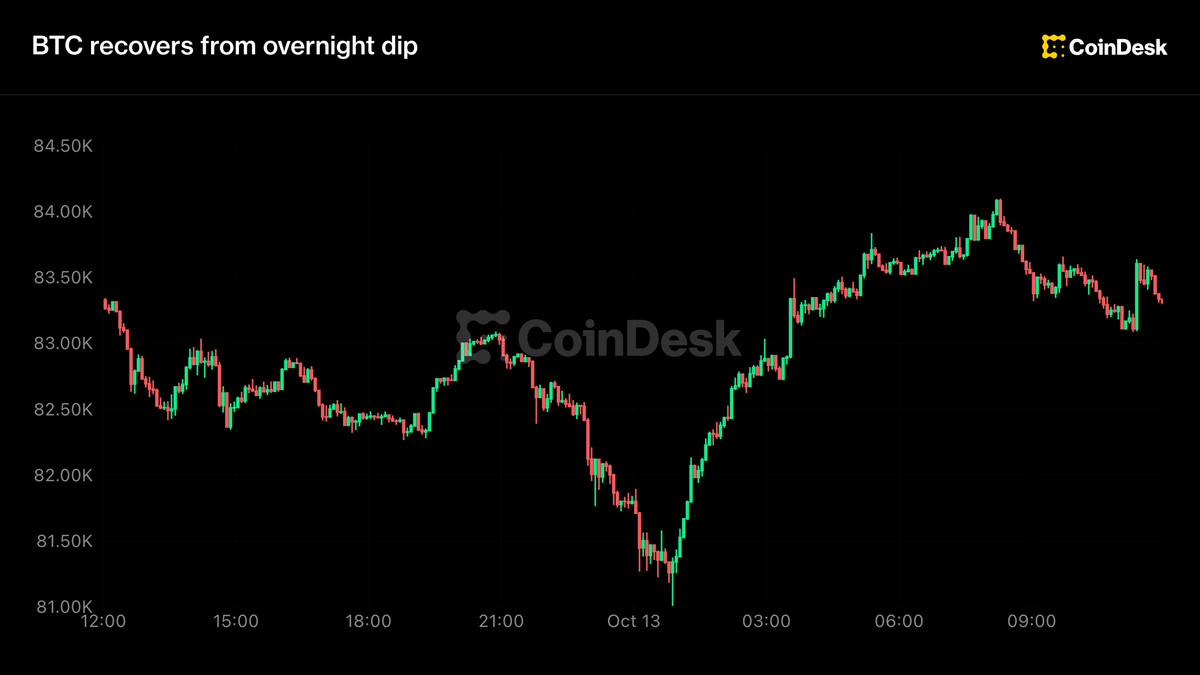
A burst of stop-loss selling knocked bitcoin to $81,000 early Tuesday, dragging it back to its 50-day moving average before buyers lifted it to about $83,700.
Stop-loss orders are automatic sell instructions traders set to cap their losses, and a cluster of them firing at once can push the price down quickly. The 50-day moving average, bitcoin’s average closing price over the past 50 days, is a level traders watch for the medium-term trend. Buyers defended it on Tuesday, as they did on Thursday when bitcoin bottomed near $80,400.
The rebound shows “just how easily it can rise after long positions have been liquidated,” said Alex Kuptsikevich, chief market analyst at FxPro.
Kuptsikevich said bitcoin could move quickly to $85,000 and retest $87,000, the top of the range it traded in last week, if Tuesday’s drop proves to be a healthy correction. He added that the speed of the reversal may point to a broader return of appetite for risk, though he wants to see that confirmed in other markets.
Share this post
Bitcoin swung through a $3,000 range over the past 24 hours. It fell to about $81,000 in early Asian trading, then ripped back above $84,000 and traded near $83,500 early Tuesday.
Altcoins didn’t bounce back as hard. ZEC was the laggard, down nearly 8% to about $1,210, and HYPE fell nearly 6% to about $82. SOL and DOGE each dropped 4%, and XRP lost about 3% to $1.36. Ether and BNB slipped between 1% and 2%, according to CoinDesk data.
The Crypto Fear & Greed Index, which tracks market sentiment, fell to 57. That’s still in “greed” territory, but it’s the lowest reading since Sept. 18.
The selloff in chipmakers ran for another day. Nasdaq 100 futures fell 0.5%, and an exchange-traded fund tracking chip stocks headed for a sixth straight daily loss as traders questioned whether the pace of AI spending can last amid safety concerns and signs of funding strain. JPMorgan dropped more than 2% in early trading after its results opened the U.S. earnings season. Europe’s Stoxx 600 rose 0.4%, helped by falling oil prices and bond yields.
U.S. inflation data on Thursday is the next big test for both markets.

- 1
- 2
- 3
- 4
- 5
- 6
- 7
- 8
- 9
- 10


Sep 24, 2026
Why it matters:
Diversified RWA stablecoins sustain 5-7% yield from real credit as crypto funding compresses to ~4%. GENIUS pushes yield off-chain; TAM grows to $4B in 3 years.

