
liveUpdated 6 minutes ago
Bond yields and Fed rate hike expectations are jumping higher after the September CPI report was hotter than expected at both the headline and core levels.
By Shaurya Malwa and Stephen Alpher|Edited by Stephen Alpher
Share this post
Following weak employment data and a string of dovish comments from Fed speakers over the past two weeks, markets had more or less written off the chance of a rate hike when the central bank next meets on October 27/28.
But after this morning’s inflation data — particularly at the core level, where CPI rose 0.3% versus 0.2% expected, and 2.6% year-over-year versus 2.5% expected — traders are pricing in a 44% chance the Fed hikes in two weeks, per CME FedWatch.
The odds of two rate hikes by year-end have soared to 44% from just 13% one week ago.
Share this post
U.S. inflation sped up more than expected in September, perhaps putting multiple Federal Reserve rate hikes back into play.
The September Consumer Price Index rose 0.6%, according to a Wednesday morning report from the Bureau of Labor Statistics. That’s up from 0.4% in August, and in line with economist forecasts for 0.6%.
On a year-over-year basis, however, CPI rose 3.7% versus 3.4% in August and above estimates for 3.6%.
Core CPI — which strips out food and energy costs — also disappointed, rising 0.3% in September. That was the same pace as August, but above consensus forecasts for 0.2%.
Year-over-year core CPI was higher by 2.6% versus 2.4% the previous month and above estimates for 2.5%.
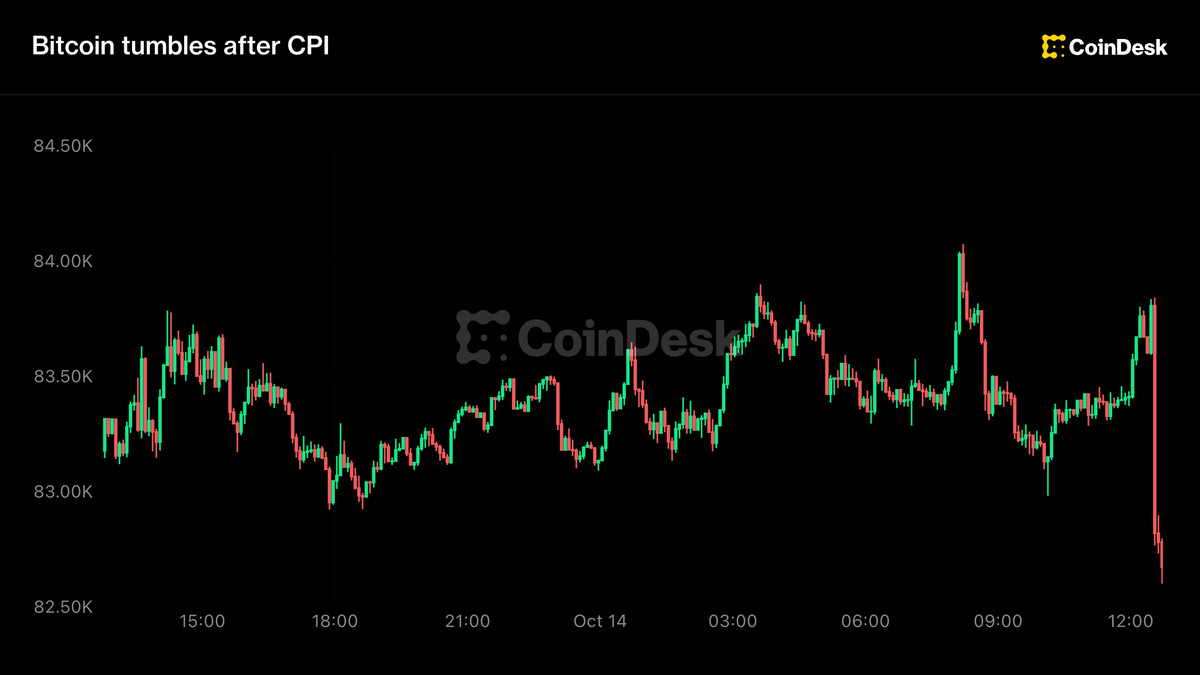
Bitcoin BTC$83,212.45 dropped $1,000 on the news, now trading at $82,800.
The bond market is getting crushed, the 10-year U.S. Treasury yield jumping 9.3 basis points to 5.308%, and the 2-year yield soaring 13.1 basis points to 4.924%.
Nasdaq 100 futures are lower by 0.65% and S&P 500 futures by 0.3%. Gold has slumped 1.5% to $4,116 per ounce.
Ahead of the data, a string of Fed speakers had hinted that the central bank was likely to raise interest rates another 25 basis points before year-end. Market pricing reflected that information, with most expecting the central bank to pause at its upcoming meeting later this month, but hike at its final meeting of the year in early December.
This morning’s numbers just might put an October rate hike back on the table.
Share this post
Strive ASST has added another 2,822 bitcoin for $235 million (an average of $83,266 each) in the early days of this week, bringing total holdings to 35,595 coins.
This morning’s announcement comes just 48 hours after the company disclosed the purchase of more than 3,000 BTC last week.
Funds for this latest buy came from the exercise of PIPE-related warrants, which raised $369.2 million. There are no further warrants left to exercise, said the company in an SEC filing.
Read more: Strive raising $500 million to buy additional bitcoin with new preferred share class
Share this post
Treasuries extended their rebound on Wednesday ahead of the September U.S. inflation report, pulling the 10-year yield down one basis point to 5.20%. That’s down from about 5.32% last week, when it hovered near its highest since 2002.
Forecasts point to the report showing underlying prices, which strip out volatile food and energy costs, rising more slowly than in August. A softer reading would ease pressure on the Federal Reserve to keep raising rates, and bitcoin has been held back by those rate fears all month.
Share this post
Bitcoin sat near $83,200 on Wednesday, 34% below the record above $126,000 it set a year ago. Traders were holding back ahead of U.S. inflation data, and chip stocks looked set for a sixth day of losses.
A lasting recovery “will require genuine buying demand, not just short covering,” said Javier Molina, a market analyst at eToro. Short covering is when traders who bet on a decline buy back to close their positions. It can lift prices fast, but it fades once those bets are closed.
Molina said spot bitcoin ETFs have opened the asset to big investors but haven’t shielded it from interest rates, the dollar or liquidity.
Share this post
A brief spike to $84,000 early Wednesday faded within the hour, leaving bitcoin down 0.5% at about $83,200. It’s still boxed between its 50-day moving average near $81,000 and a ceiling at $84,000.
The 50-day moving average is bitcoin’s average closing price over the past 50 days, and traders watch it for the medium-term trend. Buyers defended it on Tuesday, when bitcoin bottomed near $81,000, but they haven’t managed to push the price through $84,000 since.
ZEC and TRX were the only gainers among the majors, up about 1%. HYPE was the laggard, down 2% to about $81. SOL fell 1.4% and ether slipped 1% to just under $2,500, according to CoinDesk data.
Bitcoin trades close to the Nasdaq 100 in how institutions rank risk, and “the latter’s caution is preventing Bitcoin from spreading its wings,” said Alex Kuptsikevich, chief market analyst at FxPro.
Nasdaq 100 futures were little changed, and an ETF tracking chipmakers pointed to another day of selling even after ASML rose more than 2% in Europe. The chip-equipment maker said it can’t fully meet demand for the next two years. Bank of America and Morgan Stanley report later Wednesday, and forecasts point to the September U.S. inflation report showing a slowdown in underlying prices.
A daily close above $84,000 would be the first sign that buyers have broken out of the range.

- 1
- 2
- 3
- 4
- 5
- 6
- 7
- 8
- 9
- 10


Sep 24, 2026
Why it matters:
Diversified RWA stablecoins sustain 5-7% yield from real credit as crypto funding compresses to ~4%. GENIUS pushes yield off-chain; TAM grows to $4B in 3 years.