
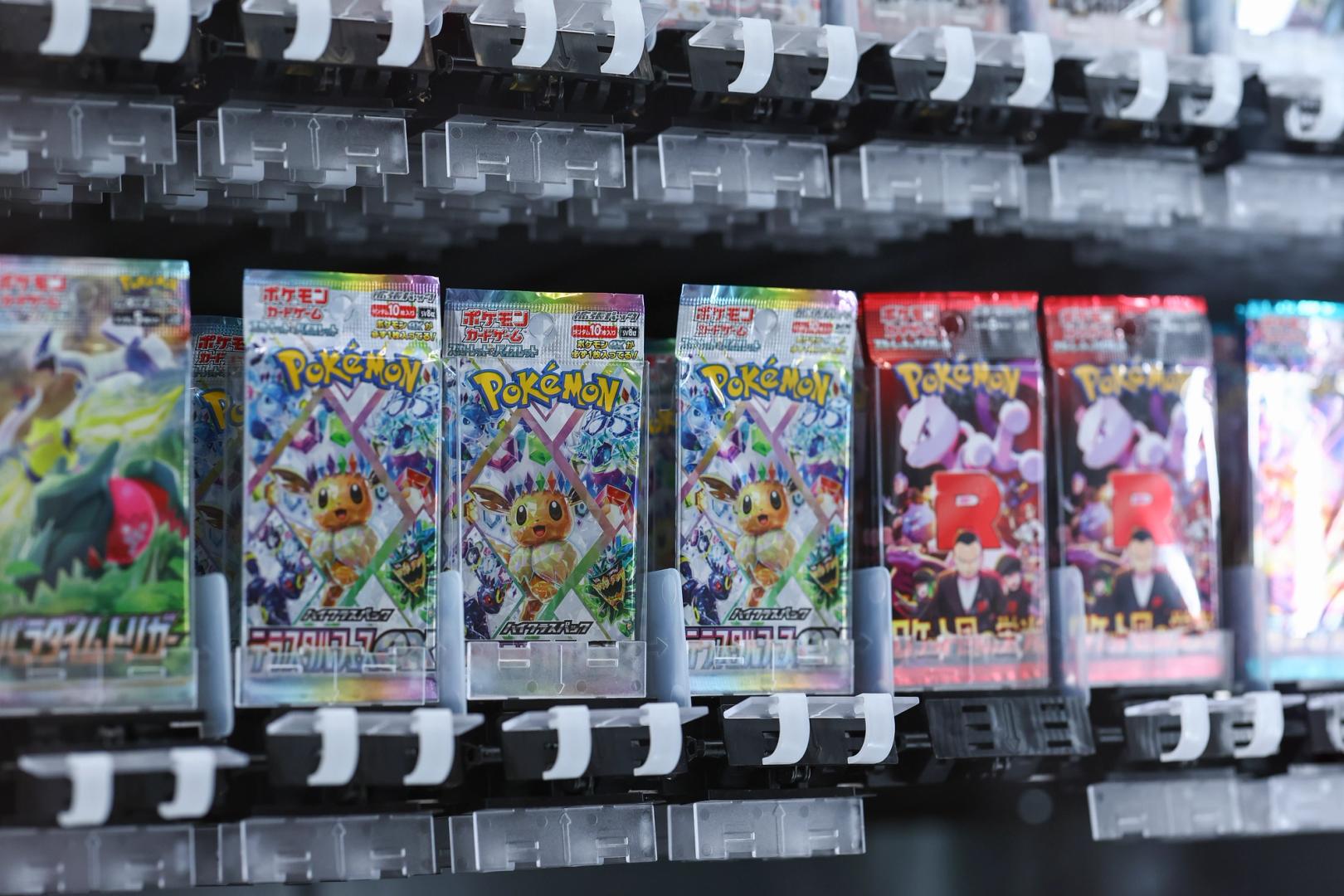
Collectors are spending millions on trading cards, while blockchain startups are turning physical Pokémon cards into digital assets. The harder task is creating enough liquidity to compete with established marketplaces.
By Aoyon Ashraf|Edited by Cheyenne Ligon
Updated Published
Share this article

Summary
It’s 3:30 a.m. on a cool April morning, and hundreds of people are already lined up outside a Costco in British Columbia, some sitting in folding chairs, hours before the store opens.
The buyers aren’t here for a bulk deal on toilet paper or groceries. They’re waiting to be the first to get their hands on boxes of Pokémon cards, specifically the “Prismatic Evolutions” cards, selling around C$100 each. On secondary marketplaces such as Facebook Marketplace, the cards often get listed for several times their retail price.
And just recently, popular influencer Logan Paul sold a rare Pokémon card, a Pikachu Illustrator, for $16.5 million dollars, reportedly earning him more than $8 million in profit. The buyer? AJ Scaramucci, founder of venture capital firm Solari Capital and son of financier Anthony Scaramucci.
In addition to Costco, other big-box retailers are seeing the Pokémon card frenzy show up in their businesses. Target said that sales of its trading cards were up nearly 70% last year, driven largely by Pokémon, and that it plans to expand store space dedicated to trading cards as part of its growth strategy. Walmart also reported its online marketplace saw 200% jump in trading card sales last year. Both retailers have had to impose purchase limits on trading cards to curb scalping. Meanwhile, eBay, the largest marketplace for these cards, saw $2.62 billion in sales in 2025.
In fact, both the S&P 500 (up about 13%) and bitcoin (down 29%) underperformed this year compared with the value of Pokémon cards (rose 28%).

The hype is part of a broader transformation of trading cards from hobby-store collectibles into a multibillion-dollar market that increasingly resembles an alternative asset class.
Exactly how large this market is hard to pin down, because it has developed through dense, decentralized dealer networks, local card shops and conventions. So the market size varies by methodology and firm, but the rough estimates put the value around $10-$15 billion today. For example, Kovoy VC, which invests in gaming platforms and tech, pegged the value at around $13 billion in 2024, and Mordor Intelligence puts it at around $15 billion in 2026. Meanwhile, TCGCharts estimates that the market cap of every “graded” card is around $10.8 billion today.
But there’s a big problem: the trading card business is booming, but the infrastructure required to trade them quickly and efficiently hasn’t kept pace with the explosion of popularity.
Collectors are still stuck with a 1990s-style slow, arduous process of waiting weeks or months for their cards to be graded for value, listing them on inefficient marketplaces with high fees, and then having to ship them by snail mail to reach buyers. For the new generation of investors, who are used to transacting financial assets within a fraction of a second, the process seems antiquated.
A new class of platforms is betting that blockchain technology can replace some of those old ways by storing the physical card in a secure vault while enabling faster, digital ownership transfers.
One of such products is Deadstock, the first platform from startup ATH Labs. The firm, based in Abu Dhabi and co-founded by Dominic Jang, a longtime Pokémon card collector and traditional finance veteran, runs a closed beta of its platform on the Arbitrum blockchain, featuring high-value, professionally graded Pokémon cards. Bullish Capital, CoinDesk’s parent company’s venture arm, has invested in the company.
ATH is betting that the next stage of growth in the collectibles market will depend less on creating more cards than on making existing ones easier to trade, finance and use as collateral.
“There has never been a central registry or clearing house for this market,” ATH argued in a recent research report. That fragmentation, the firm said, creates an opportunity for blockchain-based ownership and settlement infrastructure.
The company is aiming to do so by placing physical cards, primarily ‘PSA-10s’ (cards receiving the highest grade awarded by Professional Sports Authenticator), in a secure, professionally managed vault. Each physical card would then be matched one-to-one with a digital token representing ownership. The token could change hands while the underlying card remains in storage, only moving when an owner chooses to redeem it for physical delivery.
The process is similar to putting physical assets, such as gold, Treasury bills, stocks and private credit, onto the blockchain. This process, called tokenization, has become one of the biggest topics in blockchain technology recently, as proponents say it reduces costs, makes settlement more efficient and enables around-the-clock trading of assets.
That model, for trading cards, appears to be attracting user activity.
Courtyard, one of the best-known platforms in the trading card space, offers digital packs whose contents correspond to physical collectibles held in a vault. It currently processes roughly $139 million of volume over 30 days and is running at an annualized fee of about $48 million, according to DeFiLlama data.

There are other blockchain platforms tokenizing trading cards, including Collector-Crypto ($148.2 million in annualized fees and $77.8 million in 30-day volume) and Phygitals ($15.2 million in annualized fees and $7.4 million in 30-day volume).
The growth of Courtyard and other platforms provides early evidence of demand to trade vaulted physical collectibles on crypto rails.
“For years, we tried to make RWAs work. we got stuff like tokenized credit facilities for shoddy motorcycle loans in east africa. turns out people just wanted tokenized psa 10 first edition shadowless charizards,” said VC firm Paradigm’s general partner, who goes by “Frankie,” in an X post.
However, their volumes remain small compared to the incumbent marketplaces that dominate card trading. The composition of these activities also warrants some caution, according to House of Chimera, a crypto research firm. The firm found that much of the volume comes from gamified pack openings and instant buybacks rather than collectors simply buying and selling individual cards with one another.
Additionally, Asia-based MemeStrategy has also entered the market, claiming to have launched the “world’s first” tokenized Pokémon trading card fund, designed to offer professional investors access to PSA-10-graded “Pikachu with Grey Felt Hat” trading cards available on the market.
ATH is trying to differentiate itself by focusing on a different part of the market: access to supply. “We aren’t just tokenizing a card, we are tokenizing a lot of cards,” said Jang.
House of Chimera found that many tokenized-card platforms rely on the same grading and storage providers, making the underlying infrastructure relatively similar across competitors. The research firm said a more meaningful advantage may be having enough capital and inventory to support buybacks and liquidity.
To secure the supply of these highly graded cards, ATH has partnered with Japan Trading Card Center (JTCC), which operates a large Japanese online marketplace for mystery card packs. The company said the agreement grants Deadstock “exclusive” access to tokenizing JTCC’s inventory and sourcing network. ATH’s Jang said JTCC’s scale gives ATH access to a continuously replenished pool of cards that would be difficult for a new Western platform to replicate.
“They are single-handedly the largest buying stream in Asia,” he said.
JTCC reportedly booked about $2.4 billion yen in profit for the period from Dec. 2024 to Nov. 2025 and had total assets of 6.9 billion yen, according to publicly available documentation.
According to ATH, having access to an ample supply of cards is important because tokenized or digital cards must be backed by a physical card. ATH’s pitch is that access to Japan’s dense ecosystem of specialist card stores allows it to source inventory closer to the source, rather than competing for cards that have already passed through several layers of dealers in Western markets.
“Access to JTCC’s supply, one of the world’s largest liquidity streams in the trading card space, gives Deadstock an unfair advantage most platforms can never reach: deep, continuously replenished real-world inventory at scale,” said Jang.
However, there is an important caveat to this model: liquidity.
eBay remains the industry’s dominant source of price discovery and liquidity in the trading card sector. More than $2.62 billion worth of individual trading cards changed hands on the marketplace in 2025, according to GemRate data, including about $837 million of trading-card-game and non-sports cards. The tally doesn’t include sealed boxes, packs, sets or lots, meaning the broader card business conducted on eBay is even larger.
Liquidity begets liquidity. A seller is naturally drawn to the venue with the largest number of potential buyers, while buyers benefit from a deep history of completed sales that can help establish a particular card’s actual value. That network effect gives eBay an advantage that newer tokenized marketplaces have yet to replicate.
And that creates a chicken-and-egg problem for platforms such as Deadstock.
Transferring ownership on a blockchain may allow a trade to settle almost immediately, but it doesn’t guarantee that someone will be on the other side of the transaction. A tokenized card trading among a small number of users could be less liquid — and harder to price — than the same card listed on an established marketplace.
That is particularly important in collectibles, where seemingly minor differences can produce large price differences. Two copies of the same Pokémon card may receive different grades based on condition; even cards with the same grade can command different prices depending on centering, provenance or other characteristics prized by collectors. Rare cards may trade infrequently, leaving only a handful of recent transactions from which to determine fair value.
However, ATH argues that traditional marketplaces carry their own issues. A physical card may have to be shipped repeatedly, sellers incur marketplace fees, and buyers have to assess whether an item is authentic and accurately described.
On Deadstock, ATH says, a card would be authenticated before entering the system and remain in custody while ownership changes hands. The company says that it would likely be attractive for collectors.
“They will get what they bought right away,” said Jang.
Additionally, with any speculative assets comes the risk of market cycles. Prices can be driven as much by nostalgia, scarcity and online attention as by anything resembling the cash flows investors use to value stocks or bonds. A record-setting Pikachu sale may demonstrate enormous demand at the very top of the market, but it doesn’t guarantee that a buyer will find someone willing to pay a higher price later.
ATH is betting that those risks won’t deter collectors from seeking a faster, more secure way to trade. The company said that its ultimate goal is to make the blockchain largely invisible to users. A collector would buy a card, hold it, sell it or redeem it without having to think about the underlying settlement technology.
Ultimately, the test will be less about whether a Pokémon card can be represented by a token. That part is already possible.
The harder question is whether enough collectors will choose to trade that token rather than list the card on eBay, take it to a convention, or simply keep it in a binder.

- 1
- 2
- 3
- 4
- 5
- 6
- 7
- 8
- 9
- 10


Zcash’s Tachyon upgrade aims to scale shielded payments, improve quantum readiness, and test whether its funding, security, and governance can hold.
Jun 30, 2026
Zcash’s Tachyon upgrade aims to scale shielded payments, improve quantum readiness, and test whether its funding, security, and governance can hold.
Why it matters:
Zcash’s Tachyon upgrade aims to scale shielded payments, improve quantum readiness, and test whether its funding, security, and governance can hold.