
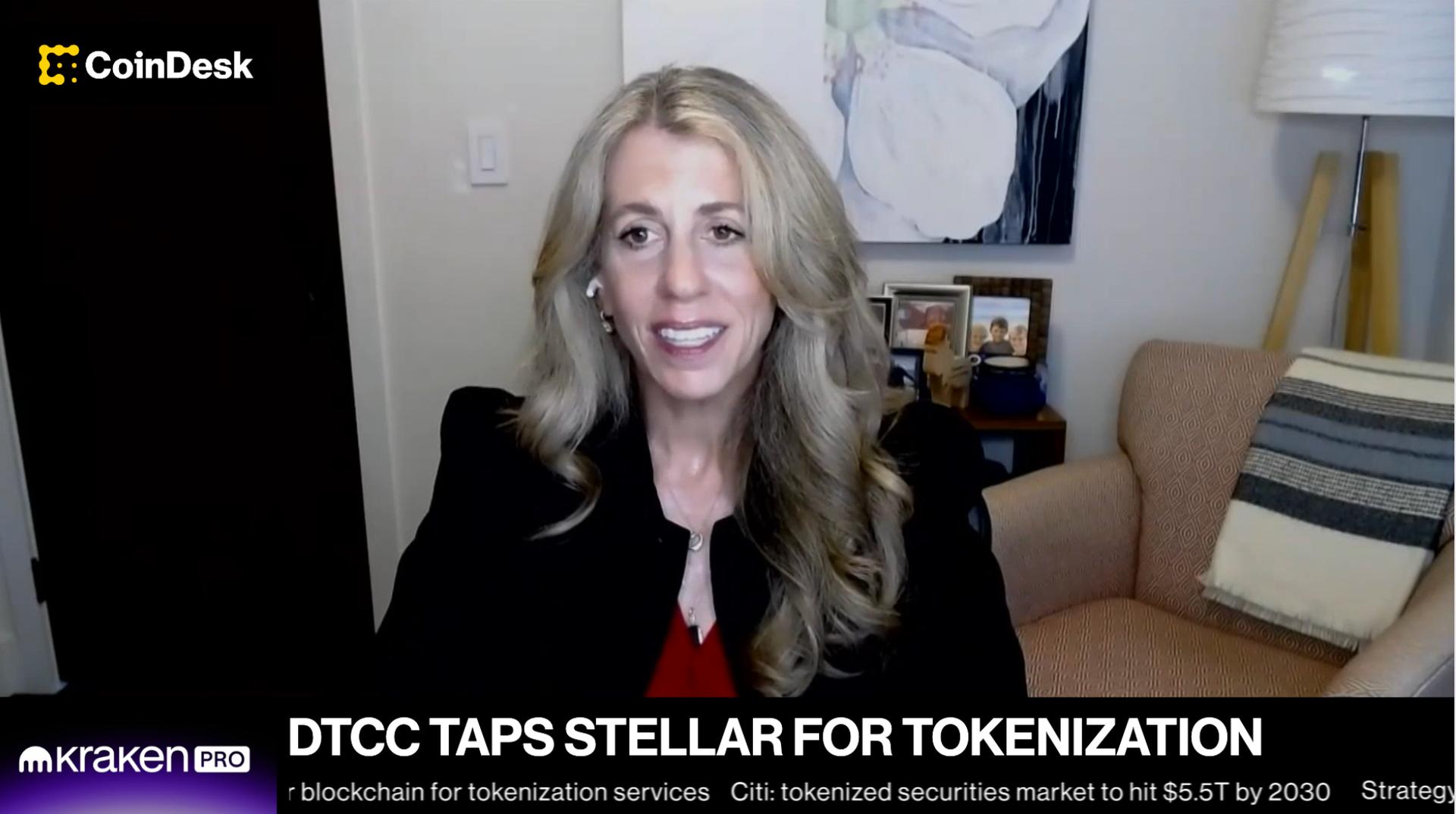
Stellar CEO says Clarity Act would help, but tokenization isn’t dependent on It
Share this article
DTCC’s decision to connect its tokenized securities platform to Stellar marks a new phase of institutional adoption for public blockchains.
By AI Boost|Edited by Jennifer Sanasie
Jun 2, 2026, 12:35 p.m. 2 min read

Latest developments: Stellar Development Foundation CEO Denelle Dixon joined CoinDesk’s Public Keys and said DTCC’s selection of Stellar validates years of infrastructure built for institutional use.
- DTCC recently chose Stellar as the first public blockchain connected to its upcoming tokenized securities settlement platform, Dixon said.
- Stellar surpassed $1 billion in tokenized real-world assets in December and has since grown to roughly $3 billion in about five months, according to Dixon.
- Dixon described the partnership as “the moment Stellar was built for” after more than a decade of focusing on compliance and institutional requirements.
What this means: Regulatory progress is helping institutions move from experimentation to deployment.
- Dixon said the GENIUS Act gave financial institutions confidence that the U.S. government intends to support the industry through a clearer regulatory framework.
- She noted that firms such as Franklin Templeton were already building tokenized products before recent legislation, citing the firm’s money market fund on Stellar.
- While she said passage of the Clarity Act would benefit the industry, Dixon argued that tokenization adoption is unlikely to be derailed if the bill stalls.
Closer look: Stellar is positioning its technology stack around compliance, privacy and scalability for large financial institutions.
- Dixon said Stellar has maintained 99.99.99% uptime and processes billions of transactions each quarter.
- She emphasized that compliance tools were built into the network’s architecture, reducing the need for custom smart contracts to issue assets.
- Stellar is also developing privacy features using a composable model that allows institutions to tailor controls to specific assets and use cases.
Reading between the lines: Massive transaction volumes remain a key test for blockchain-based financial infrastructure.
- DTCC processed $4.7 quadrillion in securities transactions last year, highlighting the scale traditional market infrastructure already supports.
- Dixon acknowledged that tokenized settlement volumes will ramp up gradually rather than reaching peak scale immediately.
- She said maintaining reliability and avoiding network outages are critical requirements for institutional adoption.
Broader view: Dixon expects tokenized assets to be distributed across multiple public blockchains rather than concentrated on a single network.
- She rejected the idea that one blockchain will dominate all institutional tokenization activity.
- Instead, Dixon said a handful of networks will likely capture most real-world asset issuance based on their technical strengths.
- She argued that open public blockchains will ultimately outperform closed alternatives because they evolve rapidly through global developer participation.
AI Disclaimer: Parts of this article were generated with the assistance from AI tools and reviewed by our editorial team to ensure accuracy and adherence to our standards. For more information, see CoinDesk’s full AI Policy.
More For You
By AI Boost|Edited by Jennifer Sanasie
42 minutes ago

Recent Bitcoin ETF outflows look dramatic in headlines, but Bloomberg Intelligence’s Eric Balchunas says the broader adoption story remains intact.


Top Stories


