
The VIX of bonds is rising but bitcoin and stocks aren’t hearing it yet : Crypto Daily
By Omkar Godbole|Edited by Jamie Crawley
Share this article

Summary
Are bitcoin BTC$86,320.95 and U.S. stocks truly calm and poised for more gains, or is this the calm before the storm? That is the question some macro observers are asking.
They point to rising volatility in Treasury notes, which underpin global finance, as an early sign of stress that usually spills over into other markets with a lag.
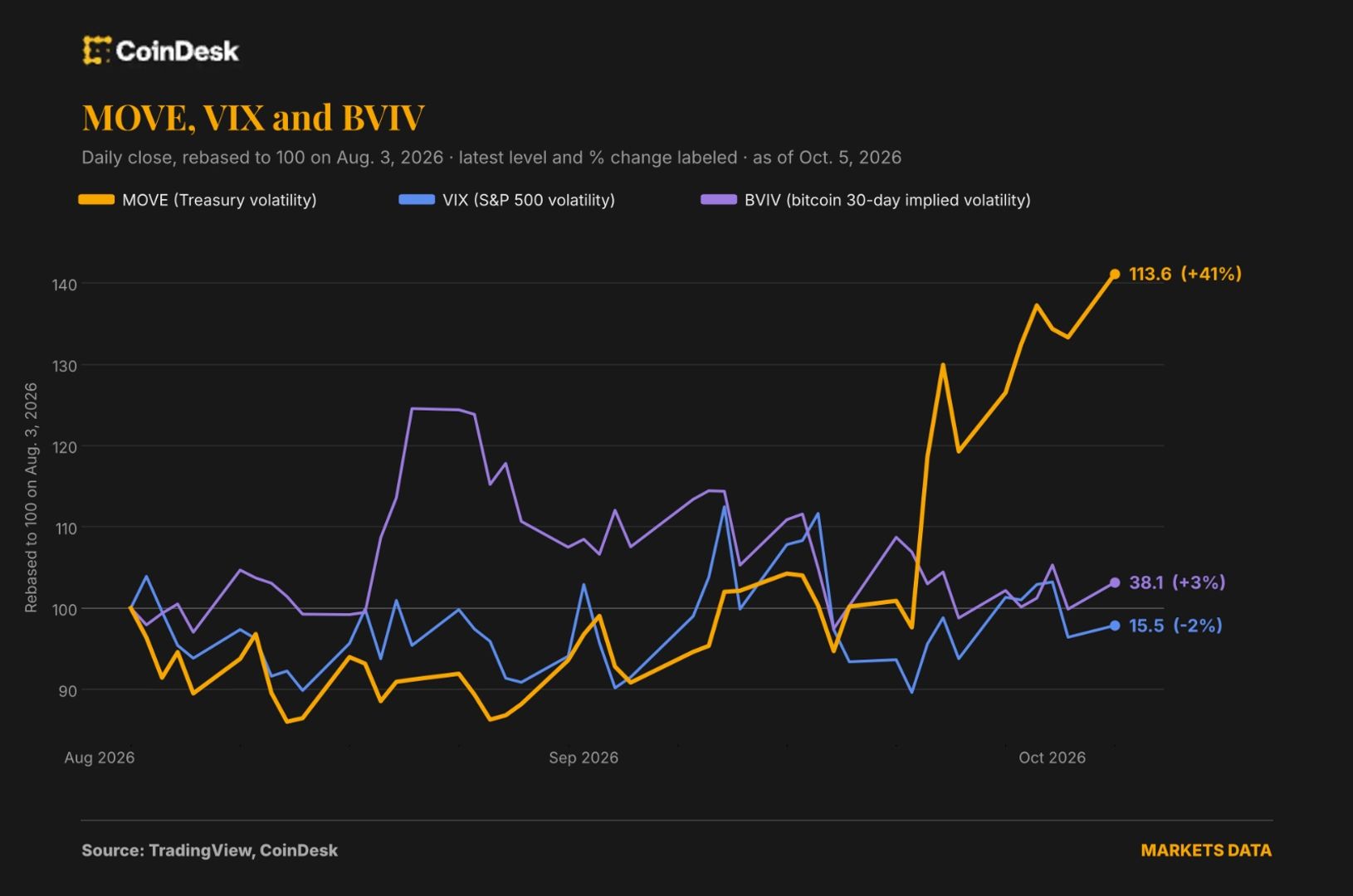
“The MOVE index is making higher lows while the VIX makes lower highs. The MOVE leads: it flashed turbulence before the VIX in 2022, in 2023, and at the start of the Iran war. Stocks are usually the last to get the message,” Kurt S. Altrichter, wealth manager and writer of the RiskSIGNAL Report, said.
The MOVE Index, officially the ICE BofA U.S. Bond Market Option Volatility Estimate, is the bond market’s version of the VIX. It gauges how much U.S. Treasury yields are expected to swing over the next month, using options on 2-, 5-, 10- and 30-year bonds, with the 10-year given the heaviest weight. In plain terms, it tells us how much movement traders are pricing into Treasury yields over the next month, without saying whether yields will go up or down.
Because Treasury notes are preferred collateral in international finance and affect almost all kinds of borrowing costs in the economy, a rising volatility in these instruments can cause global financial tightening, push up risk premiums, and trigger broad-based risk aversion.
Lately, the index has been on the rise. It jumped 46% in June and is hovering around 116, close to its March high and the loftiest reading since April 2025.
The upswing in MOVE is already affecting corporate borrowing.
“Corporate bond volatilities have both continued to climb with investment grade (IG) and high-yield (HY) vols jumping from 6th and 11th percentile lows 2 weeks ago to their 79th and 84th percentile highs respectively,” Cboe said on X.
Bitcoin’s daily returns don’t track the MOVE Index closely over 60- or 90-day windows, according to data analyzed by CoinDesk. Even so, analysts have told CoinDesk previously that sudden jumps in Treasury volatility can hurt bitcoin, with the magnitude of moves in bonds mattering more than whether yields rise or fall.
So, traders may want to watch for a potential spike in bitcoin and S&P 500 volatility, especially if the MOVE Index clears its March high. For now, BTC’s 30-day implied volatility gauge (BVIV) and the S&P 500’s VIX are hovering near year-to-date lows.
For now, steady ETF inflows, fewer whale deposits to exchanges, and supportive regulatory tailwinds underpin the bull case. Stay alert.
Read more: For analysis of today’s activity in altcoins and derivatives, see Crypto Markets Today. For a comprehensive list of events this week, see CoinDesk’s Crypto Week Ahead.
- U.S. scraps proposed $10,000 reporting rule for for crypto sent to private wallets (CoinDesk): The Treasury Department scrapped a years-old proposal that would have forced banks and crypto businesses to collect and report more information when customers sent large amounts of crypto to wallets they controlled themselves.
- Why bitcoin is down ‘just’ 32% a year after its record high of $126,000 (CoinDesk): A year after hitting a record high above $126,000 on Oct. 6, 2025, bitcoin is down just 32%, at $85,453. Essentially, two things have changed. The bear market has been shallower, and its worst point arrived earlier.
- Stocks climb, yields retreat from multi-decade highs (Reuters): European stocks rose on Tuesday, extending a global equity rally as investors turned more optimistic ahead of earnings season, while easing pressure in longer-dated bonds and lower oil prices helped calm markets.
- Nvidia heads for $6 trillion value with chipmaker back at record (Bloomberg): Nvidia Corp. is on the verge of becoming the first company with a $6 trillion market capitalization as investors rotate back into the artificial-intelligence chipmaker.

The chart shows daily swings in the MOVE index.
It’s close to topping its March high of 115 points. The next resistance is seen directly at 140, the high registered in early April when escalating trade tensions between the U.S. and China rocked global markets.
Related Assets

- 1
- 2
- 3
- 4
- 5
- 6
- 7
- 8
- 9
- 10


Sep 15, 2026
Why it matters:
As stablecoins move into regulated finance, APAC is becoming a key proving ground. This report maps the region’s rules, use cases, and RLUSD’s role.

