
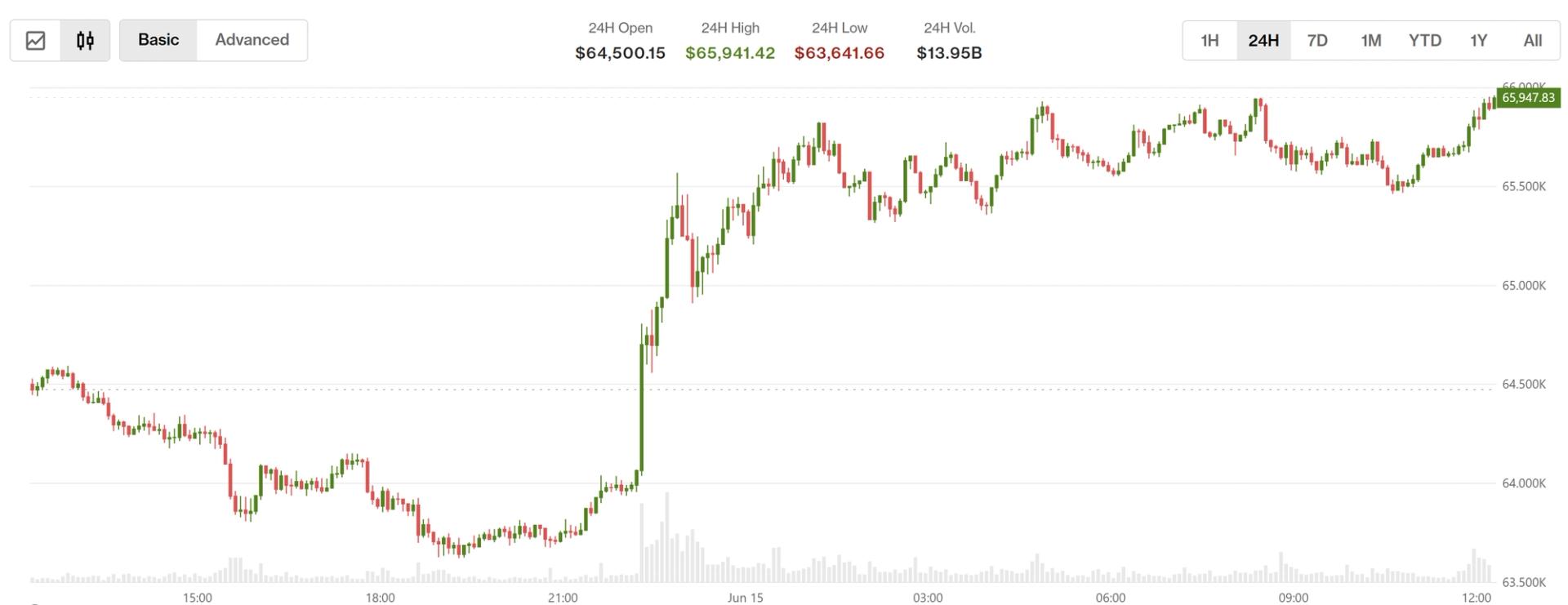
The peace deal reached over the weekend provided the stimulus many markets had been waiting for. Crypto traders, however, have learned to distrust this particular headline
By Shaurya Malwa, Saksham Diwan|Edited by Sheldon Reback
Jun 15, 2026, 11:19 a.m.
Share this article

Summary
The U.S.-Iran peace deal reached over the weekend provided the stimulus many markets had been waiting for.
Oil fell more than 4% on news the Strait of Hormuz would reopen, copper jumped. MSCI’s broadest index of Asia-Pacific shares rallied 3% and Japan’s Nikkei 225 hit a record high.
Crypto markets, however, posted muted gains after the announcement, with the CoinDesk 20 Index (CD20) little changed since midnight UTC. The measure, however, is 2.4% higher over 24 hours.
Bitcoin BTC$66,143.87 held below $66,000, barely moving since midnight after adding 3.4% over the weekend. Ether’s (ETH) performance mirrored its larger peer. The biggest gains came in the smaller altcoins, with the CoinDesk 80 Index adding 1.5% since midnight.
The crypto market, reacting to geopolitics in the absence of industry-specific catalysts, has learned to distrust this particular headline. A ceasefire in April collapsed. U.S. strikes broke another truce on June 9. Both times, bitcoin gave back the relief rally. Today, traders appear not to be prepared to pay for an agreement that won’t be signed until the end of the week.
While the market appears to have steadied after an early June rout, the onchain crowd remains split. Valuation models say the worst of the selling is done. Flow data, in contrast, says no real bid has returned. Both can be true at the same time.
The other pull is competition. SpaceX (SPCX) went public Friday in the largest IPO in history and popped 19% on day one, with ARK Invest, the fund management company led by bitcoin bull Cathie Wood, leading the charge.
OpenAI and Anthropic have filed to follow suit. The hottest innovation trade right now is a stock, not a token, and it is pulling from the same pool of risk capital.
- BTC derivatives positioning firmed this week. Open interest (OI) rose to $17.4 billion, up about 7% from a week ago, and three-month annualized basis ticked up to 3.0% from 2.8%.
- Funding rates, however, remained subdued, ranging from 0% to roughly -4% annualized across multiple venues. Levels like that indicate that leverage demand on perpetuals is muted even as OI and basis gained.
- Rising OI and a firmer basis point to incremental institutional appetite, but soft funding signals little aggressive directional positioning.
- Options positioning is mixed: the 24-hour put/call has skewed to puts (~25/75), but the volatility surface doesn’t confirm stress. Deribit’s implied volatility index, DVOL, has eased to 39, down 3.4% on the day and near multiyear lows, and the ATM term structure stays in contango (30–31% at the front end and around 43% to March 2027) rather than backwardation. The read is targeted downside hedging, not a broad vol bid.
- Coinglass data shows $343 million in 24-hour liquidations, with a 27-73 split between longs and shorts. BTC (136 million) and ETH ($60 million) were the leaders in terms of notional liquidations.
- The Binance liquidation heatmap indicates $66,100 as a core liquidation level to monitor, in case of a price rise.
- Decentralized-AI tokens jumped after the U.S. ordered Anthropic on Friday to close off foreigners’ access to its two most advanced models.
- Venice’s VVV rose about 14% to $16.37 on Saturday, with trading volume climbing nearly 200% to around $130 million, according to CoinGecko data. Morpheus’s MOR added about 21% to $2.28.
- Anthropic said the Commerce Department, citing export-control rules, directed it to cut access to its new Fable 5 and Mythos 5 models for any foreign national, inside or outside the U.S.
- To comply, Anthropic disabled both models for all users while keeping its other models running. It called the matter a narrow issue over a method of bypassing the models’ safeguards and said it is working to reverse what it described as a misunderstanding.
- Backers seized on the shutdown as proof of their pitch. Venice founder Erik Voorhees, of ShapeShift, posted: “There’s a reason we built Venice.”
- The Morpheus account thanked Anthropic CEO Dario Amodei for the “free publicity,” framing permissionless AI as something no government can switch off.
- Venice gates access to open-source models through its VVV token, and Morpheus rewards contributors of computing power and code with MOR.
- The narrative ran ahead of the product. MOR’s 21% move occurred with under $300,000 of volume, thin enough to swing on very little interest, and the open-source models of both projects test as less capable than the Anthropic systems that were pulled.
- The tokens rallied on the censorship-resistant story, not their capabilities.
Related Assets

- 1
- 2
- 3
- 4
- 5
- 6
- 7
- 8
- 9
- 10
Summer of crypto (regs): State of Crypto
17 hours ago


Binance’s US-equities launch already outpaces the tokenized market – and with bStocks live, it now competes on composability too. Real shares and tokens, one platform.
2 hours ago
Binance’s US-equities launch already outpaces the tokenized market – and with bStocks live, it now competes on composability too. Real shares and tokens, one platform.
Why it matters:
Binance’s US-equities launch already outpaces the tokenized market – and with bStocks live, it now competes on composability too. Real shares and tokens, one platform.